

Explore the region
A port town built up the slope
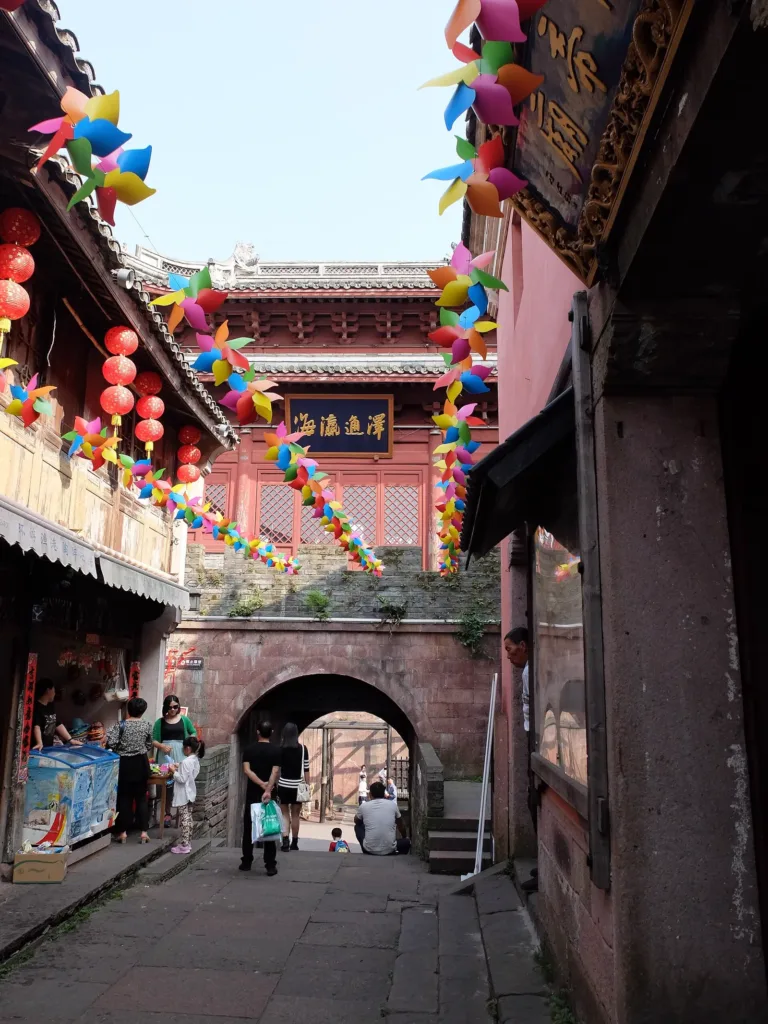
Shipu is not a single grand palace complex. It is a compact old-town landscape shaped by the harbour: streets climb the hillside, houses rise in terraces, and the view repeatedly opens back toward the water. The historic town was founded as a walled settlement in 1369, while the wider port town grew around fishing, commerce and coastal defence.
The best way to read the place is on foot. Follow the stepped curves of Wanhang Street (碗行街), look for Zhongjie’s old commercial buildings and its moon-shaped fire-separation walls, and slow down on Houjie where older residences remain. Fujian Street adds a film-history detail: the crew of Fishing Song stayed at Jinshan Hotel in 1933. These are small, physical clues rather than a single panoramic monument.
The ticketed route also includes exhibition spaces that give the streets a subject. Hongzhang Silk Shop reconstructs maritime trade and displays Chinese buttons; Yuansheng Money House evokes a historic shop and its accounts; and the fishing and maritime displays connect boats, nets, seafood and work at sea with everyday life on land. Sources describe about 14 halls, but individual displays can close or change.
Plan your visit
The listings I read describe the attraction as open from 08:00 to 17:00, with admission ending at 16:30 for the October–December period. Qunar marks advance reservation as required; a current Tongcheng listing shows adult tickets from CNY 50 and concession tickets from CNY 30, while a 2025 local guide lists CNY 60. Treat the price as date-specific rather than fixed, and check the booking page or the venue before travelling.
Qunar currently displays a notice that the Genghai Muyufu Hall (耕海牧渔馆) is temporarily closed for repairs from 13 August through 31 December 2026. That closure does not mean the old-town streets are closed, but it does remove one of the most direct fishing-life displays from the visit while the notice remains in force.
This is a lived-in historic quarter as well as a paid visitor route. Keep to visitor areas, ask before entering residential spaces, and ask before photographing residents. Bring shoes suitable for steps and uneven paving. The pages I read do not state a passport-specific booking or ID rule; international visitors should confirm that point with the venue when reserving and carry the passport used for the booking. The listed enquiry number is +86 574 6597 1999.
Getting there and back
From Ningbo, the practical public-transport approach is an intercity coach from Ningbo South Bus Station (宁波汽车南站) to Shipu. On arrival in Shipu, the current visitor listing directs travellers to local bus route 2 and Jiangxin Street 4 (石浦镇江心街4号); the heritage record also lists routes 1 and 2 through Haixia Square (海峡广场), near the old-town approach. Because the sources do not establish a current last departure, check the same-day coach and local-bus timetable before entering the old town, then reverse the same route for the return.
If you arrive by rail, Ningbo Railway Station (宁波站) is only the rail gateway: the published connection continues by coach through Xiangshan County and then on to Shipu, rather than by train to the town itself. For a direct road transfer, give the driver the Chinese destination 石浦渔港古城景区,浙江省宁波市象山县石浦镇江心街4号 and use the marked visitor approach; do not rely on an English name alone.
No current, bookable harbour boat route with a confirmed boarding point and return timetable was established in the sources I read. Treat any boat ride mentioned in older descriptions as a separate activity, not as a guaranteed way to reach or leave the ancient town.
Find Shipu Fishing Port Ancient City
石浦渔港古城 · 象山县
The pin marks the area, not the entrance.
Sources & visit information
Sources checked on 24 October 2026. Hours, tickets, reservations and transport can change; confirm with the operator before you go.
Image credits & notes (1)
- A steep stone lane beneath traditional roofs, an archway and festive paper pinwheels in Shipu Fishing Port Ancient City, photographed on 3 May 2015. Photo: Danny LuoPhoto: CC BY-SA 3.0