

Sliced sticky-rice cake 切糕
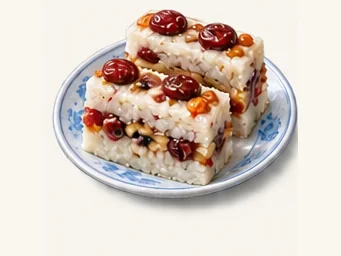
Beijing qiegao (切糕), also called jiangmi qiegao (江米切糕), is a dense, slice-to-order sticky-rice cake found among the city’s traditional snacks. Depending on the maker, steamed sticky rice or rice flour is layered with red dates or sweet bean filling; expect a tender, chewy bite rather than the nut-and-syrup confection also called qiegao elsewhere in China.
Tap any red Chinese text to hear it in Mandarin.
What “qiegao” means in Beijing
In Beijing food listings, 切糕 refers to a rice-based cake cut from a larger steamed piece. It is associated with the city’s traditional snack trade: accounts of Old Beijing’s Xuanwu-era Niujie area list qiegao and basin cake among the many foods once sold by neighborhood snack shops, and a Beijing tourism listing describes Jiangmi cake as a traditional local specialty.
The name is not unambiguous nationwide. A separate Xinjiang use of 切糕 refers to maren tang (玛仁糖), a dense confection of nuts and dried fruit bound with syrup. That is not the Beijing sticky-rice cake described here.
Rice, filling, and the cut surface
The base is glutinous rice, called jiangmi (江米) in many Beijing food contexts, or a preparation made from glutinous-rice flour. A traditional-looking red-date version can be pale and softly translucent, with dates set through the rice; other makers layer rice with sweet red-bean filling. Individual shops also sell different rice bases, including white or purple rice, millet flour, and glutinous-rice flour, so “qiegao” does not specify one exact recipe.
A shop-style version may be built by steaming rice and filling in layers, then cutting portions from the set slab. One household-style jujube recipe instead steams dampened glutinous-rice flour with dates and stacks the cooked pieces afterward. These examples show different ways to make a cuttable cake, not a single required method.
Look for a compact, moist slice with a soft, elastic stickiness and a satisfying chew. Red dates add concentrated fruit sweetness and a gentle date-and-rice aroma; red-bean filling gives a smooth-to-slightly-grainy, deeper-colored middle. The sweetness and firmness vary with the rice, filling, and maker.
How it is served
Buyers commonly ask for a portion cut from the larger cake; the amount can be specified by weight or by a small piece. A slice can be eaten as it is. One Beijing-style home recipe also serves the cake warm or pan-fried in thin slices until the outside is lightly browned and the middle softens again. Ask what the shop has ready rather than assuming every vendor offers the same filling or serving temperature.
Useful words to show when ordering:
- 切糕 (qiegao) — sliced cake
- 江米切糕 (jiangmi qiegao) — sticky-rice qiegao
- 枣切糕 (zao qiegao) — date qiegao
- 豆馅儿切糕 (douxianr qiegao) — qiegao with sweet bean filling
- 给我切一小块 / 切半斤 — Please cut me a small piece / half a jin (about 250 g)
Rice is the defining base; date and bean fillings are common examples, but the seller’s ingredients may differ. Ask which version is being sold if you avoid a particular ingredient.
More dishes to compare
Explore related local specialties and compare their names, preparation notes and ordering guidance.
Soybean-dusted rice rolls 驴打滚 →
Sticky-rice dough is steamed, rolled around sweet bean paste and coated in toasted soybean powder before being sliced. The powder also helps keep the sticky surface manageable. Each piece combines a soft, elastic wrapper, smooth filling and dry, nutty coating.
Pea-flour pudding 豌豆黄 →
Peeled peas are cooked until soft, worked into a smooth sweetened paste and set before being cut into neat yellow pieces. The texture depends on careful cooking and straining rather than a heavy pastry crust. Each square is tender, fine-textured and gently sweet, with a recognizable pea flavor. It should feel smooth rather than sticky like a glutinous-rice cake.
Sources & reading
Recipes and servings vary between kitchens.