

Explore the region
Read the cave as a three-dimensional landscape
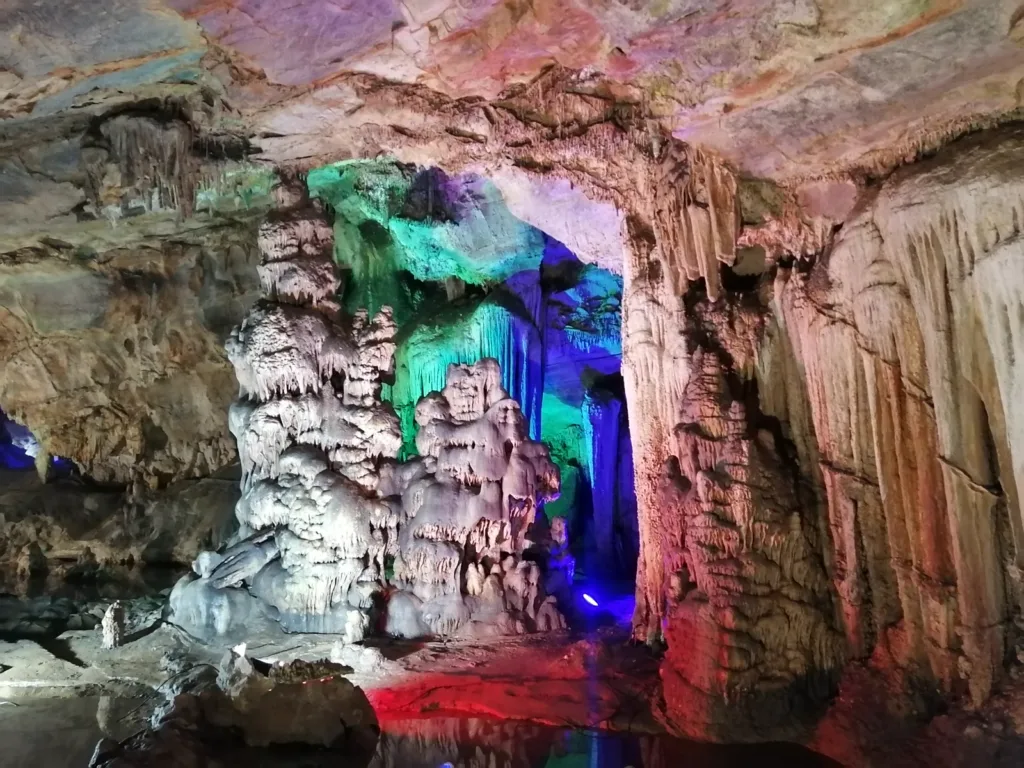
Shihua Cave lies in Ordovician limestone in Nancheying Village, Hebei Town, Fangshan District. Water moving through cracks in limestone dissolves and carries carbonate; when mineral-rich seepage loses carbon dioxide or evaporates in the cave, calcite is deposited. Drops build hanging stalactites and upward-growing stalagmites; flowing films spread into draperies and curtains, while seepage along cracks can form shields and branching, flower-like deposits. The district’s geological description notes that the cave preserves a particularly broad range of these forms, from water-drop and flow deposits to seepage- and splash-related structures.
Rather than treating each chamber as a row of named curiosities, compare how the water reached the rock: a pendant from a ceiling drip, a column where formations meet, a broad sheet where water ran down a wall, or fine branching shapes fed by seepage. Some formations called moonmilk or “stone flowers” are pale and delicate in form. Keep to the marked route and do not touch the deposits; they are slow-growing records of water movement, not decorative rockwork.
The cave has a human history as well as a geological one. Fangshan’s district account records an earlier name, Qianzhen Cave, and a Ming-period discovery tradition dating to 1446; it also records the placing of a carved Dizang Bodhisattva image in 1456, after which the cave was also associated with the name “Ten Buddhas Cave.” These are historical accounts of the site, not a promise that every named object is visible on today’s visitor route.
Plan for the route that is actually open
The Beijing tourism guide describes a 2,500-metre visitor route through levels 1–4 and recommends about three hours. Treat that route description as a guide to the cave’s visitor layout, not a guarantee that every level will be open on your date. During the 1–7 October 2026 holiday free-entry campaign, reporting based on the scenic area’s arrangements said only levels 1 and 2 were open; that campaign ended on 7 October, and normal ticketing resumed on 8 October. Confirm the current route with the operator before booking, especially around holidays or maintenance.
A practical visit is to allow roughly 2–3 hours as an editorial planning estimate, including entry checks and a deliberate walk through the formations; the official city guide’s suggested duration is three hours. At the cave, follow the current signed visitor flow rather than assuming a one-way layout or planning to retrace a particular passage. The public official descriptions establish the scenic-area entrance in Nancheying Village but do not give a dependable current exit arrangement. If you need a precise pickup point, ask the operator before entry and agree it with your driver.
Cave formations are best read at a walking pace. Pause to compare a drip-built stalactite with a floor-grown stalagmite, then look for curtains and less familiar shield or branching deposits. The illuminated displays can make the space vivid, but colored lights alter how the stone appears; use the shape and texture, rather than the lighting color, to understand the geology.
Booking, prices and seasonal hours
The scenic-area operator’s travel notice says visitors must buy a named, real-identity ticket online through the official “北京市石花洞风景名胜区” WeChat public account and enter in the time slot printed on the ticket. It warns that entry may be stopped when the daily limit is reached, so do not rely on buying at the gate or arriving without a confirmed booking.
The Beijing tourism service listing gives a standard adult ticket price of CNY 70 and a half-price ticket of CNY 35 for listed eligible categories. The Fangshan holiday free-entry promotion ended on 7 October 2026; a report published on 8 October says Shihua Cave returned to its regular CNY 70 price that day. Treat any promotion, concession and availability as date-specific, and confirm the amount and eligibility in the official booking account before payment.
The municipal tourism listing gives summer hours of 09:00–16:30, with ticket inspection ending at 16:00, from 16 April to 15 October. Its winter schedule, applicable from 16 October to 15 April, is 09:00–16:00, with inspection ending at 15:30. On the 21 October 2026 fact-check date, that listing places the cave in its winter schedule; the operator’s booked time slot and any live notice take precedence.
Reaching the cave and planning the return
Set the destination to Shihua Cave Scenic Area, Nancheying Village, Hebei Town, Fangshan District—not simply “Fangshan.” It is a separate western-Fangshan outing, rather than a stop beside central Beijing attractions. A car or taxi arranged to the scenic-area entrance is the simplest last-leg plan; confirm the return pickup and the driver’s waiting point before entering the cave.
The Beijing tourism guide lists Fangshan Bus 43 from Liangxiang Nanguan Metro station to the Shihuadong terminus. It also lists Bus 833 from Suzhuang Metro station to Shihuadong intersection, followed by a walk of roughly 3–4 kilometres or a taxi. Those are the guide’s published options, not a guarantee of today’s service: check current Beijing transit departures and the exact stop-to-entrance walk before relying on a bus, and check the return departure before beginning the cave visit.
Combine your visit
Suggested order within this visit:
-
Cave entrance and geological introduction
Learn the distinction between the cave's overall layers and the open visitor route.
-
Stalactite and flowstone sections
Compare forms created by dripping and flowing water.
-
Shield and moonmilk displays on the open route
Look for the more unusual deposits identified by the geological interpretation.
This sequence is an editorial suggestion based on the features described in the sources. Access to individual buildings or areas should be checked locally; no travel time or shared admission is implied.
Find Shihuadong Cave
石花洞 · 房山区
The pin marks the area, not the entrance.
More places nearby
Approximate straight-line distances between map pins, not travel distances.
Zhoukoudian 周口店
13 km awayThe Peking Man Site at Zhoukoudian preserves limestone caves and excavation localities that transformed the study of early humans in Asia. Finds include human and animal fossils, stone tools and evidence associated with the use…
View guide →Tanzhe Temple 潭柘寺
14 km awayTanzhe Temple occupies a mountain setting in Mentougou, with a long Buddhist history expressed mainly through buildings surviving from the Ming and Qing periods. Its principal halls form several north–south sequences, and the…
View guide →Jietai Temple 戒台寺
14 km awayJietai Temple on Ma’an Mountain is closely associated with Buddhist ordination. Its central attraction is the large square bluestone altar in Jietan Hall, built in tiers with carved decoration and surrounding niches. The altar’s…
View guide →Sources & visit information
Visitor details checked on 21 October 2026. Opening limits, ticket availability and transport timetables can change; confirm them with the scenic area before setting out. Hours, tickets, reservations and transport can change; confirm with the operator before you go.
Image credits & notes (1)
- Calcite curtains and clustered cave formations in Shihua Cave, photographed on 20 June 2023. The colored illumination is part of the scene; it does not represent the formations' natural color. Photo: YumetoPhoto: CC BY-SA 4.0