

Explore the region
Tap any red Chinese text to hear it in Mandarin.
Read the evidence in its landscape
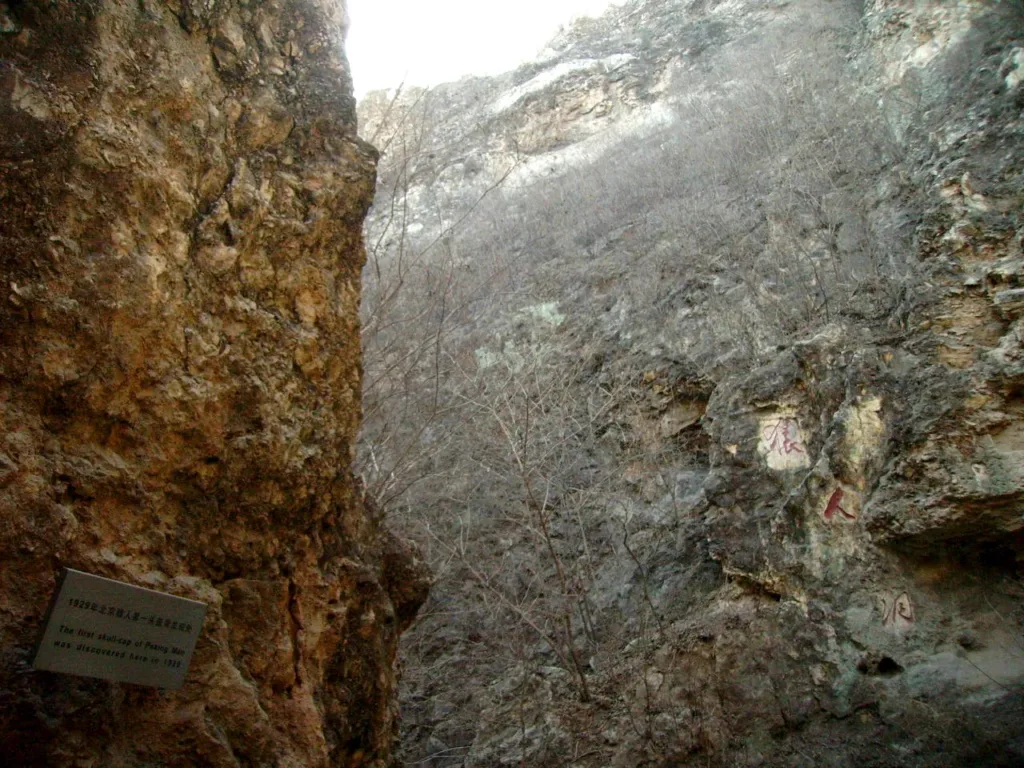
Zhoukoudian is not just a single cave or a room of fossils. The UNESCO World Heritage property includes 23 archaeological localities at the meeting of the North China Plain and the Yanshan Mountains, where limestone caves and water shaped a setting used by early humans. Finds across the property span a long prehistoric sequence. At the Peking Man localities, evidence includes Homo erectus pekinensis, stone tools, animal fossils and traces of fire such as hearths, ash and burned bone.
Peking Man lived in the Middle Pleistocene, approximately 700,000–200,000 years ago. Zhoukoudian also preserves evidence of later human groups, so the site is best understood as a set of localities and discoveries rather than one moment in human history.
The museum gives that dispersed archaeology a readable introduction. Its four galleries display more than 1,000 objects, including human and animal fossils and cultural remains, and combine artefacts with interactive displays and reconstructed scenes. The story covers discovery, excavation, research and conservation. Begin here to understand what the caves and finds represent, then go to the outdoor archaeological area to connect the displays with the hill.
A visit also carries a sobering part of archaeology’s history. Excavations in the 1920s and 1930s produced important Peking Man fossils, but the outbreak of war in 1937 interrupted work and many of those earlier fossil remains were lost or dispersed. The site and later discoveries retain scientific value; a museum display or reconstruction should not be mistaken for the return of the missing original specimens.
How to plan the visit
Think of the museum and the outdoor archaeological localities as two parts of the same heritage visit, not as interchangeable stops. The museum stands at the foot of Longgu Hill; the park and localities have their own visitor access and listed opening information. Check the official booking and notice pages for the particular area you plan to enter, and do not assume one ticket or one entry arrangement automatically covers both.
Editorial pacing suggestion: about 2–3 hours. Start in the galleries, where the discoveries and reconstructions provide context. Continue to the outdoor site and look for the relationship between the cave faces, the terrain and the archaeological localities. Use the current park map and on-site signs to follow the areas open to visitors; conservation boundaries and access can limit how close you can get to a particular excavation. The duration is a planning suggestion, not a promise by the museum.
Opening, booking and cost
The museum’s visitor guide lists entry from 09:00. From 1 April to 10 October, ticket sales stop at 16:00 and the museum closes at 16:30. From 11 October to 31 March, sales stop at 15:30 and closing is 16:00. The official homepage says the museum closes on Mondays while the archaeological grounds remain open; its notice says the grounds do not close for holidays. Check announcements for any date-specific changes.
The museum website provides a booking entry and lists a group-booking telephone number, 010-69301278. Its readable visitor guide does not state a current individual ticket price or make the individual reservation rule clear. Check the official booking service for the price, eligibility and availability for each area before travel rather than relying on third-party ticket listings.
Getting there
For a car journey, the museum’s own route guide directs drivers from the Yancun exit of the Beijing–Hong Kong–Macau Expressway onto Jingzhou Road toward Zhoukoudian. Follow a live map to the exact museum or archaeological-park destination; the two areas are not the same arrival point.
For public transport, a 5 October 2024 Beijing Daily report describes taking F80 from the Yanshan or Raolefu stops on the Yanfang Line. It identifies separate bus stops: 猿人遗址博物馆站 Yuánrén Yízhǐ Bówùguǎn Zhàn for the museum and 猿人遗址站 Yuánrén Yízhǐ Zhàn for the archaeological park. Check the current bus operator or a live transit planner before departure. The museum’s own visitor guide still lists older bus connections, so those routes should not be treated as current service information without confirmation.
The official pages do not establish one universal entrance or ticket valid for every locality. Confirm the gate and access for the museum or park you have chosen, arrive before the last ticket-sale time, and follow the current site notices.
Combine your visit
Suggested order within this visit:
-
Zhoukoudian site museum
Use the fossils and reconstructions to understand what was discovered.
-
Archaeological grounds
Connect the exhibits with the excavation landscape.
This sequence is an editorial suggestion based on the features described in the sources. Access to individual buildings or areas should be checked locally; no travel time or shared admission is implied.
Find Zhoukoudian
周口店 · 房山区
The pin marks the area, not the entrance.
More places nearby
Approximate straight-line distances between map pins, not travel distances.
Shihuadong Cave 石花洞
13 km awayShihuadong is a layered limestone cave in Fangshan, where different movements of water have produced a remarkable variety of mineral deposits. Hanging stalactites, rising stalagmites and broad stone curtains share the cave with…
View guide →Yunju Temple 云居寺
17 km awayYunju Temple in Fangshan is closely associated with the Fangshan Stone Sutras, a long effort to preserve Buddhist scriptures by engraving them on stone. The project began with the monk Jingwan and continued across many…
View guide →Jietai Temple 戒台寺
24 km awayJietai Temple on Ma’an Mountain is closely associated with Buddhist ordination. Its central attraction is the large square bluestone altar in Jietan Hall, built in tiers with carved decoration and surrounding niches. The altar’s…
View guide →Sources & visit information
Sources checked on 21 October 2026. Hours, tickets, reservations and transport can change; confirm with the operator before you go.
Image credits & notes (1)
- A limestone cave face at the Zhoukoudian Peking Man Site. The marker is visible at the foot of the rock. Photo: MuttPhoto: CC BY-SA 4.0