

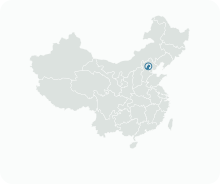
Get to know Fangshan District
- Administrative area
- District · 市辖区
- Part of
- Beijing
- Chinese name
- 房山区
- Local areas
- District guide
Area & population
- Area
- 2,019.00 km²
- Population · 2020 census
- 1,312,778
Source: English Wikipedia, as of the dates shown.
Explore Fangshan as a set of distinct areas
Fangshan stretches from built-up communities and university facilities in the east toward foothills, river valleys and mountain landscapes in the west. Its visitor appeal is not one central attraction but a set of cultural and natural areas separated by long journeys. The district’s current cultural-tourism plan groups Zhoukoudian, Yunju Temple and Liulihe as three distinct heritage clusters, and treats Shidu, Baihua Mountain, Shangfang Mountain and Shihua Cave as separate mountain and geology destinations. Use these as trip-planning clusters rather than assuming they form one continuous walking route.
Liangxiang and Changyang make a practical urban starting area for food, shopping and everyday services. The district plan identifies Changyang’s commercial centres and the Liangxiang University City area as part of its urban and visitor-service landscape. Stay here if you want a suburban base; it is not a substitute for lodging near western mountain attractions when an early start or overnight stay matters.
Zhoukoudian: caves, excavations and human evolution
At Zhoukoudian, limestone caves and fossil localities sit where the North China Plain meets the Yanshan Mountains. UNESCO describes the World Heritage property as 23 localities that have yielded hominin fossils, cultural remains and animal fossils across a very long span of time. Finds include Homo erectus pekinensis, stone tools and evidence of fire use. The importance is scientific as well as historical: the site preserves evidence used to study early human communities and evolution, rather than a single reconstructed “Peking Man” cave.
Plan the site area and museum as a single focused outing, allowing time for both the landscape and the interpretation indoors. Beijing’s tourism bureau describes Zhoukoudian as a two-part visitor destination, with a site area and museum; its published listing says it is open year-round, but does not provide enough current detail here to rely on for same-day hours or admission. Check the museum’s own visitor notice before setting out.
Yunju Temple and Stone Sutra Mountain: a connected heritage landscape
Yunju Temple is best understood together with nearby Stone Sutra Mountain, not as a stand-alone temple stop. The complex joins temple halls and pagodas with caves cut into the hillside for the preservation of Buddhist scriptures. Carving of the Fangshan Stone Sutras began in 605 and continued across six dynasties for 1,039 years; the district’s published heritage account records 14,278 inscribed stone slabs. At the open Leiyin Cave, four stone pillars carry 1,056 carved Buddhas. The temple also preserves paper and woodblock sutras, including a substantial collection of Qing-dynasty Dragon Tripitaka printing blocks.
A Beijing municipal tourism itinerary pairs a climb up Stone Sutra Mountain with the temple, describing a 108-step stairway and nine sutra caves before the temple visit. Treat that as a route idea, not a guarantee about present access: the same source does not establish current opening conditions, ticket arrangements or whether every cave is accessible. Check with the temple or its current official visitor channel before travelling.
Shidu: a river-and-karst day or overnight
Shidu follows the Juma River through a limestone gorge in southwestern Fangshan. Its landscape is a contrast to the enclosed caves and temple courtyards elsewhere in the district: river bends, cliffs and valley scenery shape the visit. The Beijing tourism bureau describes Shidu as the core park of the Fangshan geopark and recommends one to two days, which makes it a better choice for a dedicated outdoor trip than an add-on after a full day at Zhoukoudian.
Use a map app to select a specific Shidu village, scenic site or activity, rather than navigating to “Fangshan” or assuming the entire river valley has one entrance. The bureau’s listing says the scenic area itself has no general admission charge while some individual attractions require tickets. That page does not show a clear update date, so confirm current activity availability, prices and operating hours with the named operator before departure.
Liulihe: the early Yan capital and Beijing’s urban origins
Liulihe is Fangshan’s third major heritage cluster. The district’s 2025–2027 action plan identifies the Liulihe archaeological site with the “city origins” story and lists research, protection and display projects for the walled settlement, palace area and burial grounds. It also describes a new museum and other visitor-facing work as projects to be initiated or studied, not as services already completed. Treat Liulihe as a developing archaeological destination: check which areas and exhibitions are open before building a visit around it.
Choose a route by interest, not by district boundary
For an archaeology-focused day, centre the itinerary on Zhoukoudian’s site and museum. For Buddhist heritage, pair Yunju Temple with Stone Sutra Mountain. For outdoor scenery, dedicate a separate day or overnight to Shidu. Liulihe is a different archaeological story and should be scheduled only after confirming what is accessible. These combinations follow the district’s geography and official cultural-tourism groupings; they are planning suggestions, not operator-guaranteed itineraries.
Getting around and checking access
Choose the actual destination name in a map app—周口店遗址, 云居寺, 石经山, 十渡 or 琉璃河遗址—because the district is too large for “Fangshan” to function as a useful arrival point. The places described here belong to separate clusters, and a district-level visit does not have one shared gate, ticket or timetable. For Zhoukoudian, Yunju Temple, Stone Sutra Mountain and Liulihe, confirm current entry, reservations and opening arrangements with the individual site before travelling. At Shidu, check both the scenic-area conditions and the separate operator for any paid activity. Current details can change, so do not use an old district overview as a substitute for a venue’s live notice.
Explore Fangshan District
Core places to explore, with English and Chinese names.
Places to explore around Fangshan District
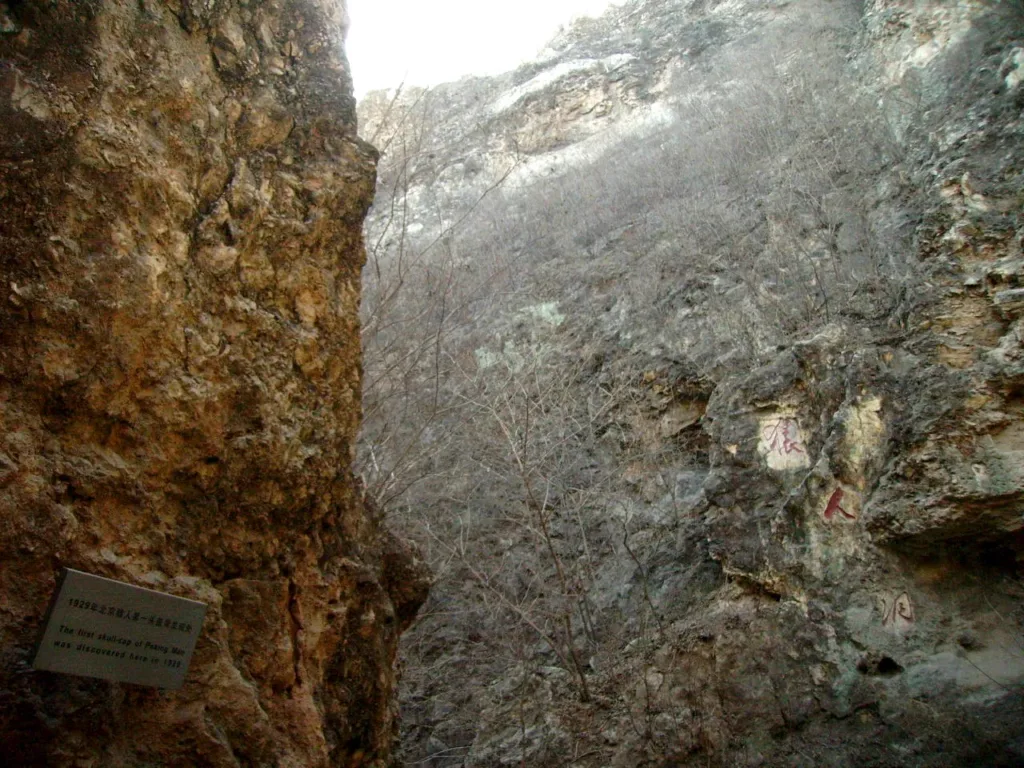
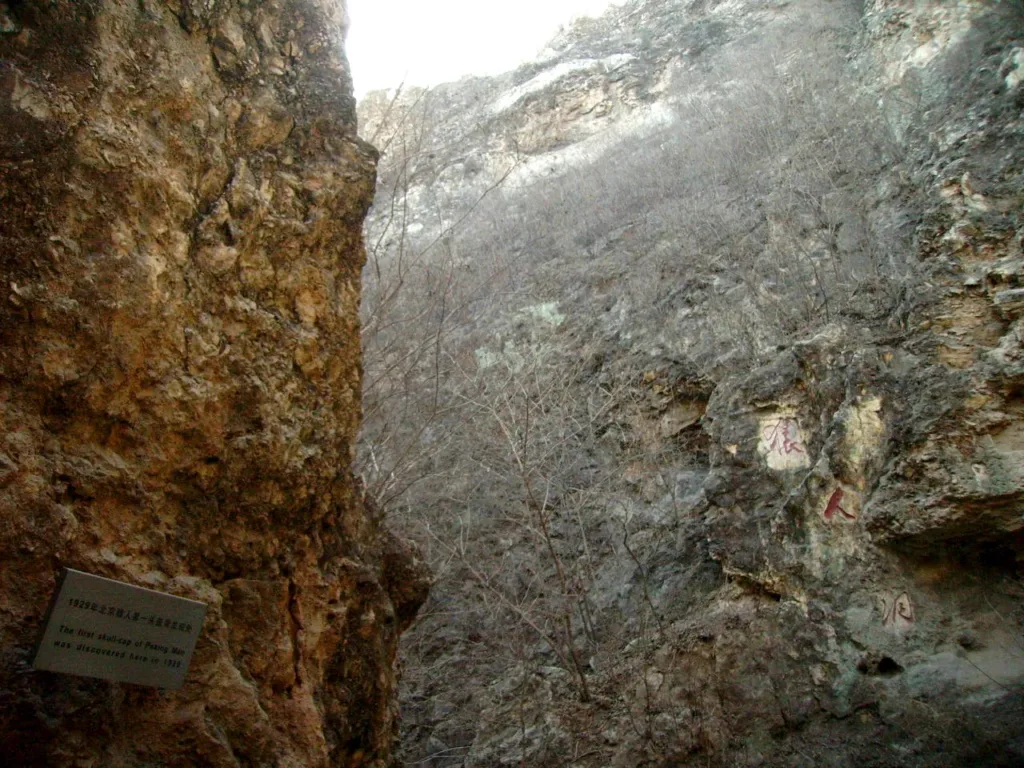 A limestone cave face at the Zhoukoudian Peking Man Site. The marker is visible at the foot of the rock. Photo: Mutt · CC BY-SA 4.0
Zhoukoudian周口店
At Zhoukoudian in Fangshan, a museum on the lower slopes of Longgu Hill interprets one of Asia’s most important prehistoric sites, while the nearby archaeological park lets visitors see the limestone setting and fossil localities themselves. The evidence ranges from human fossils and stone tools to traces of fire; plan time for both the indoor displays and the outdoor ground, and check the separate visitor arrangements before setting out.
Read the place guide →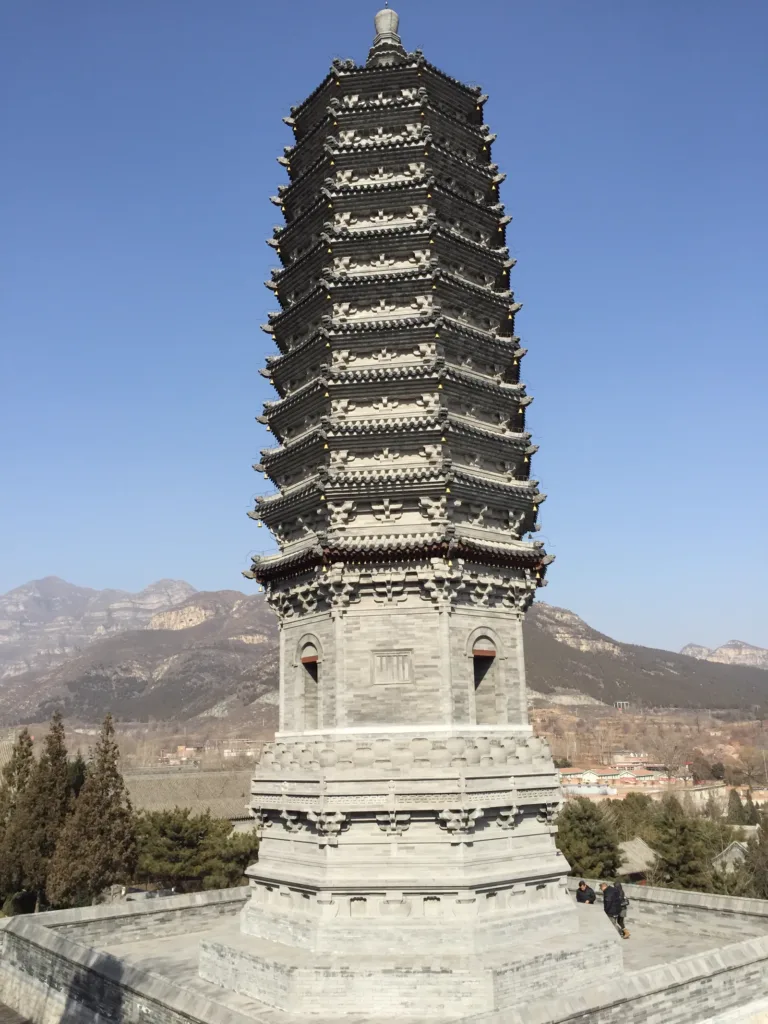 The South Pagoda at Yunju Temple, with the Fangshan hills behind it. Photo: N509FZ · CC BY-SA 4.0
Yunju Temple云居寺
At Yunju Temple in Fangshan, the story is written into stone: generations of Buddhists carved a vast canon over more than a millennium, while temple courtyards, historic pagodas and the nearby scripture caves show how those texts were preserved. Begin with the temple’s courts and displays, then treat the mountain caves as a separate access question. Current visitor listings give seasonal hours and a CNY 40 adult ticket; confirm the live details before setting out.
Read the place guide →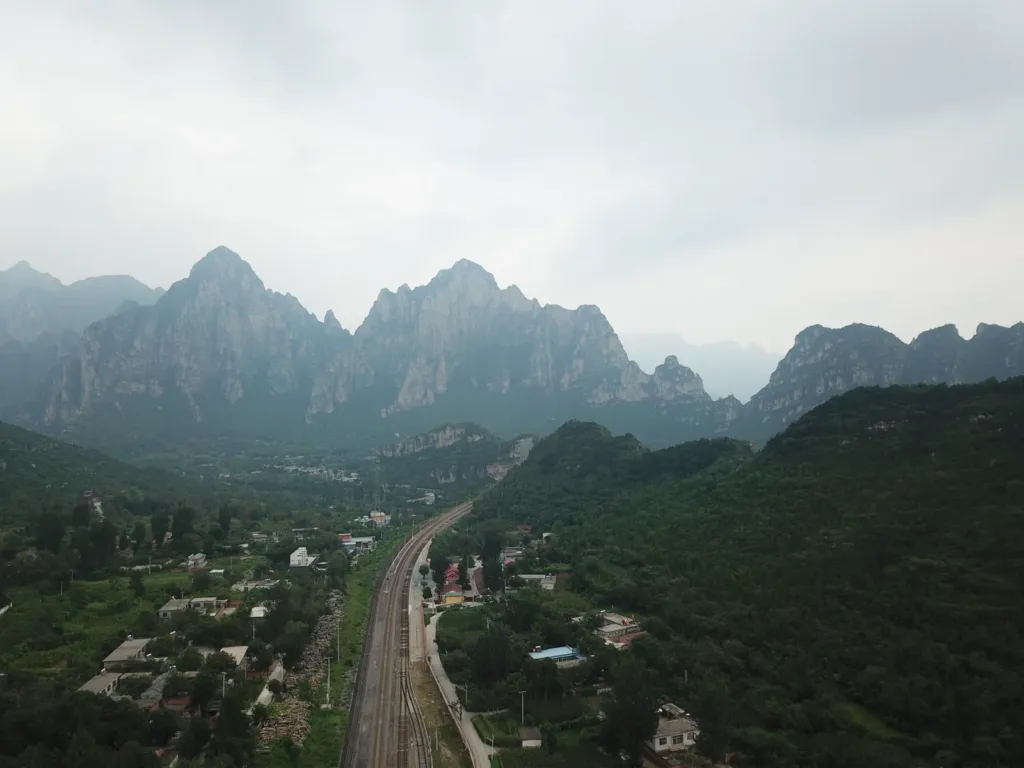 Karst peaks rise above a railway corridor and scattered settlements in Shidu. Photo: David290 · CC BY-SA 4.0
Shidu十渡
Shidu is the name for a long, settlement-lined stretch of the Juma River valley in southwestern Fangshan, where steep limestone walls and karst peaks shape the scenery. It is best planned around one named site at a time: the current operator promotes high-view activities at Juma Paradise and a gorge walk at Gushan Zhai, which are separate stops rather than entrances to one continuous park.
Read the place guide →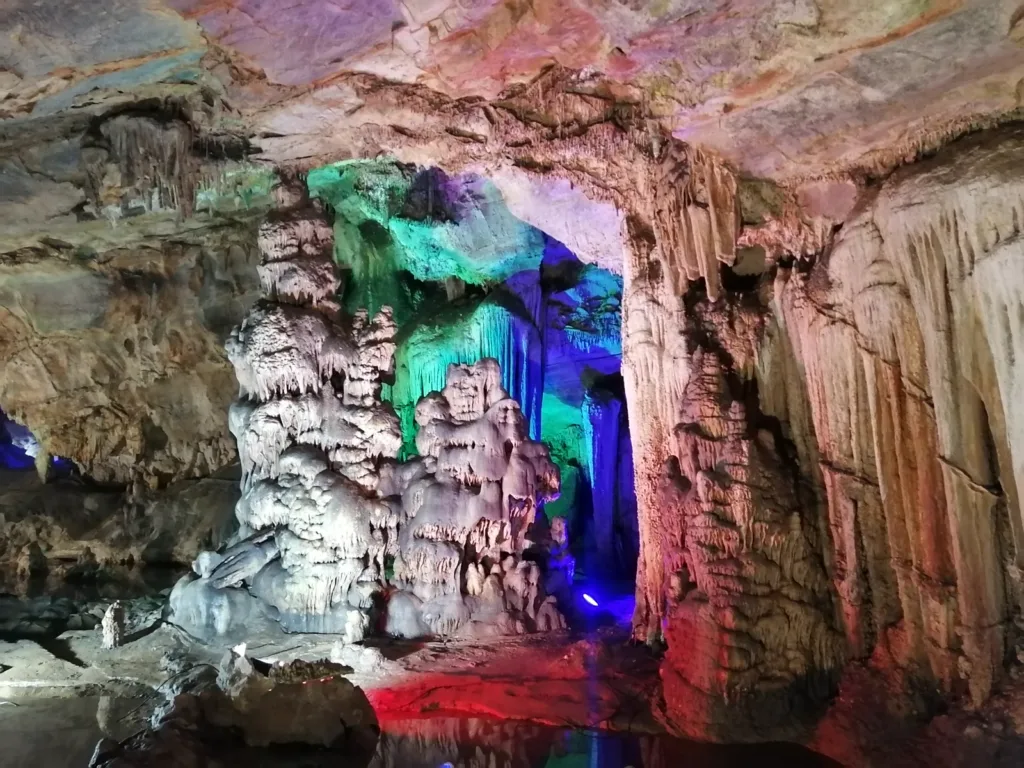 Calcite curtains and clustered cave formations in Shihua Cave, photographed on 20 June 2023. The colored illumination is part of the scene; it does not represent the formations' natural color. Photo: Yumeto · CC BY-SA 4.0
Shihuadong Cave石花洞
In Hebei Town, western Fangshan, Shihua Cave is a multi-level limestone cave whose open galleries display stalactites, stalagmites, curtains, shields and flower-like mineral deposits. The official visitor description gives a roughly 2.5-kilometre route through levels 1–4, but the operator requires advance real-name booking and may restrict access; check the current ticket slot and route before travelling.
Read the place guide →Plan your visit
Getting there
Fangshan District is about 30 km (straight-line distance) from central Beijing. Search for 房山区 in a map app to find stations and your accommodation.
Where to stay →Build your route
Zhoukoudian and Yunju Temple are about 15 km apart (straight-line distance). The linked place guides have entrance and visit details.
Continue with Beijing →More in Beijing
Sources & geographic information
Administrative names and parent areas: Official geographic directory (dmfw.mca.gov.cn) · Reference date 2026-09-06.
Background text adapted from Fangshan, Beijing — Wikipedia contributors, under CC BY-SA 4.0. Text has been shortened and reorganized; source revision 1357082403.
Map data © OpenStreetMap contributors. Pins mark approximate centres, not entrances or boundaries.
Image credits & notes (2)
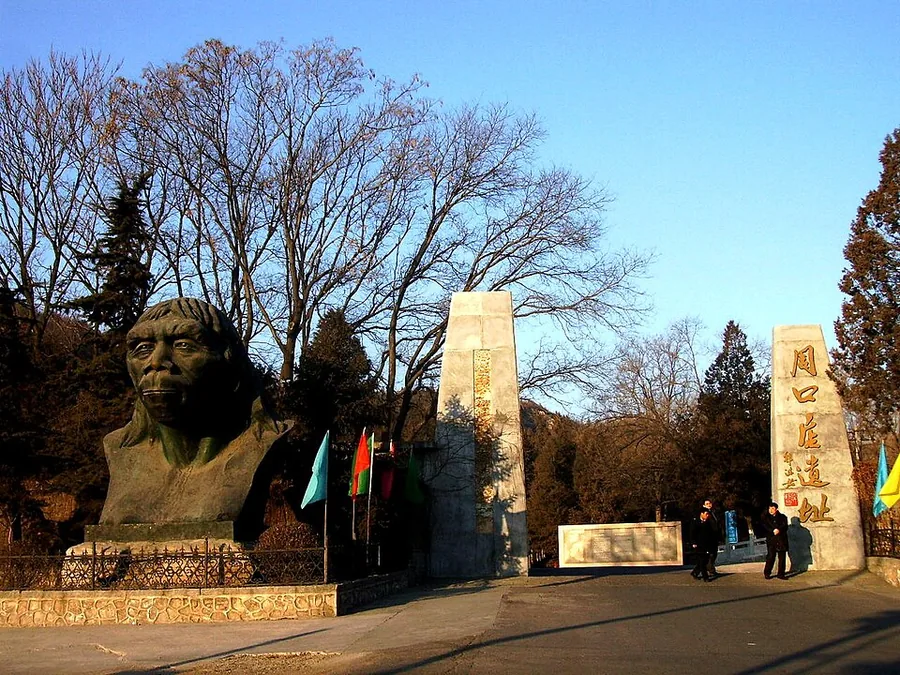
- The entrance to the Zhoukoudian Peking Man Site in Fangshan District, Beijing. Photo: 2008-04-21.Photo: Mutt · CC BY-SA 4.0Resized for the web; the photo itself has not been edited.
- Zhoukoudian Peking Man Site. Photo: MuttPhoto: CC BY-SA 4.0
