

Highland Barley Wine 青稞酒
In Garzê, qingke jiu (青稞酒) is a fermented highland-barley drink whose strength, sweetness and acidity vary with the fermentation and the water added before filtering. It is best understood through its grain, household brewing process and shared toasting customs, rather than as one fixed recipe or brand.
Tap any red Chinese text to hear it in Mandarin.
What the drink is
Qingke jiu is a regional Tibetan drink made from qingke, or highland barley. It is not a single standardized bottled style. The Daocheng County Government describes both stronger and lighter forms, while accounts from Daocheng and Batang place it in festival meals, weddings, births, and the welcoming or seeing-off of relatives and friends.
The written local name is not completely consistent across sources. The Daocheng page calls it “羌,” while a 2022 Sichuan Daily report carried by People’s Daily Online writes “穹.” For ordering or map searches, use the unambiguous Chinese name 青稞酒 Qīngkē Jiǔ rather than relying on a transliteration.
In English, it is often rendered as “Highland Barley Wine.” Here, “wine” means an alcoholic drink made from fermented grain, not grape wine.
How the grain becomes a drink
The local accounts describe a home-scale process, with timing and proportions that can change with the household and the season. Plump barley is washed and soaked overnight, then cooked in water. Daocheng’s description says to boil it for about two hours; the Batang account instead emphasizes cooking until the grains are fully tender and allowing them to cool briefly.
When the cooked barley is warm rather than hot, powdered fermentation starter is mixed through it and the grain is sealed and kept warm. The Batang account warns that grain that is too hot can make the drink bitter, while grain that is too cool may ferment poorly. It describes roughly two nights in summer and three in winter, with a suitable temperature sometimes producing an aroma after one night. These are useful descriptions of a traditional method, not a guaranteed schedule for every serving.
After fermentation, the Batang account transfers the grain to a pottery filtering vessel. Water is added and left for several hours before filtering if the drink is needed immediately; if it is being held, the vessel can be sealed and watered later. That extra water and the timing of filtering help explain why the same name can cover noticeably different strengths and textures.
How to taste it
Expect variation rather than one official tasting profile. Daocheng’s government page describes a fragrant, full and softly sweet drink. The People’s Daily Online report, citing Sichuan Daily, describes a lighter style with a gentle sourness. The drink may therefore read as grainy, sweet, or lightly tart depending on fermentation, dilution and the batch.
In a shared meal, the important part is often the social act of offering rather than drinking quickly. Local accounts describe toasts at celebrations and a three-sip pattern: the guest takes a sip, the host refills the cup, and the final refill completes the cup. The People’s Daily Online report also records touching a little wine with the right ring finger and flicking it into the air three times before drinking. Customs vary between households, so watch the host, ask politely what is expected, and do not assume that a toast means you must finish a large serving.
This is an alcoholic drink, and local sources distinguish stronger and lighter forms without giving one universal strength. If you avoid alcohol, are pregnant, are below the legal drinking age, or take medicine that interacts with alcohol, do not taste it. Do not infer that a drink is alcohol-free, vegetarian, or free of allergens from its appearance; ask about the batch and fermentation starter when that matters.
Finding it while travelling
Qingke jiu has no single visitor entrance, ticket, address or transport route. Search for “青稞酒” on Meituan (美团) or Amap / Gaode Maps (高德地图) to find nearby places serving this dish. Check menus, recent reviews, opening information and today’s availability before choosing.
Adding a county or town name such as 甘孜州 Gānzī Zhōu, 康定 Kāngdìng, 稻城 Dàochéng, or 巴塘 Bātáng can reduce ambiguity, but a search result is not proof that a venue still serves the drink. Menus, opening hours and batch availability should be confirmed on the day. The Chinese name is also the most reliable phrase to show a host or server when asking about the drink.
Sources & reading
Image credits & notes (1)
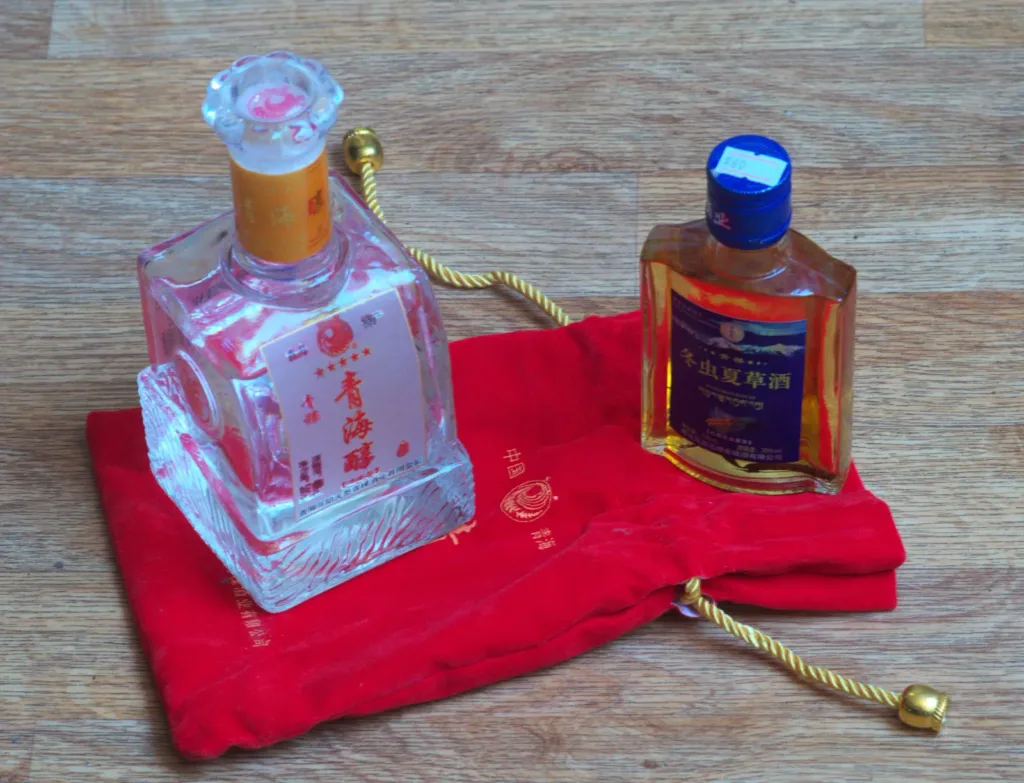
- Two highland-barley alcohols photographed in Qinghai; the left bottle is qingke jiu. This is a regional visual example, not a photograph of a specific Garzê batch or venue. Photo: PopolonPhoto: CC BY-SA 3.0