

Tongguan roujiamo 潼关肉夹馍
Tongguan roujiamo is a Shaanxi meat-filled flatbread built around a crisp, layered bun. Its flaky shell, tender braised filling and often-used hot-bun/cool-meat contrast make it a distinct Tongguan variation rather than a single province-wide roujiamo recipe.
Tap any red Chinese text to hear it in Mandarin.
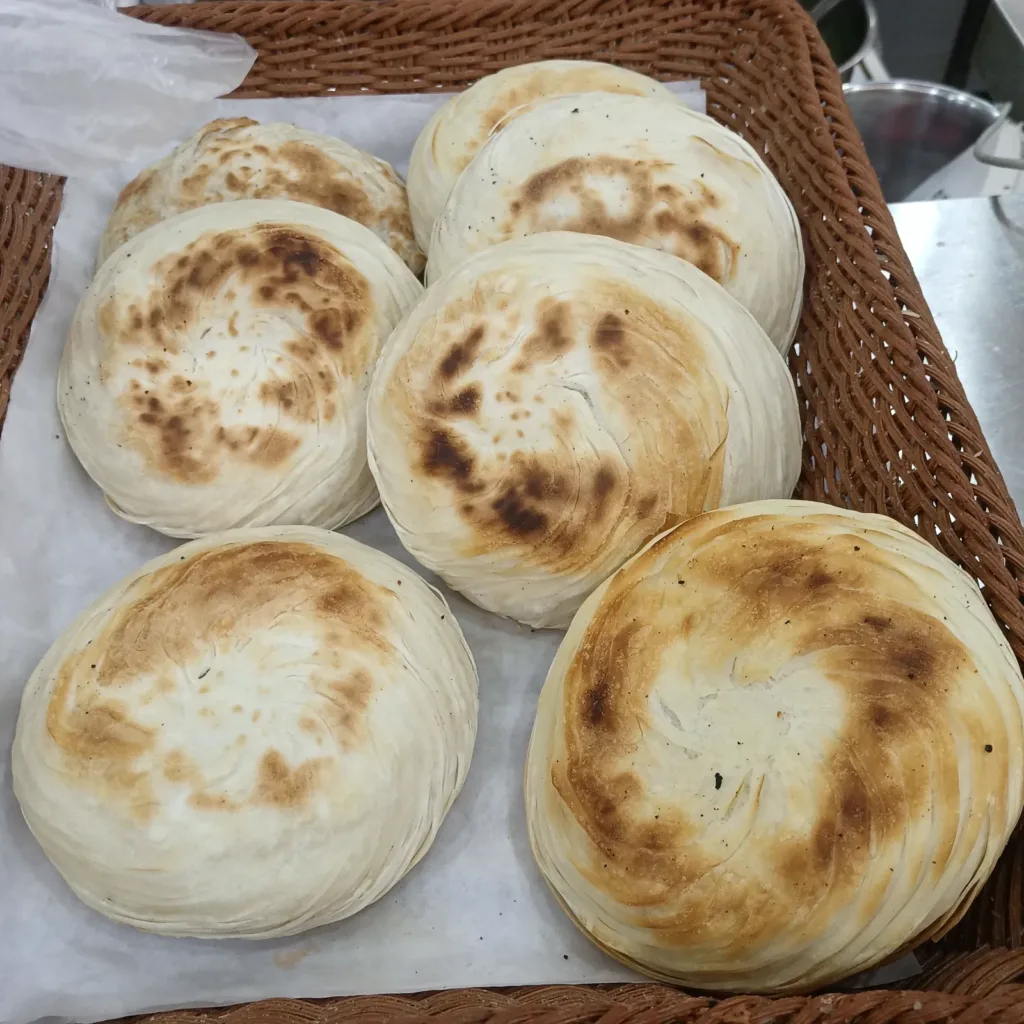
Tongguan roujiamo is associated with Tongguan County in Weinan, Shaanxi. The part to notice is the bun: unlike the denser, softer baijimo often used for Xi’an-style roujiamo, the Tongguan version is made as a layered shaobing with a brittle surface and visible folds. It is one of the clearest examples of how the shared name roujiamo can cover different local breads and eating styles.
What to look for
Watch the bun before you focus on the filling. A freshly baked one should show a coiled or layered structure when opened, with thin flakes breaking from the shell rather than a single soft crumb. The traditional technique was added to Shaanxi’s provincial intangible cultural heritage list in 2011; later documentation of the craft describes both hand-shaped buns and a modern production line, so a shop’s exact process may differ.
A familiar Tongguan version uses chopped braised pork. The meat is tender and savoury, but it should not erase the bread: the appeal is the contrast between a crisp, shedding crust and a moist, seasoned filling. The “hot bun with cool meat” style is a useful detail to ask about. It is not a promise that every kitchen serves the same temperature combination, and it is not a reason to treat one recipe as the only authentic form.
How it is made and why the texture changes
The documented traditional dough uses refined wheat flour with warm water, an alkaline ingredient and lard. The dough is worked into a long strip, rolled into a coil, flattened into a round and baked until evenly coloured. Those folds, together with the fat in the dough, create the thin layers that crackle when bitten.
The filling is prepared separately. Pork is put into a seasoned braising pot and cooked until tender, then chopped for the bun. The published descriptions support pork as a familiar version, not a universal rule for every modern menu. If a listing offers beef, lamb or another labelled filling, ask what meat and cooking fat are actually used instead of inferring it from the appearance. Wheat flour and animal fat may both matter for allergies, vegetarian diets or religious dietary needs.
How to order and eat it
Keep the Chinese name 潼关肉夹馍 Tóngguān Ròujiāmó ready to show when ordering. Ask which meat is used, whether the bun contains lard, and whether the filling is chopped or mixed with additional ingredients. Eat it soon after filling: the layers are easiest to read while the shell is crisp. Hold the lower half in its paper wrapper so crumbs and juices do not spill, and expect a takeaway bag to soften the crust through trapped steam.
This is a meal-sized snack, but portion sizes vary. Try one fresh bun before adding noodles or soup, especially if you are planning to compare it with another Shaanxi speciality. “Tongguan” identifies a regional style; it does not certify a fixed filling, price or preparation at every seller.
Finding it without inventing a restaurant address
潼关肉夹馍 is a dish, not a single venue. Search 潼关肉夹馍 Tóngguān Ròujiāmó on Meituan (美团) or Amap / Gaode Maps (高德地图) near your current location. Check the selected listing’s menu, recent reviews, opening information and same-day availability before choosing. Do not use a generic Tongguan County pin as if it were a restaurant entrance, and do not read a search ranking as proof of quality or authenticity.
Because the dish has no fixed address, its last mile and return route depend on the listing you choose. If you are making a separate trip to Tongguan County to look for the local style, save the selected shop’s current Chinese address, confirm the route from your actual arrival point and check the return connection before you eat. No station-to-shop walking time, outlet number, fare or fixed return service is claimed here; those details belong to the chosen venue and travel date, not to the dish itself.
A useful comparison
Order Tongguan roujiamo beside another clearly labelled roujiamo only if you want to compare breads. The Tongguan test is the flaky, layered shell and the way it fractures against the braised filling. Xi’an-style roujiamo commonly centres on baijimo and a different bread-to-meat balance. Both belong to the wider Shaanxi roujiamo family, but the shared name should not flatten their real differences.
More dishes to compare
Explore related local specialties and compare their names, preparation notes and ordering guidance.
Stone-baked flatbread 石子馍 →
Thin wheat dough is baked among or against hot pebbles, which leave characteristic depressions on the surface. Seasoning and added fat vary by producer. The bread is dry and crisp, with toasted wheat flavor and uneven crunchy ridges. It is intended for breaking into bites rather than folding around a filling.
Qishan saozi noodles 岐山臊子面 →
Fine wheat noodles are served with a sour, seasoned broth and finely diced saozi toppings, commonly including pork and vegetables. Small bowls allow the noodles and broth to be eaten while hot. The flavor is fragrant, tangy and often spicy, with tender noodles and tiny toppings in nearly every spoonful. Vinegar is central to the overall balance.
Sources & reading
Recipes and servings vary between kitchens.
Image credits & notes (1)
- Layered buns for Lao Tongguan roujiamo, photographed before filling; the image illustrates the flaky, coiled bread rather than a finished meat-filled sandwich. This is a regional-style reference image, not a claim that the photo was taken in Tongguan County. Photo: Fumikas SagisavasPhoto: CC0 1.0