


Get to know Tongguan County
- Administrative area
- County · 县
- Part of
- Weinan
- Chinese name
- 潼关县
- Local areas
- County guide
Area & population
- Area
- 526.00 km²
- Population · 2018
- 154,200
Source: English Wikipedia, as of the dates shown.
Why Tongguan feels different
Tongguan is best understood as a landscape of thresholds rather than as a single old-town photo stop. The county sits at a bend of the Yellow River, between the Qinling Mountains to the south and the river corridor to the north. The Wei River enters at Huayuankou in Qindong Town, while local descriptions place the Luo, Wei and Yellow rivers in the same broad confluence landscape. That geography explains the county’s long role as a passage between the Guanzhong Plain and the Central Plains.
The old county seat once stood beside the river. It was moved in 1960 during preparations for the Sanmenxia Reservoir, so today’s visitor sees both a reconstructed ancient-city complex and small surviving pieces of the earlier settlement, rather than an untouched medieval town.
What to look at
Start at Tongguan Ancient City and the Yellow River viewing area (潼关古城与黄河观景区). Do not try to read the whole county from one tower: first look at the rebuilt gates, platforms and public spaces, then move to a river-facing viewpoint and watch how the river corridor, northern bank and Qinling backdrop set the scale. The county’s official description treats the Yellow River landscape as a long zone, not a single compact attraction. Its published outline runs roughly from Jinpen Interchange to downstream of the Yellow River highway bridge, with wetland, riverbank and historic sites distributed along the corridor. Current boat or water activities are not confirmed by that outline, so do not build a day around a promised cruise.
For the most useful indoor orientation, enter Tongguan Museum (潼关博物馆) in the Dongshan scenic area. The building reconstructs the appearance of the old Shanhe Yilan Tower and uses four floors to move from local history and pass culture to water-transport customs, folk life and present-day Tongguan. From the third- and fourth-floor viewing platforms, look back at the ancient-city site and the river plain; inside, compare the military story of the pass with the practical story of grain transport, trade and household customs. The museum page lists free admission, Monday closure and Tuesday–Sunday hours of 09:00–16:00, but that page was published in 2023, so confirm the current day’s opening and entry arrangement before setting out.
Then walk Shuipo Lane (水坡巷) as a residential record, not as a stage set. The county describes it as an 800-metre lane near the old south gate, with a slope-shaped layout, houses built to the terrain and the function of a mountain runoff channel. The surviving street includes Ming- and Qing-period residences, a Tang-period well and a tree associated with the Qianlong era, although some buildings were rebuilt or altered during and after the reservoir period. Look for changes in paving, wall material, roofline and elevation; do not assume every façade is an untouched relic.
The river edge adds a different kind of visit. The official scenic-area account includes a 467-hectare national wetland park and records birds such as swans and mandarin ducks. Treat this as a habitat and open-landscape walk: stay on managed paths, keep away from unprotected banks and do not assume that a historic description of the ferry or a promotional water-tour paragraph means a boat is operating on your date.
A local taste to look for
The food most closely tied to the county is Tongguan roujiamo (潼关肉夹馍). Its local production technique entered Shaanxi’s provincial intangible-cultural-heritage list in 2011. A recent heritage account describes the bread process through kneading, rolling, cutting and coiling into a crisp, layered bread blank; it also records a hand-made version in which dough resting and the oil pastry affect the result. Industrial frozen blanks and hand-made breads are now both part of the real variation, so do not treat one shop’s method as the only standard.
For a current meal, search 潼关肉夹馍 Tóngguān Ròujiāmó on Meituan (美团) or Amap/Gaode Maps (高德地图), and search 潼关酱菜 Tóngguān Jiàngcài if you want the county’s long-associated pickled vegetables. Read the current menu, recent reviews, opening information and same-day availability before choosing. These searches are a way to find nearby supply, not an endorsement of a particular merchant, address or “most authentic” ranking. The county’s food history also mentions duck-slice soup and Yellow River catfish soup, but recipes and daily availability vary by kitchen; ask about ingredients if you have allergies or dietary restrictions.
How to plan the visit
Tongguan is not a walkable downtown district in the sense of one continuous tourist street. A practical first visit is to combine the rebuilt ancient city and museum, walk Shuipo Lane, and then choose one confirmed river or wetland viewpoint. Keep the water-tour and seasonal wetland elements flexible. The ancient-city complex, the surviving residential lane and the broader Yellow River zone should be treated as separate stops; the sources accessed here do not establish one unified ticket, one current gate or one guaranteed boat timetable.
Getting there and returning
The most useful rail anchor is Tongguan Railway Station (潼关站). Search the current service on China Railway 12306 using the Chinese station name before departure. A 2022 travel report records a route from the station, a walk of about 800 metres to 中心街东口 (Zhongxin Street East Entrance), and Tongguan Bus Route 3 (潼关3路) onward to 潼关古城 Tóngguān Gǔchéng. Because that report is not a current bus-operator notice, treat the stop and line as a route lead: confirm the live stop name, direction and last return bus in Amap/Gaode Maps on the day. If you use it, return by reversing the same chain to 潼关站 and leave time for the final train.
By road from central Weinan, a Ministry of Culture and Tourism route page gives the ancient city as about 87 kilometres away and roughly 60 minutes by car. That is a route-level indication, not a guaranteed travel time. Use the Chinese destination 潼关古城 Tóngguān Gǔchéng or 潼关博物馆 Tóngguān Bówùguǎn in Amap/Gaode Maps and ask the driver to confirm the current visitor approach; the pages read here do not verify a single current entrance gate. The museum’s own guide also lists an intercity coach from Weinan Coach Station to Tongguan County followed by a taxi, but its quoted fare and operating details are dated information and must be checked before relying on them. Return by the same road connection or to 潼关站 after confirming the day’s timetable.
Guide sources
Explore Tongguan County
Core places to explore, with English and Chinese names.
Places to explore around Tongguan County
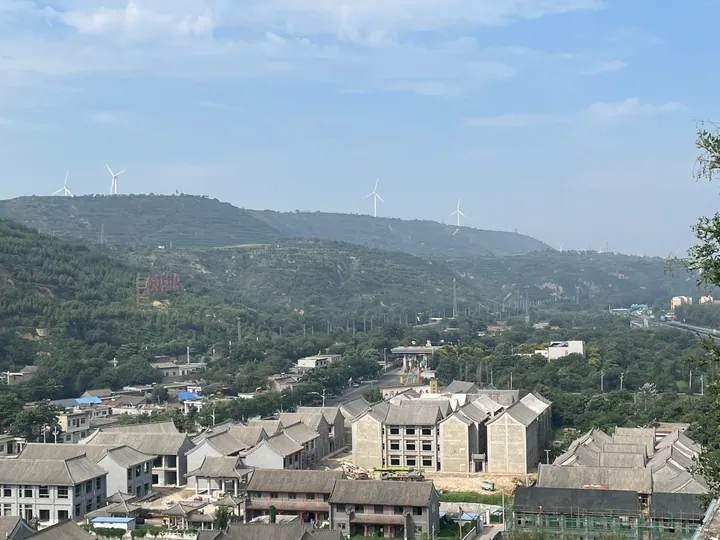
 A broad view from above Tongguan Ancient City toward the Yellow River plain. Photo: MNXANL · CC BY-SA 4.0
Plan your visit
Getting there
Tongguan County is about 75 km (straight-line distance) from central Weinan. Search for 潼关县 in a map app to find stations and your accommodation.
Where to stay →Build your route
Start with Tongguan Ancient City and Yellow River Viewing Area. The linked place guides have entrance and visit details.
Continue with Weinan →More in Weinan
Sources & geographic information
Administrative names and parent areas: Official geographic directory (dmfw.mca.gov.cn) · Reference date 2026-09-06.
Background text adapted from Tongguan County — Wikipedia contributors, under CC BY-SA 4.0. Text has been shortened and reorganized; source revision 1337086257.
Map data © OpenStreetMap contributors. Pins mark approximate centres, not entrances or boundaries.
Image credits & notes (1)
- Rebuilt historic buildings overlooking the hills of Tongguan County · 潼关县重建古城,俯瞰山地Photo: MNXANL · CC BY-SA 4.0 · taken 2023-09-06Resized for the web; the photo itself has not been edited. Thumbnails may show a cropped view.
