

Suzhou Mutton Vermicelli Soup 肃州羊肉粉汤
Suzhou Mutton Vermicelli Soup is featured among the local specialties of Gansu.
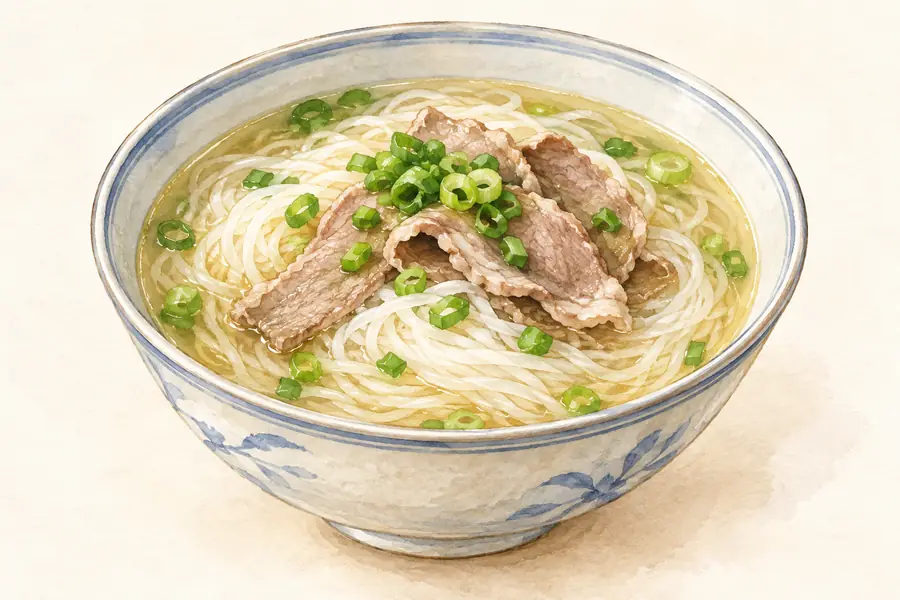
Su zhou yang rou fen tang is Jiuquan's mutton soup with broad-bean vermicelli — a Suzhou district street bowl that belongs to a wider local family of mixed broths.
How it is made
The bowl sits inside a Jiuquan group of dishes called 合汁, in which mutton stock is blended with pork and chicken stock and then poured over broad-bean vermicelli with sliced pork and mutton. The province's tourism account notes that seafood is sometimes added as well.
In the fuller versions the pot also takes meatballs, fried meat rolls, wood-ear fungus, more noodles and tofu, so the soup becomes a whole bowl rather than a broth with a garnish.
Flavour and texture
The stock is the base note and the vermicelli is the body: broad-bean noodles stay firm and slightly slippery instead of softening the way wheat noodles do in hot soup. Blending several stocks gives a rounder, meatier depth than a single-animal broth would carry.
Because the noodles are starch and the soup is rich, the bowl is filling; the smell is savoury and mutton-forward rather than heavily spiced.
Local roots
The Suzhou district government lists mutton-vermicelli soup among the street snacks that have turned into recognised local brands in its night markets, in the same breath as roast lamb, village-style spicy hot pot, apricot juice flatbread and liang pi.
The province's tourism account places the dish in the Jiuquan 合汁 tradition and names Dunhuang's mutton version as the best known of the mutton ones, so the Suzhou bowl is one branch of a dish family rather than an isolated recipe.
Ingredients and dietary needs
Mutton stock, often cut with pork and chicken stock; broad-bean vermicelli; sliced mutton and pork; and, in fuller versions, meatballs, fried meat rolls, wood-ear fungus, tofu and other ingredients.
Mixed-meat soups in the region can include offal even when the name does not say so, and the blended stock means the dish is usually not pork-free. Ask at the stall before ordering if either matters to you.
How to order
Ask for 羊肉粉汤. A bowl is 一碗, and 小碗 asks for the smaller size if you are also ordering skewers or a cold dish.
不要猪肉 asks for it without pork, 多加点粉条 asks for more vermicelli, and 有丸子吗 asks whether meatballs are included. Chilli and vinegar usually sit on the table, so 辣子自己放 means you season it yourself.
How it is eaten
It is eaten hot with a spoon and chopsticks, and it works as a late bowl on the night-market streets where Jiuquan's snack trade is concentrated. Seasoning goes in at the table, so taste the broth before adding chilli.
Portions vary between stalls. If you want it as a snack rather than a meal, ask for the small bowl and keep room for the other street food on the same street.
More dishes to compare
Explore related local specialties and compare their names, preparation notes and ordering guidance.
Lanzhou beef noodles 兰州牛肉面 →
兰州牛肉面 is a clear beef and radish broth with hand-pulled wheat noodles, and the diner chooses the noodle width. 肃州羊肉粉汤 is built on mutton stock that may be blended with pork and chicken stock, and its noodles are broad-bean vermicelli rather than pulled wheat, with meatballs and fried meat rolls appearing in the fuller versions.
Questions before you order
Is this the same as the mutton soup sold elsewhere in Gansu?
The Suzhou bowl belongs to Jiuquan's 合汁 tradition, where several stocks are blended; the province's tourism account also names Dunhuang's mutton version as the best known of the group.
Is it only a night-market dish?
The Suzhou district government records it among the street snacks that anchor Jiuquan's night markets, so treat it as a casual stall bowl rather than a restaurant dish.

Sources & reading
The supplied food list supports this name and regional association. The culinary terms below are explained as menu vocabulary; a local recipe, origin story and venue availability have not been independently verified.