

Lanzhou beef noodles 兰州牛肉面
Lanzhou beef noodles are a hand-pulled wheat-noodle soup rooted in Lanzhou’s food culture: clear beef broth, radish, sliced beef, green herbs and optional chilli, with noodle width chosen at order. The local technique is listed in China’s national intangible cultural heritage register, and the official description connects its ingredient geography to wheat from the Loess Plateau and beef from Gannan and Qinghai.
Tap any red Chinese text to hear it in Mandarin.
What makes the bowl local
In Lanzhou, this is not just a generic bowl of beef soup with noodles. The national heritage register describes Lanzhou as the craft’s core area and links the bowl to two nearby food geographies: wheat from the Loess Plateau and beef from Gannan and Qinghai. That connection helps explain why the dish is treated as a local food tradition rather than only a restaurant style.
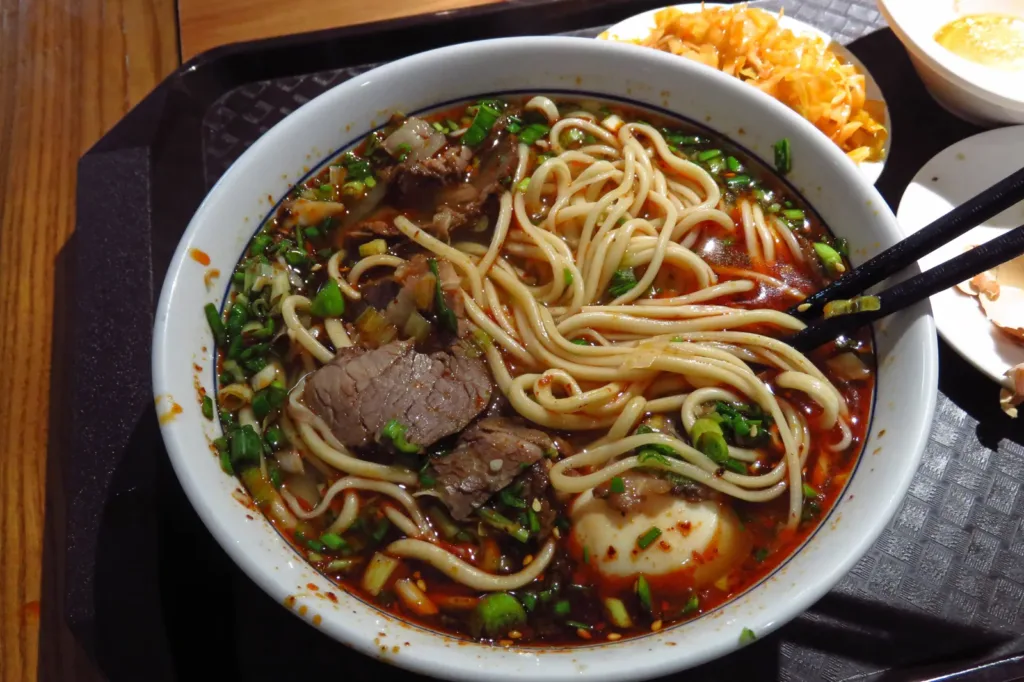
A familiar way to read the bowl is “one clear, two white, three green, four red and five yellow”: a clear broth, white radish, green coriander and garlic sprouts, red chilli oil, and yellow-gold noodles. It is a traditional visual shorthand, not a promise that every shop will use exactly the same garnish or amount of chilli.
The dish’s history is also better understood as a long local development than as one simple origin story. The heritage entry records more than a century of development and highlights the Ma Baozi lineage, while a Gansu provincial account traces the earliest documented local record further back to the Qing dynasty. For a visitor, the enduring point is the technique and the bowl’s place in everyday Lanzhou food culture.
How dough becomes noodles and soup
The heritage description divides the noodle craft into selecting ingredients, kneading, resting the dough, working it into a smooth strand, and pulling it to order. The puller stretches and folds the dough repeatedly, so the same dough can become strands with noticeably different thicknesses and widths. In an open kitchen, this is worth watching as a practical skill rather than a staged performance: the speed and regularity of the pull determine the bite.
The broth is not normally a quick pour over plain noodles. The official description says beef or beef bones are simmered with seasonings such as tsaoko, ginger, Sichuan pepper, nutmeg, clove, pepper and angelica root; it gives five to seven hours as the described slow-cooking time. The cooked noodles are then served with beef, coriander, garlic sprouts and chilli oil. Exact seasoning, meat quantity and chilli strength vary between kitchens, so treat the heritage description as the craft’s reference pattern rather than a fixed recipe card.
Choosing a noodle shape
Show the name 兰州牛肉面 Lánzhōu Niúròumiàn when ordering. The heritage register lists five thickness choices—粗 (thick), 二细 Èrxì, 三细 Sānxì, 细 and 毛细 Máoxì—as well as wider forms such as 大宽 Dàkuān, 宽 and 韭叶 Jiǔyè. Menus may not offer every choice, and the Chinese labels are more reliable than trying to translate the names literally.
A useful first bowl is a width you can easily pick up with chopsticks, with chilli added only after tasting the broth. If you want more meat or a different topping, ask what the current menu includes and whether an add-on is separate; the dish is not served under one universal portion rule. For a more focused comparison, order the same broth with two noodle widths on separate visits and notice how the chew and soup-to-noodle balance change.
Dietary notes
The standard bowl is wheat-based and beef-based. It is not vegetarian, and it is not suitable for someone avoiding wheat unless the kitchen confirms a genuinely different preparation. Radish, coriander, garlic sprouts and chilli oil are common components, but their presence and the seasonings in the broth can vary. Do not infer that a bowl is free of an allergen, alcohol or a particular animal product from its appearance. Explain the restriction clearly and ask about the actual broth and preparation; if halal certification matters to you, ask the venue what certification or assurance it provides rather than assuming from the dish name.
Finding it without choosing a single shop
This is a citywide dish rather than a fixed attraction with one address. Search for 兰州牛肉面 Lánzhōu Niúròumiàn on Meituan (美团) or Amap / Gaode Maps (高德地图) to find nearby places serving this dish. Check menus, recent reviews, opening information and today’s availability before choosing. Search results and ranking can help locate a bowl, but they do not prove quality or authenticity.
More dishes to compare
Explore related local specialties and compare their names, preparation notes and ordering guidance.
Zhangye beef tiny-noodle soup 张掖牛肉小饭 →
Wheat dough is cut into very small pieces and cooked in a savory soup with beef and other additions. The pieces are small enough to eat comfortably with a spoon. The soup is meaty and warming, while tiny dough pieces provide a soft, lightly chewy texture. The name's 'small rice' wording does not mean the base must be rice grains.
Niangpi noodle sheets 酿皮 →
A flour or starch batter is steamed into sheets, cooled and sliced, then dressed with savory condiments. Wheat-based versions may be served with separate pieces of gluten, but ingredients vary. The sheets are smooth and elastic, with the dressing contributing sourness, chili heat and aromatic richness. Gluten adds a spongier bite when included.
Sources & reading
Recipes and servings vary between kitchens.
Image credits & notes (1)
- A bowl of Lanzhou beef noodles with side dishes in Anning District, Lanzhou, photographed on 5 October 2017. Photo: N509FZPhoto: CC BY-SA 4.0