

Ili Horse Sausage 伊犁马肠子
Ili Horse Sausage (伊犁马肠子) is a Kazakh horse-meat sausage from the Ili region, valued for its rib-meat-and-fat filling, slow air-drying or smoking, and strong winter-food connection.
Tap any red Chinese text to hear it in Mandarin.
Ili Horse Sausage (伊犁马肠子) is best understood as a regional food tradition, not a dish with one fixed restaurant or one fixed recipe. In the Ili Kazakh Autonomous Prefecture, a traditional method cleans a horse intestine, packs it with strips of rib meat—sometimes with the rib bone—and seasons it with salt and pepper before tying it and hanging it to dry. The result connects the food to Kazakh winter preservation practices in the Ili valley rather than turning horse meat into a novelty challenge.
What the name covers
For searching, keep the Chinese name 伊犁马肠子 Yīlí Mǎchángzi at hand and also try 马肠子 Mǎchángzi or 熏马肠 Xūn Mǎcháng. The preparations overlap but are not identical. The local government’s description is an air-dried version: seasoned rib meat is stuffed into cleaned intestine, tied with animal sinew and hung indoors for about a month. Smoked versions add a separate smoking step; one documented Kazakh-style method uses salt, garlic and pepper before smoking the filled casing and drying it further. That is a documented variation, not a universal recipe.
The seasonal setting matters. Yining’s government describes late November and December as the main period when Kazakh herders prepare smoked meat for winter. A People’s Daily report places the related Dongzai Festival from November to January and describes families in Gongliu County preparing smoked horse meat and sausage before the coldest part of winter. This explains why the dish feels especially tied to the cold season, but it does not guarantee that a restaurant has it on a particular day. In April 2026, an Ili government article also reported that smoked horse meat and smoked horse sausage had been included in a Xinjiang “ten classic dishes” list.
Flavour, texture and serving
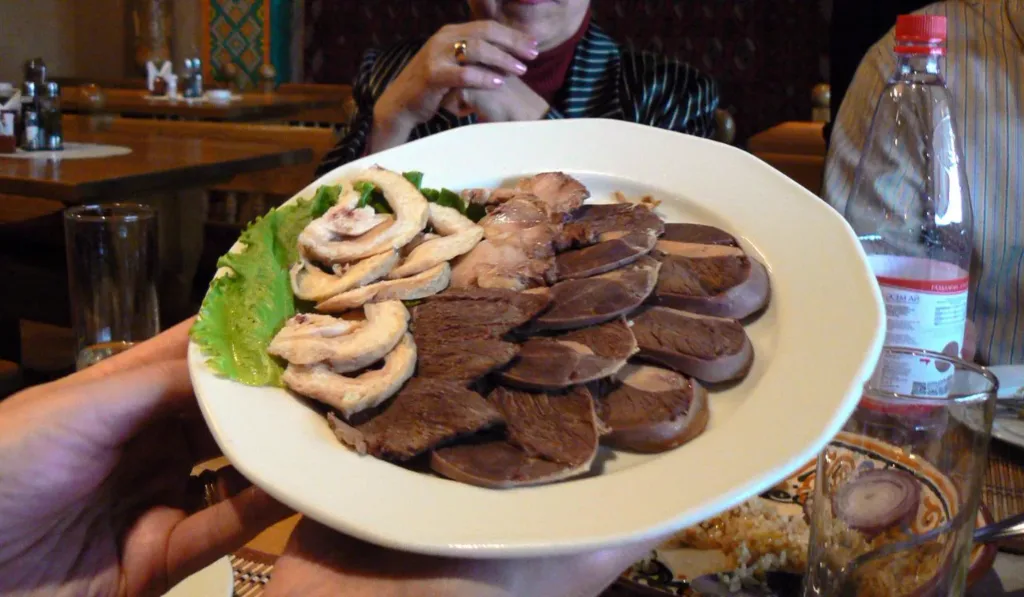
Expect a cured-meat flavour rather than the softness of a fresh sausage. Rib strips and fat can remain visibly distinct in a slice, giving the sausage a firm, chewy bite; smoking adds a wood-smoke note, while an air-dried version emphasizes salt, meat and the aroma of the casing. Recipes and the balance of lean meat, fat, bone, salt and spices vary between households and producers, so do not treat one colour or spice profile as the definition of every Ili version.
When it is served as part of a Kazakh boiled-meat course, kazy-style sausage is commonly cooked before slicing. An independent Xinjiang food guide describes boiling it in plain water, cooling it slightly and cutting it across the grain into thin rounds, sometimes alongside noodles or other parts of the meal. If a restaurant offers a plate that looks ready to eat, still ask whether that batch is already cooked and how it was prepared.
This is horse meat in a natural casing, so it is not vegetarian. If halal assurance, a meat restriction or an allergy matters to you, ask the specific kitchen about its sourcing, seasoning, casing and shared equipment; appearance alone cannot establish halal status or the absence of an allergen. Garlic, pepper and other seasonings are used in some documented smoked versions, but no single ingredient list applies to every batch.
How to look for it
There is no fixed “Ili Horse Sausage” attraction, ticket, gate or visitor entrance. To look for a current serving without endorsing a particular restaurant, search 伊犁马肠子 Yīlí Mǎchángzi in Meituan (美团) or Amap/Gaode Maps (高德地图) near your current location. You can also try 熏马肠 Xūn Mǎcháng and 马肠子 Mǎchángzi if the first search is sparse. Open a nearby result and check four things before setting out: whether the current menu names the dish, whether recent reviews describe an actual serving rather than a packaged product, whether the business is open that day, and whether the sausage is available today. Ask whether it is smoked or air-dried and whether it arrives pre-cooked or needs cooking. Platform listings and supplies change, so this is a verification method, not a restaurant ranking or a promise of year-round availability.
Because this is a food item rather than a venue, airport, railway, coach, taxi and local-bus routing are not applicable to the dish itself. There is no dish-specific ticket, reservation or foreign-passport entry rule. Plan transport to the chosen restaurant or market only after checking that specific listing, and make a separate return plan rather than treating the regional food entry as a destination.
Sources & reading
Image credits & notes (1)
- A cold horse-meat platter at Kishlak, an Uzbek restaurant in Kazakhstan; the photographer identifies the sausage slices on the right. This is a regional Kazakh horse-sausage example, not a photograph from Ili. Photo: Sara YeomansPhoto: CC BY 2.0