

Photo adjustments
Proportionally resized and converted to WebP without cropping, retouching or changing the photographed subject.
Explore the region
About Ningbo Museum
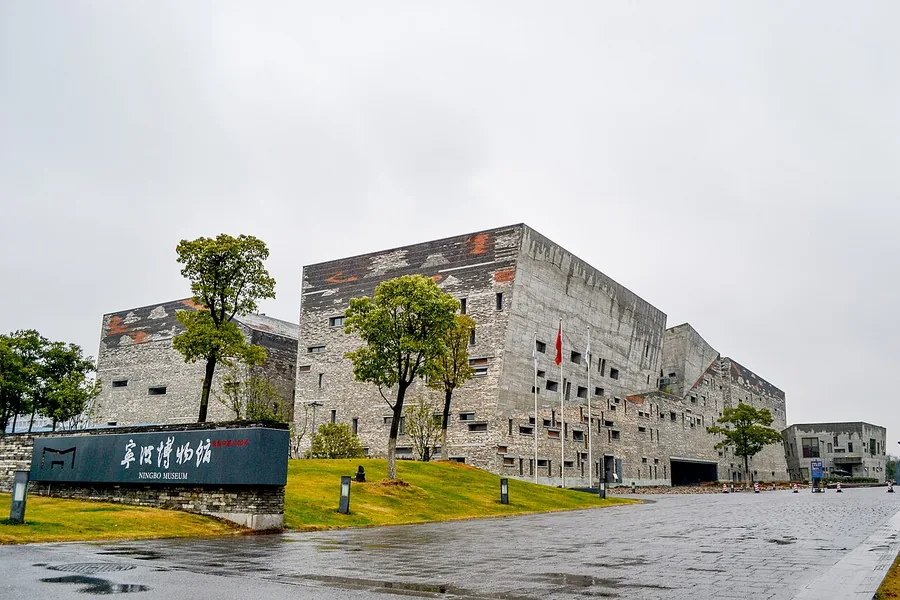
Wang Shu’s design contrasts patched masonry with bamboo-imprinted concrete, while courts and openings break up the heavy exterior. Inside, the history collection follows Ningbo from early settlement toward maritime commerce, and the customs displays recreate aspects of commercial street life. Begin outside to read the materials, then connect them with the local history preserved in the galleries. The architecture and collections make complementary parts of the visit.
The museum opened on December 5, 2008. Its masonry uses the wapan technique, in which mismatched pieces of stone or tile are joined with thin layers of lime. The resulting connections combine strength with flexibility. This construction method was historically used in the region to rebuild villages after typhoons.
During construction, builders were given some freedom to arrange the collected materials, making their placement part of the finished design. The angle of each wall also influenced the choice of material: more vertical surfaces received recycled brick and stone, while more sharply angled walls used bamboo and concrete construction.
What to look for
- Reused bricks and tiles form distinctive wapan-style walls.
- Bamboo-textured concrete, courtyards and angular upper volumes create contrasting surfaces and spaces.
The surrounding area
A coastal city chapter centered on maritime food, Tianyi Pavilion and Moon Lake.
Location & getting there
Getting to Ningbo Museum
Approach 1000 Shounan Middle Road in Yinzhou, Ningbo. Yinzhou Government metro station is the documented station for the museum area.
Combine your visit
A suggested sequence linking the specific features of this visit.
-
Exterior walls and entrance court
Begin with the salvaged masonry and bamboo-textured concrete.
-
Ningbo history galleries
Connect the building’s material memory with the city’s development.
-
Local customs galleries
Compare archaeological and historical objects with the interpreted street-life setting.
This order is editorial. Confirm access and any transfers between stops; it does not establish a walking route, same-day connection or common admission ticket.
Find Ningbo Museum
宁波博物院 · 宁波市
The pin marks the area, not the entrance.
More places nearby
Approximate straight-line distances between map pins, not travel distances.
Moon Lake (Ningbo) 月湖
6 km awayMoon Lake forms a historic water landscape in Ningbo’s Haishu old city. Its stone-arched Central Lake East Bridge and the water-level stele near Pingqiao River connect scenic design with practical water management. Shrines and…
View guide →Tianyi Ge 天一阁
6 km awayTianyi Ge combines Fan Qin’s historic private library with a Jiangnan garden and other traditional buildings. The two-storey library faces a pond intended to help protect the books from fire, giving the water both practical and…
View guide →Baoguo Temple 保国寺
19 km awayBaoguo Temple is a study in timber construction on the southern slope of Lingshan. Its main hall retains a Northern Song core dated to 1013, enclosed by later alterations and expanded eaves. Fluted, assembled columns, bracket…
View guide →Sources & visit information
The sources below support the place-specific description and arrival information. Suggested combinations are editorial planning ideas; confirm current opening, entry arrangements and transport services for your date.
Visitor information adapted and edited from Wikivoyage contributors, listing “Ningbo Historic Museum” · CC BY-SA 4.0.
Visitor information adapted and edited from Wikipedia contributors, “Ningbo Museum” · CC BY-SA 4.0. Source revision 1363333671.
Background paragraphs condensed from Wikipedia contributors, "Ningbo Museum", English Wikipedia · CC BY-SA 4.0. Source revision 1363333671.