

Explore the region
The site lies at the foot of Kaolao Mountain around Shanglin Lake in Cixi, Ningbo. Nearly 120 kiln sites are distributed across 12.9 square kilometres, with production from the Eastern Han through the Song period. This is why a visit feels part museum, part archaeological landscape: the park has a visitor and service area and a site exhibition area, but also archaeological reserves, forest and agricultural zones rather than one continuous trail.
Yue celadon here links workshop technology with maritime trade. The official English description identifies Shanglin Lake as a major Tang–Song production centre, while Mise ware was fired in carefully controlled saggars to protect the glaze; the site’s products travelled through Mingzhou Port. For an international visitor, the point is not only the beautiful green glaze but the chain you can read on site: clay, kiln furniture, firing, failed wares and finished forms.
What to see
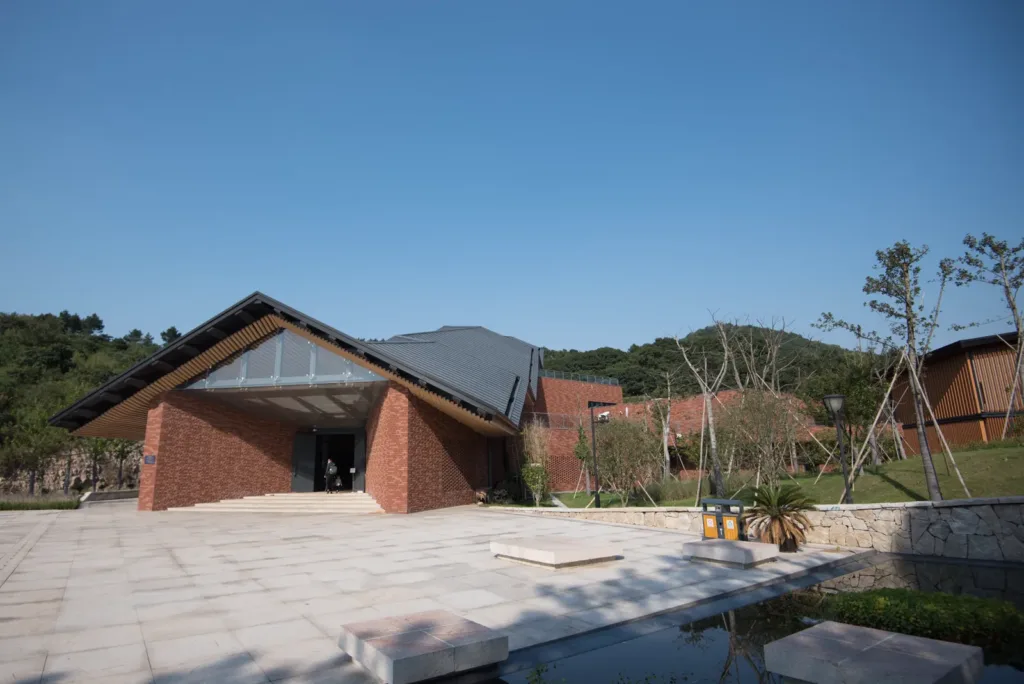
Begin at the Shanglin Lake Yue Kiln Museum (上林湖越窑博物馆). Use the displays to connect celadon vessels with kiln furniture, production stages and the Mise ware associated with the site. A separate museum listing uses the fuller name 慈溪市上林湖越窑青瓷博物馆 and places the visitor facility at 横筋线毛洋坪, so keep the Chinese name ready when setting your destination.
At Hehuaxin (荷花芯), the protected dragon kiln is the clearest physical explanation of firing. The kiln was built up the slope and is about 41.8 metres long, with a fire chamber, kiln bed and kiln tail; its openings show how fuel was fed from the side. A 2024 report describes visitors viewing the Tang-period dragon-kiln remains there, alongside the museum and the lake landscape.
Housi’ao (后司岙) is the place to look for the production system behind the finished vessels. Excavation revealed a central dragon kiln, workshop remains, clay-storage pits, glaze vats and a waster area. The site is especially important for late-Tang and Five Dynasties Mise ware, whose fine body and glaze can be compared with high-status finds elsewhere in China.
Treat the exposed deposits and unexcavated slopes as protected archaeology. Stay on designated paths and viewing areas, and do not remove pottery fragments or enter a closed shelter. The national park includes archaeological reserve land as well as visitor facilities, so the displays are selected windows into a much larger landscape.
Plan your visit
The national archaeological-park listing gives free general admission. Its seasonal hours are 08:30–17:00 from May to October, with last entry at 16:30, and 08:30–16:30 from November to April, with last entry at 16:00. A separate listing for the museum gives 09:00–17:00 and Monday closure. Because the museum and the wider park are not necessarily on identical schedules, confirm the museum’s opening before a Monday visit or a late arrival; the published park contact is +86-574-63697210.
No passport-specific booking or entry procedure was stated on the pages read for this guide. If you are travelling on a passport, call the venue before setting out rather than assuming that a domestic ID reservation system applies. The displayed kiln points may also have different access arrangements from the museum, and the two points should not be treated as one guaranteed walking route or one combined ticket.
Allow a half day if you want the museum, Hehuaxin and Housi’ao rather than a quick museum stop. The archaeological park is spread around the lake; it is not a compact old-town walk. Bring water and shoes suitable for uneven outdoor paths, and check the return connection before entering the site area.
Getting there
For a taxi or ride-hailing car, show 上林湖越窑国家考古遗址公园(横筋线毛洋坪) and ask for the main visitor area. The park’s service zone includes the main entrance and museum, while the kiln displays are separate points within the archaeological landscape. Do not use the approximate map pin as an entrance.
The transport information that can be traced to the site lists Cixi Bus Tourist Line 2 (慈溪公交游2路); a current visitor guide also renders it as 226路 / 游2路 and names Shanglin Lake (上林湖) as the stop. Confirm the present route, direction and last return bus with the operator or local map on the day, then use the same stop in reverse for Cixi.
If you arrive by high-speed rail, use Yuyao North Railway Station (余姚北站) as the rail gateway and continue by taxi to the Chinese destination above. A visitor route reports bus 255 to Qiaotou Town Wufeng Road Junction (桥头镇五丰道口) followed by a walk, but this is not an operator timetable; taxi is the safer choice when you need a dependable return to the station. There is no confirmed metro connection to the site, and the park’s dock should not be read as proof of a scheduled public boat service.
Combine your visit
A suggested sequence linking the specific features of this visit.
-
Yue Kiln museum
Begin with ceramic forms, kiln furniture and production context.
-
Hehuaxin kiln display
Read the shape of a dragon kiln on the ground.
-
Housi’ao display
Compare the kiln structure with workshop and waste-deposit evidence where access is open.
This order is editorial. Confirm access and any transfers between stops; it does not establish a walking route, same-day connection or common admission ticket.
Find Shanglin Lake Kiln Site
上林湖越窑遗址 · 宁波市
The pin marks the area, not the entrance.
More places nearby
Approximate straight-line distances between map pins, not travel distances.
Daishan Island 岱山岛
6 km awayDaishan offers three contrasting island landscapes: Dongsha’s old fishing-town lanes, the long sandy shore of Lulan Qingsha, and the elevated temple setting on Moxin Mountain. In Dongsha, residential architecture and maritime…
View guide →Hemudu Site 河姆渡遗址
18 km awayHemudu reveals a Neolithic settlement beside the Yao River through rice remains, timber construction and distinctive pottery. Excavations exposed posts and building elements associated with raised longhouses, together with tools…
View guide →Cicheng ancient town 慈城古县城
19 km awayCicheng retains the street pattern and buildings of a former county seat within present-day Ningbo. The Confucian Temple makes education and ritual visible in a formal compound, while traditional residences such as the Fuzi…
View guide →Sources & visit information
Sources checked on 24 October 2026. Hours, tickets, reservations and transport can change; confirm with the operator before you go.
Image credits & notes (1)
- Exterior of the Shanglin Lake Yue-Kiln Museum in Cixi, Ningbo. Photo: Siyuwj (Wikimedia Commons user)Photo: CC BY-SA 4.0