

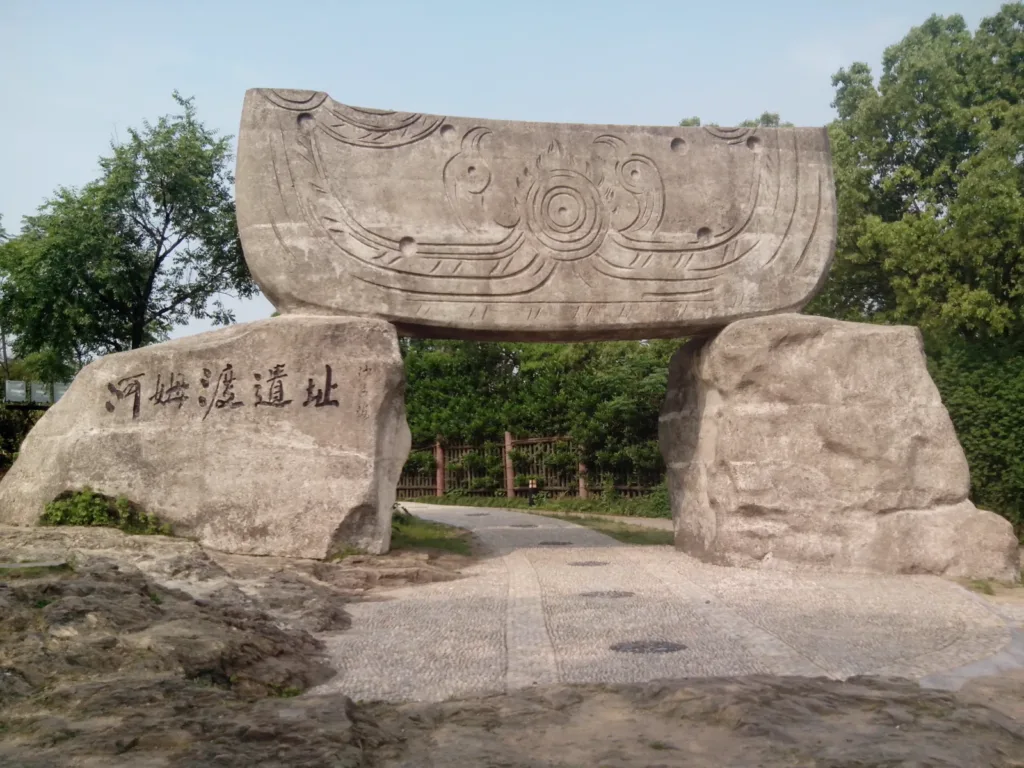
Explore the region
Tap any red Chinese text to hear it in Mandarin.
Hemudu matters because the archaeology is readable in several connected layers rather than as a single famous object. Excavations in 1973 and 1977 revealed four cultural layers, cultivated-rice remains, extensive wooden building evidence, tools and animal and plant remains dating broadly from about 7,000 to 5,300 years ago. Together they show a community that farmed, worked timber, used the river-and-wetland environment and made its everyday equipment from wood, bone, stone and pottery.
At the site park, look for the relationship between raised timber construction and the wet ground, the rice-growing landscape, and the water-and-plant setting around the reconstructed scenes. The park is a roughly 3-kilometre outdoor visit with themed areas including “The Shape of Civilisation” and “Rice from the Remote Past”; the displays and paths are interpretations of the archaeological record, while some excavation-display areas may remain closed. A current programme may add a sightseeing vehicle, boat or hands-on activity, but those extras are separate from basic admission and should not be assumed to run every day.
Keep the two visits separate
The outdoor archaeological site park sits northeast of the museum and has its own operating and ticket arrangements. The Hemudu Site Museum at Lushan Temple Village is a related but separate place: its displays are the better setting for recovered objects and the wider Hemudu cultural sequence, while the park is the longer outdoor landscape visit. The museum is free but normally closes on Mondays; a local notice says it is closed for upgrading from 12 to 26 October 2026 and is due to reopen on 27 October, while the archaeological site park remains open during that work.
Plan your visit
The park’s current trial admission price is CNY 30 per person, effective from 27 March 2026. It opens daily from 09:00 to 16:30, with last entry at 16:00. Use the official “Hemudu Archaeological Site Park” mini-program or the operator’s current channel for booking; groups should call 0574-62958802 at least three working days ahead.
Allow time for a long outdoor walk and wear comfortable shoes. The operator advises that the route is about 3 kilometres, some excavation-display areas are temporarily unavailable, parking is limited, and the sightseeing vehicle, boat experience and other activities may carry separate charges. Follow on-site signs rather than trying to enter fenced or closed archaeological areas.
Getting there and back
The park’s opening notice names Yuyao bus route 405 to the 河姆渡遗址 (Hemudu Site) stop. The local route directory records route 405 between 兰江首末站 (Lanjiang Terminus) and 龚冯 (Gongfeng), but warns that stops and times can change; check the Yuyao Bus mini-program for the live departure and the reverse service before leaving the park.
For a less time-sensitive local fallback, the same directory lists route 603 (车厩, Chejiu) stopping at 河姆渡遗址 in both directions, towards 丈亭 (Zhangting) or 车厩 (Chejiu). It is a low-frequency local service and the directory’s entry is older, so treat it as a backup only after checking the day’s operation.
By taxi or ride-hailing car, use the Chinese destination 河姆渡考古遗址公园 Hémǔdù Kǎogǔ Yízhǐ Gōngyuán or 河姆渡遗址 Hémǔdù Yízhǐ. The site is at Lushan Temple Village, Hemudu Town, Yuyao, on the north bank of the Yao River; the park notice confirms a dedicated car park, but does not name a separate English entrance. Arrange the return pickup at that car park or use a confirmed reverse bus rather than assuming a vehicle will be waiting.
Combine your visit
A suggested sequence linking the specific features of this visit.
-
Museum archaeological displays
Begin with the recovered objects and settlement evidence.
-
Reconstructed excavation area
Relate the displays to the building posts and ground plan.
-
Yao River edge
View the water setting that shaped the settlement from the public route.
This order is editorial. Confirm access and any transfers between stops; it does not establish a walking route, same-day connection or common admission ticket.
Find Hemudu Site
河姆渡遗址 · 宁波市
The pin marks the area, not the entrance.
More places nearby
Approximate straight-line distances between map pins, not travel distances.
Cicheng ancient town 慈城古县城
10 km awayCicheng retains the street pattern and buildings of a former county seat within present-day Ningbo. The Confucian Temple makes education and ritual visible in a formal compound, while traditional residences such as the Fuzi…
View guide →Baoguo Temple 保国寺
16 km awayBaoguo Temple is a study in timber construction on the southern slope of Lingshan. Its main hall retains a Northern Song core dated to 1013, enclosed by later alterations and expanded eaves. Fluted, assembled columns, bracket…
View guide →Shanglin Lake Kiln Site 上林湖越窑遗址
18 km awayThe Shanglin Lake kilns connect Yue celadon with the places where it was fired. At Hehuaxin, the exposed dragon-kiln structure explains the firing process; Housi’ao preserves evidence of workshops and pottery waste associated…
View guide →Sources & visit information
Sources checked on 24 October 2026. Hours, tickets, reservations and transport can change; confirm with the operator before you go.
Image credits & notes (1)
- The stone entrance marker for the Hemudu Site in Yuyao, Ningbo. Photo: Hxtecai (as credited on Wikimedia Commons)Photo: CC BY-SA 3.0