

Photo adjustments
Wikimedia thumbnail; fitted to the ranking-card frame.
Explore the region
About Mount Huangshan
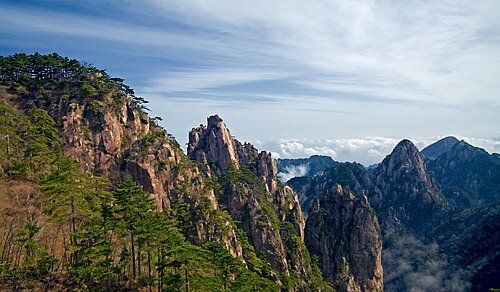
Around Yuping, Welcoming-Guest Pine gives the rock-and-tree relationship a particular focus; Bright Summit opens a broader view across the high peaks when visibility allows. The mountain is crossed by long stair routes, so the choice of entrance, cableway and descent matters as much as a list of sights. Clouds, sunrise and snow are weather-dependent additions to the enduring rock forms and vegetation.
Mount Huangshan lies in southern Anhui, within Huangshan City, and extends about 40 kilometers north-south and 30 kilometers east-west; the range covers 1,200 square kilometers, with a core scenic area of about 160.6 square kilometers. Composed mainly of granite, its highest point is Lotus Peak (莲花峰), at 1,864.8 meters.
The mountain was originally called Yishan (黟山) for the bluish-black color of its peaks. According to legend, the Yellow Emperor (Xuanyuan Huangdi) once refined an elixir of immortality there, and combined with Emperor Xuanzong's Daoist beliefs this led to its renaming as Huangshan in 747, in the Tianbao era of the Tang dynasty. The mountain is regarded as a cradle of Chinese landscape painting; the Huangshan School (黄山画派), formed in the late Ming and early Qing dynasties, took its scenery as its subject, and painter Shi Tao was the first to depict all 72 of its peaks.
Huangshan was included in the first group of State-designated Scenic Areas in 1982 and named one of China's ten most renowned scenic spots in 1986. It was inscribed on the UNESCO World Heritage List in 1990 as a mixed cultural and natural heritage site, designated a World Geopark in 2004, and placed on the IUCN's first Green List of well-managed protected areas in 2015.
What to look for
- Welcoming-Guest Pine and the granite scenery around Yuping.
- Bright Summit’s high-mountain panorama and the ridges surrounding it.
Location & getting there
Getting to Mount Huangshan
For a southern approach, reach Tangkou’s scenic transfer centre and take the shuttle serving your chosen Yuping or Yungu route. Huangshan North’s tourist passenger centre provides onward connections to the mountain gates. Confirm trail and cableway availability before choosing the ascent and descent.
Combine your visit
A suggested sequence linking the specific features of this visit.
-
Yuping and Welcoming-Guest Pine
Start with the mountain’s characteristic interaction of granite and pine.
-
Bright Summit
Continue only on a suitable open route for a wider high-mountain view.
This order is editorial. Confirm access and any transfers between stops; it does not establish a walking route, same-day connection or common admission ticket.

Find Mount Huangshan
黄山 · 黄山市
The pin marks the area, not the entrance.
More places nearby
Approximate straight-line distances between map pins, not travel distances.
Tiandu Peak · Yuping visitor-area reference 天都峰·玉屏片区示意点
Less than 1 km awayTiandu Peak rises sharply above Huangshan’s southern mountain routes, with narrow rock passages and the exposed Carp’s Backbone ridge distinguishing it from the broader summit viewpoints. The approach is a demanding stair climb…
View guide →Hongcun 宏村
22 km awayHongcun’s water system threads between whitewashed houses and links the central Moon Pond with South Lake. These two pools give the village its most recognisable open spaces, but the smaller channels beside the lanes are equally…
View guide →Chengkan 呈坎
25 km awayChengkan’s village lanes lead between houses and communal buildings of the Luo clan. The Luo Dongshu ancestral hall is the main architectural focus: its courtyards lead to Baolun Pavilion, where painted timber framing gives the…
View guide →Sources & visit information
The sources below support the place-specific description and arrival information. Suggested combinations are editorial planning ideas; confirm current opening, entry arrangements and transport services for your date.
- Huangshan ↗
- www.hslyjt.com ↗
- Huangshan ↗
- hsgwh.huangshan.gov.cn ↗
- Chinese Wikipedia: 黄山 (revision 93668688, 2026-07-27) ↗
Visitor information adapted and edited from Wikivoyage contributors, “Huangshan” · CC BY-SA 4.0.
Visitor information adapted and edited from Wikipedia contributors, “Huangshan” · CC BY-SA 4.0. Source revision 1369296156.
Background paragraphs translated and condensed from Wikipedia contributors, "黄山", Chinese Wikipedia · CC BY-SA 4.0. Source revision 93668688.