

Explore the region
Tiandu Peak (天都峰) is the steep granite horn that stands south-east of Huangshan’s Yuping terrace: one of the scenic area’s three main peaks and its most exposed climb, a staircase of cut steps and chains that is open only part of the year and only to visitors holding a quota reservation. The map point for this entry sits in the Yuping visitor area beside Welcoming-Guest Pine (迎客松), where the front-mountain trails meet the upper station of the Yuping cableway. It is an orientation reference for that terrace, not the summit trailhead — the two climbing entrances are further along the paths, and neither of them issues permits.
What the Yuping reference point covers
Yuping (玉屏, “Jade Screen”) is the central scenic area of Huangshan and was historically called Wenshu Yuan (文殊院). It is organised around Yuping Lou (玉屏楼), the building at the top of the front-mountain cableway, and takes in the Lotus and Tiandu peaks together with the surrounding rock formations, pines, cliff inscriptions and cloud seas.
For anyone using this pin, the content is threefold: the pine-and-granite terrace you are standing on, the granite profile of Tiandu Peak across the gap, and the climb itself if the day and your reservation allow it.
The peak: name, height, and why it is not always open
Tiandu lies in the south-east of the scenic area, facing Lotus Peak to the west and adjoining Bowl Peak (钵盂峰) to the east. It is one of the thirty-six great peaks of Huangshan and, with Bright Summit and Lotus Peak, one of the three main peaks. Its old description, “the capital where the immortals assemble” (群仙所都), is the source of the present name; English-language travel writing often renders it Celestial Capital Peak.
Published heights differ: the scenic area’s own reopening notice gives 1,810 m, while reference and tourism pages give 1,829–1,830 m. The shape is not in dispute. The peak is a granite horn left by Quaternary glaciation, its summit flat enough to hold a natural stone chamber, with the characters 登峰造极 (“the highest point reachable”) cut into the rock.
Huangshan has rotated its headline peaks out of service since 1987, closing one for three to five years while the vegetation along its paths recovers; the trigger is monitoring of five representative plants, among them Huangshan pine and Huangshan rhododendron. Tiandu was closed from December 2018 and reopened on 20 May 2024, after sample trees and ground cover passed the thresholds set for reopening. Lotus Peak has been resting since 1 December 2023. The peak also closes each winter for maintenance and reopens in spring: in 2026 the maintenance period ended on 6 April and the peak reopened on 7 April, with online booking opening two days earlier.
A warning stele at the foot of the peak records the fire of December 1972, started by a discarded cigarette, which burned several thousand Huangshan pines on the north slope. Smoking is prohibited on the mountain, and the stele is worth a look on the way up.
What to look at, and how
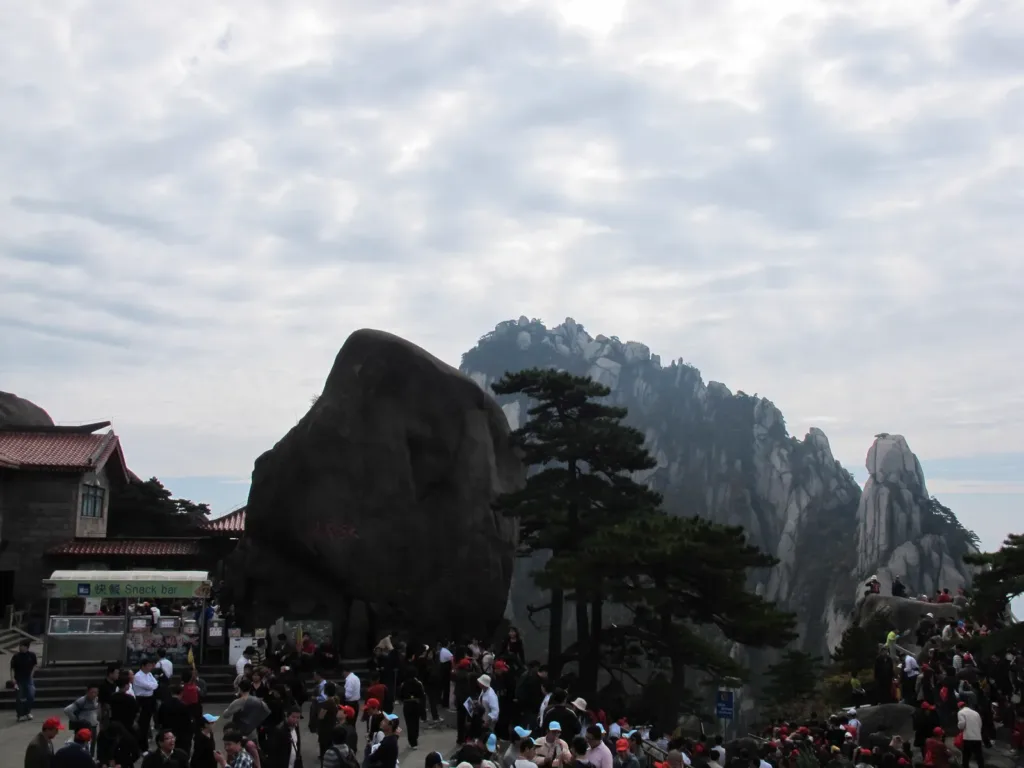
From the Yuping terrace. Welcoming-Guest Pine grows to the left of Yuping Lou; the Seeing-Off Pine (送客松) stands to the right, with the Companion Pines (陪客松) and Wenshu Terrace (文殊台) in front of the building. Behind it is Jade Screen Peak, where a rock profile is read as the reclining “Jade Screen Buddha”, with Mao Zedong’s calligraphy 江山如此多娇 carved on the rock face. The pine itself is about 1,000 years old and was inscribed with the World Heritage property in 1990; since 1981 the scenic area has kept a named caretaker for it, and protection now runs on “one tree, one plan” rules with elastic supports and a three-dimensional digital model.
The granite ridge of Tiandu. From the terrace, trace the skyline: the rock fin that gives the peak its reputation, and further along the formation read as Squirrel Skipping to Tiandu (松鼠跳天都). The route’s set pieces have names you will meet on the way up — Carp’s Backbone (鲫鱼背), the Heavenly Bridge (天桥), the Hundred-Step Cloud Ladder (百步云梯) and the rock figure of the Immortal Guarding the Cave (仙人把洞门).
Carp’s Backbone. The ridge is a little over 10 m long and about 1 m wide, with drops on both sides and slopes reaching roughly 85°. It is the section most visitors remember, and it is one-way. What is worth watching here is not only the view but the construction: stone posts, chains and cut steps are what make a bare granite fin walkable at all. The present stairway was built in 1937 and runs about 1.5 km with 1,564 steps, 194 stone posts and 600 m of iron chain.
From the summit. The top is a platform rather than a needle: cloud seas, granite ranges, and the gap between Tiandu and Lotus Peak, where you can watch cloud move through the valley. The peak is also the one the Chinese deep-space programme borrowed for two relay-test satellites, Tiandu-1 and Tiandu-2, named in 2023.
Climbing it: the two entrances
There are two ways onto the peak, and they are not equivalent.
老道口 (old path entrance) is reached from the top of the Yuping cableway: about 30 minutes’ walk from the station, then mostly stone steps cut along the rock face. Allow 40 minutes to 1.5 hours to the summit. It is the shorter, less tiring option and the one closest to Carp’s Backbone.
新道口 (new path entrance) is at Hanshan Temple (半山寺), reached by walking up from Ciguang Pavilion (慈光阁), one to two hours on foot. From there the climb to the summit takes 1.5 to 3 hours and is considerably harder.
The usual combinations: up and back by 老道口 for the least effort; 新道口 up and 老道口 down for a full traverse that brings you out at Yuping with Welcoming-Guest Pine on the way. Going up and down by 新道口 is not recommended for ordinary visitors. The peak’s paths run two-way at the two entrances, but Carp’s Backbone and One-Line Sky are one-way sections. Budget about four hours for the circuit.
The climb is stone steps, chains and exposure. The steepest stretches approach 85°, and official guidance says the peak is unsuitable for people with high blood pressure or heart conditions, for those with a fear of heights, and for young children or frail visitors. Thunderstorms and high winds close it at short notice.
Tickets, quotas and the reservation that decides your day
The peak carries no separate ticket; what it has is a quota.
- Capacity: 3,000 people a day in clear weather, with an instantaneous limit of 500, reduced when it rains or fogs.
- Booking window: on the day two days before your visit, submit the visitors’ details between 20:00 and 21:00, then claim a slot from 21:00 onwards, first come, first served. Only those who filed details in that hour can claim.
- Channel: the WeChat mini-program 黄山旅游官方平台 is the only online booking channel, and a scenic-area ticket must be booked first.
- Entry: your identity document is checked at the trail entrance; the entrances themselves do not take bookings.
- If you cannot book online: foreign passport holders and holders of free-admission certificates can apply in person at the ticket service windows at the South Gate Transfer Centre or the Xiaoyaoxi transfer point, at Songgu for the north gate and Xiaojiaoling for the west gate. Applications are same-day only and subject to the remaining quota.
- Daily hours: 7:00–15:00 in the 2026 operating pattern, with no entry after 15:00 and the peak closed at night; over the National Day holiday the window was 6:30–15:00. Winter maintenance closes the peak from December to the end of March.
Scenic-area ticket and cableway costs sit outside this. The entrance ticket is 190 CNY in the 2026 peak period (21 January to 19 December) and 150 CNY in the winter period (20 December to 20 January), and a ticket is valid for three days after first check-in, with repeat entries booked online. The Yuping cableway is 90 CNY each way in the peak period and 75 CNY in winter; the internal shuttle from the south-gate transfer centre costs about 19 CNY each way. Visitors aged 18 and under enter free from 21 September to 31 December 2026, excluding the Mid-Autumn and National Day holidays, using a special zero-yuan ticket; cableway and shuttle charges still apply.
If the quota is gone, the scenic area’s own advice is to try another date or to spend the day on the West Sea Grand Canyon or Shixin Peak.
Getting there
Huangshan has no metro; the mountain is reached by high-speed rail, then coach, then the compulsory transfer shuttle inside the scenic area.
Rail. Huangshan North Railway Station (黄山北站) is the high-speed gateway, about 50 km from the south gate at Tangkou.
Coach from the station. Tourist buses leave from the waiting area by the station’s west square for the Tangkou south gate, roughly every 20–30 minutes from about 06:30 to 19:00; travel guides put the fare at 28–33 CNY and the journey at 50–65 minutes. Treat those figures as indicative and confirm the current timetable at the station or on the official platform. A slower budget option is BRT-1 (about 5 CNY) to Huangshan Bus Terminal, then the Tunxi–Tangkou suburban bus (about 12 CNY, roughly 90 minutes).
Transfer centre to the mountain. From the South Gate Transfer Centre (南大门换乘中心, also known as the Xinguoxian Huangshan Scenic Area visitor centre, at Zhaixi in Tangkou) shuttle buses run to Ciguang Pavilion (慈光阁) for the front mountain and Yungu Temple (云谷寺) for the back mountain; the ride is about 20 minutes and about 19 CNY each way. Private cars cannot drive into the scenic area and must be left at the transfer centre or at a Tangkou hotel.
Cableway or on foot. The Yuping cableway runs from Ciguang Pavilion to Yuping Lou: 2,012 m, about 745 m of rise, roughly eight minutes, six passengers a cabin. Walking instead of riding adds about three hours. To reach the new entrance on foot, allow one to two hours from Ciguang Pavilion to Hanshan Temple.
Taxi or ride-hailing. Give the driver 黄山风景区南大门换乘中心 or 汤口镇. A travel-guide estimate for the rail station to Tangkou is 140–180 CNY; confirm with the app before setting out.
Hours that matter. Transfer vehicles and cableways follow published seasonal hours — during the 2026 National Day holiday the transfer buses ran from 5:40 upward and the cableways from 6:00 — and the last cable car down leaves between 16:00 and 17:40 depending on season and day. Check the day’s hours before you start the Tiandu climb.
Practical notes
- Yuping Lou Hotel stands beside the pine, and Baiyun Hotel serves the front side; the back side has Beihai, Shilin, Xihai and Paiyunlou hotels. On-mountain rooms require a scenic-area ticket booked in advance.
- Start the Tiandu climb in the morning. Between the quota window and the 15:00 cut-off, an afternoon start leaves no margin for the descent and the last cable car.
- The route is on bare granite: expect polished, wet steps after rain, and cold chains.
- Huangshan is a World Heritage site for both its natural scenery and its place in Chinese landscape painting; the granite peaks and pines around Yuping are part of the landscape the Shanshui school painted from the sixteenth century onwards.
Combine your visit
A suggested sequence linking the specific features of this visit.
-
Yuping visitor area
Orient the visit around the pine-and-granite landscape and current trail information.
-
Tiandu managed climb
Continue only when the route is open and the steep ascent is appropriate.
-
Carp’s Backbone ridge
Follow the controlled trail through the peak’s distinctive narrow rock section.
This order is editorial. Confirm access and any transfers between stops; it does not establish a walking route, same-day connection or common admission ticket.
Find Tiandu Peak · Yuping visitor-area reference
天都峰·玉屏片区示意点 · 黄山市
The pin marks the area, not the entrance.
More places nearby
Approximate straight-line distances between map pins, not travel distances.
Mount Huangshan 黄山
Less than 1 km awayHuangshan’s granite ridges and pines form a landscape made familiar by Chinese painting. Around Yuping, Welcoming-Guest Pine gives the rock-and-tree relationship a particular focus; Bright Summit opens a broader view across the…
View guide →Hongcun 宏村
22 km awayHongcun’s water system threads between whitewashed houses and links the central Moon Pond with South Lake. These two pools give the village its most recognisable open spaces, but the smaller channels beside the lanes are equally…
View guide →Chengkan 呈坎
24 km awayChengkan’s village lanes lead between houses and communal buildings of the Luo clan. The Luo Dongshu ancestral hall is the main architectural focus: its courtyards lead to Baolun Pavilion, where painted timber framing gives the…
View guide →Sources & visit information
Sources checked on 22 October 2026. Hours, tickets, reservations and transport can change; confirm with the operator before you go.
- 关于黄山风景区2026年“十一”假期开放时间、交通换乘和索道运营时间的公告(黄山风景区管理委员会,2026-09-28) ↗
- 线上预约已开启!黄山天都峰明日恢复开放(安徽日报/安徽新闻,2026-04-06) ↗
- 2026黄山天都峰线上预约指南(合肥本地宝,2026-04-08) ↗
- 2026黄山天都峰登峰线路推荐(合肥本地宝,2026-04-08) ↗
- 黄山天都峰今起恢复开放 此前封闭轮休了5年半(中国网旅游,2024-05-20) ↗
- “世界双遗产”黄山为主要景点轮流“放假”(新华社,2025-03-21) ↗
- 天都峰(百度百科) ↗
- Mount Huangshan(UNESCO World Heritage Centre) ↗
- 黄山旅游发展股份有限公司 常见问题(交通和游览) ↗
- Mount Huangshan Cableway Guide 2026 ↗
- 2025年12月20日至31日及2026年度黄山景区门票、索道票价格政策(黄山市人民政府发布/黄山旅游官方平台) ↗
- 黄山秋假政策发布!免门票直到年底(央广网,2026-09-21) ↗
- 千年奇松迎客来(人民日报,国家林业和草原局转载,2026-01-23) ↗
- 玉屏景區(黄山旅游资讯网) ↗
- Huangshan North Railway Station 2026 ↗
Image credits & notes (1)
- The Yuping terrace beside Welcoming-Guest Pine, with the granite spires of Tiandu Peak on the skyline — the area this map reference marks (photographed October 2010). Photo: 江上清风1961 (Panoramio, uploaded to Wikimedia Commons by Panoramio upload bot)Photo: CC BY 3.0