

Explore the region
Chengkan (呈坎) is a Luo-clan village in Chengkan Town, Huizhou District, about 20 km north of Huangshan North Railway Station and roughly 30 km north of Tunxi, the city centre. Eight low hills close around the basin it occupies, the Congchuan River (潨川河) runs along its eastern side, and the houses are packed into three streets and ninety-nine lanes. Two communal buildings carry most of the architectural interest, and they are different kinds of building: the Luo Dongshu ancestral hall, with Baolun Pavilion at its rear, and Changchun Dashe, a shrine to the earth and grain gods.
What Chengkan is
The village reads its own name through the Yijing: 呈 stands for yang, 坎 for yin, and the plan works with the ring of hills, the river and a dense lane network rather than a single ceremonial axis. Local accounts trace the settlement to Longxi in the Eastern Han and Three Kingdoms period, which is where the “1,800 years” figure comes from; the documented history begins later, when the Luo clan arrived from Jiangxi at the end of the Tang and divided into a front and a rear branch, each with its own ancestral hall. Treat the earliest date as local tradition rather than a dated foundation.
The village’s national protection comes in two parts. The Luo Dongshu ancestral hall was listed as a national key cultural relic site in 1996; in 2001 a group of twenty buildings — the Changchun shrine, the Wenxian clan hall, the Zhongying watchtower, two stone bridges and fifteen houses, most of them Ming — was listed as the Chengkan village architectural group, and twenty-eight more buildings were added to that group in 2013. Chengkan also belongs to the fourth batch of China’s historic and cultural villages, and it is one of the five scenic areas that make up the 古徽州文化旅游区, rated 5A in 2014.
The Luo Dongshu ancestral hall and Baolun Pavilion
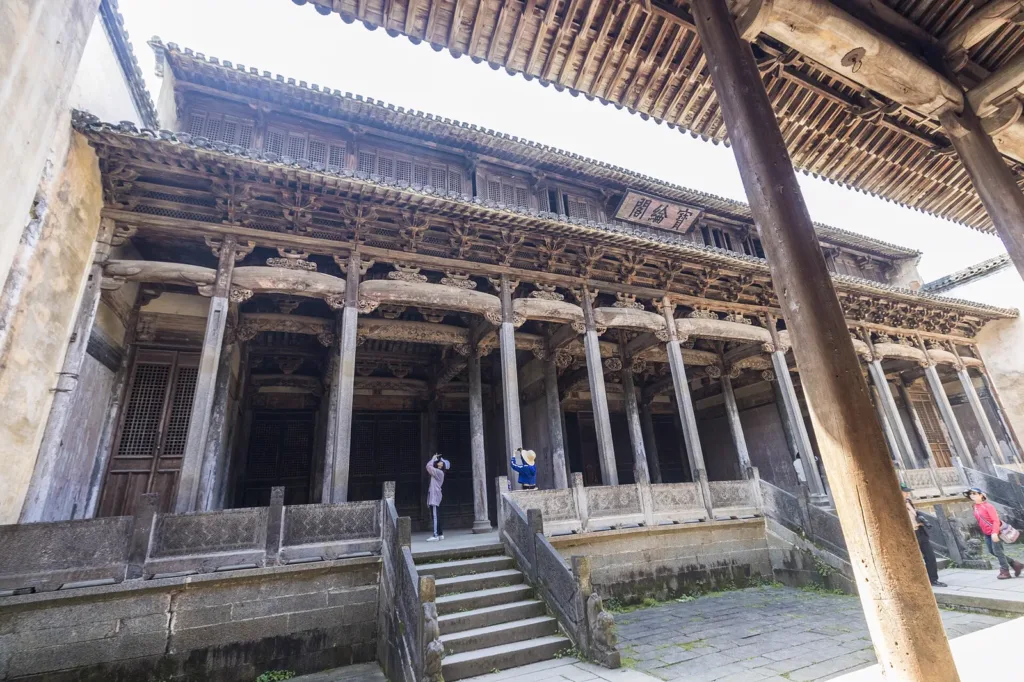
The hall — formally the Shrine of Mr Luo Dongshu, the Chaste and Tranquil (贞靖罗东舒先生祠) — is the largest of the village’s Luo branch halls and was built in two campaigns. The rear hall went up in the Jiajing period (1522–1566); seventy years later, in the Wanli period (1573–1620), the censor Luo Yinghe added the front courts through to the spirit gate, and had an upper storey built to hold the imperial documents granted to the family — hence Baolun Ge, the Pavilion of Treasured Edicts.
It stands at the northeast corner of the village on the west bank of the river, separated from the water by a curved spirit wall, and occupies more than 3,000 sq m in four courts: gate, courtyard with side galleries, main hall, and the rear hall carrying the pavilion above. The roofline steps up with each court, so the ancestor’s hall sits highest — the same hierarchy that puts the oldest generation at the back of a Huizhou house.
The rear hall is what to look at. Its main body is nine bays wide, with a stair bay at each end, and the timber frame keeps details more usually associated with Song building: entasis columns, crescent beams and short bracket arms, with bracket sets stepping outward in seven jumps under the eaves. Carved panels run along the stone balustrade in front of it, and the beams carry painted decoration. The plan also includes a separate women’s hall, which is unusual in a Huizhou ancestral hall.
Walk the axis slowly: through the gate into the courtyard, past the galleries into the main hall, then up the steps to the rear hall, looking back at how the gable walls rise one behind another and how each floor level lifts above the last.
Changchun Dashe
Changchun Dashe (长春大社, also written Changchun She 长春社) stands at the south end of the village, facing Lingshan across the river. It is a shewu — a communal shrine where the village sacrificed to the earth god and the grain god in spring and autumn — rather than a clan hall, and local heritage writing describes it as the most completely preserved building of its kind in the region. A stele inscription records a rebuilding in 1566 under Luo Zhensun; the present structure has three sections: a five-bay gatehouse in the wufenglou (five-phoenix tower) pattern, a seven-bay main hall, and a rear shrine raised six steps above the courtyard.
The main hall is where the building leaves the black-and-white Huizhou palette: its beams and columns are painted red, and the ceiling frames carry painted patterns in geometric and dragon motifs that local writing calls a Jiangnan “baofujin” (包袱锦) scheme. Above the door of the gatehouse sit six carved phoenixes. The blue-and-gold entrance plaque reading “长春大社” is traditionally attributed to Su Dongpo; the present one is a copy, and the hall’s own plaque reads “春祈秋报” — spring prayer, autumn thanks — which is the building’s function in four characters.
The lanes, the bridges and the lake
Between the halls, the village is a maze of stone-paved lanes between high walls. Zhongying Street (钟英街) carries the Zhongying watchtower, an over-street building once used for night watches, timekeeping and lookout. The listed houses that can be entered or viewed closely include Yanyi Tang, a Ming house whose three storeys wrap around a tall light well; Xiawu, a connected range associated with the Ming ink-maker Luo Xiaohua; Luo Huitai’s house; the Stone Pillar Hall; and the gatehouse of the Shou Shan Ru Zong residence — though which interiors are open changes with conservation work.
Two stone bridges cross the streams that thread the village: Huanxiu Bridge (环秀桥, Yuan) and Longxing Bridge (隆兴桥, Ming). Both were among the twenty buildings listed in 2001 and both double as places where villagers sit and talk.
At the centre of the village is Yongxing Lake (永兴湖), dug in 2007, with five bridges over its channels that local accounts link to the five elements, and a paved square at the water’s edge that serves as the village drying floor: in autumn, maize, chillies, pumpkin and beans are laid out there to dry in the sun.
Evening: the fish-lantern procession
Since 1 October 2026 the village’s night programme — “盛世徽州·呈坎社戏·呈坎鱼化龙灯会” — starts at 18:18, with the fish lanterns carried through the lanes and past the lake. Performances are cancelled in bad weather, and the scenic area’s notices ask visitors to arrive early, to watch from the marked areas and not to stand on bridges or the bank edge.
Tickets, opening and reservations
Recent visitor information (May 2026) gives the adult ticket as ¥107, with online advance booking around ¥95 and a ticket valid for three days with repeat entry; a 2024 listing on the official platform quoted ¥103. Children up to 1.2 m and adults aged 65 and over are free, minors aged 6–18 and full-time students pay half price, and identification is checked. Reported opening times are 07:00–17:30, extended to 18:00 in summer, against 08:00–17:00 in the 2024 official listing; the evening performance is timed separately at 18:18. Prices, hours and inclusions are revised from time to time, so confirm on the 黄山旅游官方平台 mini-program or by calling the scenic area on 0559-3537555 or 0559-3537777 (7:30–21:00) before you travel.
On peak days the scenic area runs capacity controls and asks visitors who have not booked to change their plans, so book ahead for public holidays. Tickets are checked more than once inside the village; carry your ticket and your passport or ID card.
Getting there and back
Huangshan has no metro; the practical approaches are high-speed rail plus a local bus, the regional tourist bus, a coach from Tunxi, or a taxi.
By rail and local bus. 黄山北站 (Huangshan North Railway Station) is the city’s high-speed station, in Huizhou District. Bus 徽州17路 runs from the station to the village terminus (呈坎站); a 2025 listing gives departures from the station at 07:30, 08:40, 09:50, 10:45, 12:30, 14:00, 15:20 and 16:20, and returns from Chengkan at 07:20, 08:40, 09:40, 11:00, 12:10, 13:40, 15:00 and 16:20. The timetable has been revised more than once, so confirm the day’s times at the bus bay when you arrive. Recent accounts quote a fare of ¥2–5 for a ride of about half an hour; one older guide measured the route at over an hour. Some recent listings also mention a 游9路 express on the same corridor.
Tourist bus 游2路. A tourist line linking 西溪南, 潜口民宅, 大灵山, 唐模, 呈坎 and 徽州古城 began trial operation in April 2026, with four departures each way around 08:00, 10:30, 13:00 and 16:00 from 西溪南 and 徽州古城 and segment fares from ¥5 to ¥20. It is a trial service and holiday timetables are adjusted, so check the current days and times before you rely on it.
Coach from Tunxi. 黄山市汽车客运总站, also called 屯溪客运中心, on Qiyun Avenue in Tunxi, runs a direct 呈坎 coach, quoted at about ¥10 and 40 minutes, with the last departure around 17:30 (May 2026).
Taxi or ride-hailing. Set the destination as 呈坎景区南门(游客中心). From Huangshan North the drive takes about 20–25 minutes, and visitor accounts quote ¥40–50, so agree the meter or the fare before setting off. From 黄山屯溪国际机场 (Tunxi International Airport) the drive is around 30 minutes.
By car. Leave the expressway at the 岩寺 exit; the village is about 7 km further on. Navigate to 呈坎景区南门停车场: parking was ¥10 a day in 2026 and cars cannot be driven into the village.
Coming back. In the 2025 listing the last local bus from the village to Huangshan North left around 16:20, earlier than the evening performance. If you stay for the lanterns, arrange a taxi or stay overnight in the village.
Practical notes
The lanes are paved with stone and are slippery after rain, and the rear halls are reached by steps. Cars and bicycles cannot be taken inside, and the lane network is easy to lose your way in: three streets and ninety-nine lanes still read as a labyrinth on foot.
Local guides approach visitors inside the village — one 2026 guide quotes about ¥50 for a walk through the lanes — but no official rate is published, so agree the price before you start. Some halls open selectively or close for conservation; ask at the ticket desk which buildings are open on the day instead of assuming that every hall on the map can be entered.
Combine your visit
A suggested sequence linking the specific features of this visit.
-
Historic village lanes
Read the relationship between houses and communal buildings.
-
Luo Dongshu ancestral hall
Move through the ceremonial courtyards towards Baolun Pavilion.
-
Changchun Society Hall
Compare a separate communal building on Nanqian Street.
This order is editorial. Confirm access and any transfers between stops; it does not establish a walking route, same-day connection or common admission ticket.
Find Chengkan
呈坎 · 黄山市
The pin marks the area, not the entrance.
More places nearby
Approximate straight-line distances between map pins, not travel distances.
Qiankou 潜口民宅
6 km awayQiankou’s historic residences form a collection of Huizhou buildings in Qiankou village. From the 1980s, threatened Ming-period structures from surrounding settlements were dismantled and reconstructed here.
View guide →Tangyue Memorial Archways 棠樾牌坊群
10 km awayTangyue’s memorial archways stand in Tangyue village, Zhengcun town, She County. Seven Ming- and Qing-period arches commemorate members of the Bao family and the moral virtues celebrated by the imperial state.
View guide →She County, Anhui 歙县
15 km awayShe County’s historic core was the seat of Huizhou, and its monuments show the wealth of officials and merchants from the region. Xu Guo’s stone memorial arch anchors the old centre, while Doushan Street leads past high-walled…
View guide →Sources & visit information
Sources checked on 22 October 2026. Hours, tickets, reservations and transport can change; confirm with the operator before you go.
- 呈坎村 — 维基百科(中文) ↗
- 罗东舒祠 — 维基百科(中文) ↗
- 长春大社 — 维基百科(中文) ↗
- 罗东舒祠 — 合肥工业大学 中国传统建筑文化 ↗
- 呈坎村古建筑群 — 合肥工业大学 中国传统建筑文化 ↗
- 千年社火映古今:呈坎长春大社的建筑美学与人文传承 — 凤凰网安徽 ↗
- 从黄山北站出发,畅达黄山市各景点的公交/班车全攻略 — 澎湃新闻 ↗
- 黄山市徽州区:坐上公交游徽州 “游2路”串起诗画风景新体验 — 人民网安徽 ↗
- 游呈坎古村 赴一场徽州旧梦 — 人民图片网 ↗
- 黄山呈坎景区门票多少钱? — 合肥本地宝 ↗
- 关于呈坎鱼化龙灯会表演时间调整的公告 — 乐活长三角转载呈坎景区公告 ↗
- 黄山部分景区发布限流公告 — 安徽新闻网 ↗
- 关于唐模、呈坎景区限流的温馨提示及周边游览推荐 — 乐活长三角转载嗨徽州 ↗
- 关于黄山北站至徽州古城旅游公交“中秋、国庆”节期间调整运营时间的公告 — 凤凰网安徽 ↗
- 古徽州文化旅游区 — 维基百科(中文) ↗
- Chengkan Village — Easy Tour China ↗
- 呈坎门票(预订与游客点评) — 去哪儿网 ↗
- 高铁黄山北站到黄山风景区、宏村等旅游公交专线班车与时刻表 — 黄山旅游网 ↗
Image credits & notes (1)
- Baolun Pavilion, the rear hall of the Luo Dongshu ancestral hall, with the 宝纶阁 plaque, seven-jump bracket sets and carved stone balustrades Photo: ScareCriterion12 (Wikimedia Commons)Photo: CC BY-SA 4.0