

Explore the region
Why this village, and how it differs from Xidi
Hongcun was founded in 1131, in the Shaoxing era of the Southern Song, and grew as the settlement of the Wang clan; it was originally written 弘村, and the name was changed to 宏村 in the mid-Qing, when the village was rebuilt on a large scale and the old character collided with the personal name of the Qianlong emperor, Hongli (弘历). In 2000 UNESCO inscribed it together with Xidi as “Ancient Villages in Southern Anhui – Xidi and Hongcun” — two villages, not a region — under criteria (iii), (iv) and (v); the citation singles out their street plans, their architecture and decoration, and the integration of houses with comprehensive water systems. Hongcun’s historic building group followed as a Major Historical and Cultural Site Protected at the National Level in 2001 (fifth batch, no. 5-320), and the village was named a China Historical and Cultural Village in 2003. The scenic area is part of the joint 5A designation “Wannan ancient villages – Xidi and Hongcun”, granted in 2011.
Xidi and Hongcun are about 10 km apart, were built by different clans, and read differently on the ground. Xidi runs along three streams that converge at a bridge south of the village; Hongcun is organised around one man-made water line, and is conventionally described as an ox — the hill behind it as head and spine, two old trees at the village mouth as horns, the four bridges over the stream as legs, the channels as intestines, the houses as the body, Moon Pond as the stomach and South Lake as the belly. Hongcun is also the busier of the two: art students set up drawing boards along the water and costumed photography fills the lanes by mid-morning, which is normal traffic here rather than a bad day. The scenic area recorded more than 1.85 million visits in the first seven months of 2024 alone.
The village’s water is the reason to come, and it is easier to understand if you follow it in one direction instead of criss-crossing the lanes.
Moon Pond and South Lake
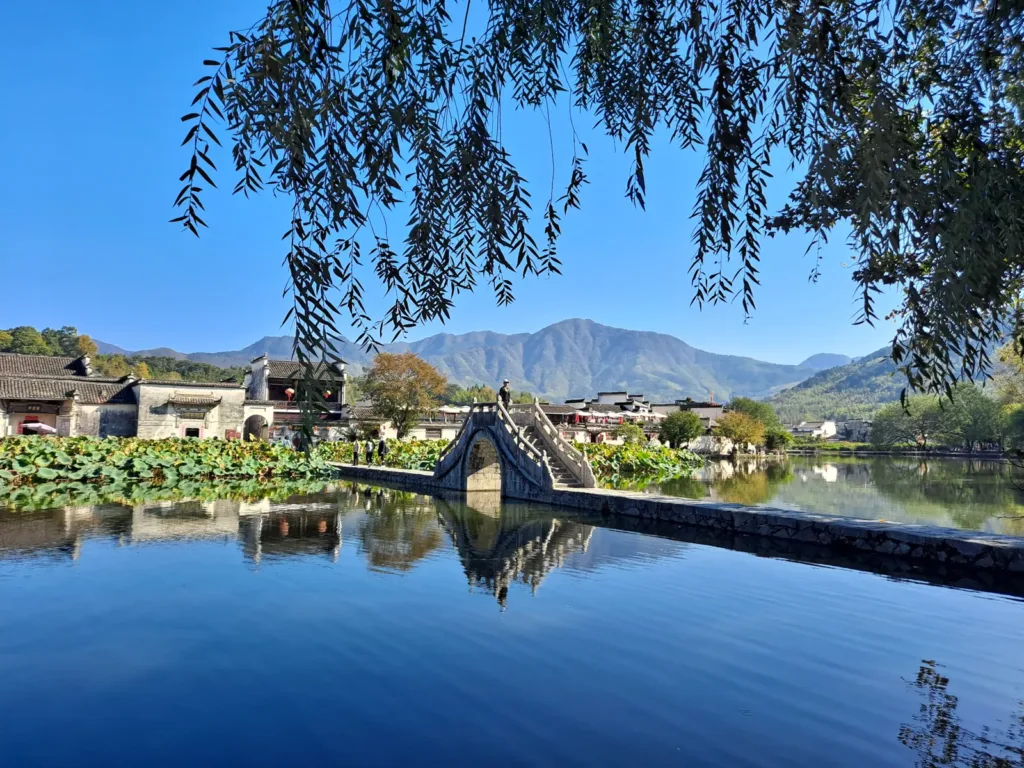
South Lake (南湖) forms the village’s southern edge. It is artificial, bow-shaped, and was dug in 1607 — the 35th year of the Wanli reign — over three years of village-funded work, with a weir inside it so that it holds a working depth in both wet and dry seasons. Its north bank carries the South Lake Academy (南湖书院), created in 1814 by merging six small lakeside schools into one academy, and divided into a lecture hall, a Wenchang shrine, a beginners’ hall, a hall for literary gatherings, a lake-viewing tower and a garden. The arch of the so-called painted bridge (画桥) over the lake is the crossing where Li Mubai leads his horse in Ang Lee’s Crouching Tiger, Hidden Dragon (2000).
Walk the whole embankment once, from the east gate to the west end near Jisi Bridge. The lake is doing two jobs at once: it is a reservoir that keeps the channels below it flowing, and a mirror that puts white gables, willows and the hills behind them on the water, which is why it is photographed so relentlessly.
Moon Pond (月沼) is the village’s centre, dug in the Ming Yongle era (1403–1424) around a natural spring and deliberately left as a half-moon. The story attached to the shape is that Hu Zhong insisted on it — a flower should not yet be fully open, nor the moon full — as a reminder that the clan’s work was unfinished. Roughly a sixth of the channel’s flow is diverted into it in front of Lexu Hall (乐叙堂), the Wang ancestral hall on the north bank.
Lexu Hall is the only surviving Ming building in the village; the rest are Qing. Inside, the clan hung a portrait of Hu Zhong under the plaque 巾帼丈夫, “a hero among women” — an exception to the rule that kept women out of clan halls, and the material trace of who actually planned the water system. Look at the two buildings together: the plain Ming timber framing here against the packed Qing carving you will see later in Chengzhi Hall. Then look at the pond’s edges — the stone steps, the low house fronts set directly on the water, the spouts where people still draw water — because they show that this is a working surface, not a decorative pool.
The channel (水圳), and how to read it as you walk
The channel is a bit more than a metre wide. Measured in the 2020s, the system totals 1,268 m: a main channel of 716 m and branch channels of 552 m, narrower than half a metre. Water leaves the stream at a weir (拦河坝) on the village’s north-west that is about 30 m long and 4 m high, and passes a hand-operated gate — rebuilt in modern times — that the village still closes in heavy rain and reopens afterwards to keep the water inside “neither overflowing nor exhausted”. The village falls roughly 4 m from the intake to South Lake, which gives the main channel a pace of about 21 m a minute, and explains why it was dug in curves instead of a straight cut: a straight channel would shorten the run, increase the drop and undercut its own banks.
Reading it while you walk is the point of the visit. Follow the open stretches beside the lanes, then look for the places where the same water slides under a building. In the courtyards built on the four-water-return principle (四水归堂), rain running off all four roof slopes is collected in the central skywell, part is stored for household use and part is led back into the channel. More than thirty old garden water pavilions survive, most of them built by drawing channel water into a private pond with a pavilion over it. At Chengzhi Hall the channel is routed through the fish-pond hall on the west side of the house, so the pond inside is living water and still holds carp.
Two things make the system legible. The first is the rules: the clan historically reserved the hours before 8 am for drawing drinking water, with all washing afterwards, and the current village covenant still bans washing meat, fish, poultry or greasy items in the channel, Moon Pond or South Lake, and any discharge into them. The second is the annual dredging each January before Spring Festival, done by hand and partly in the culverts, because machinery would damage the historic materials.
Chengzhi Hall (承志堂) and the merchant interiors
If the water is the village’s circulation, the halls are what paid for it. Chengzhi Hall was built around 1855 by Wang Dinggui, a salt merchant: roughly 2,100 sq m, more than 60 rooms arranged around nine skywells, 136 timber columns, with a family schoolroom, kitchens, stables, quarters for staff, and the owner’s mahjong room. The money is spent where visitors forget to look: beams, lintels and wall panels are carved with scenes of fishing, woodcutting, farming and study, episodes from the Romance of the Three Kingdoms, the “hundred boys” at the Lantern Festival, and birthday and banquet scenes, some of them gilded. That density of carving — not the size of the compound — is why the house is nicknamed the “folk Forbidden City”.
Worth comparing inside the village: Lexu Hall for Ming restraint, then Chengzhi Hall for Qing elaboration, then a middle-ranking house such as Jingxiu Hall, Shuren Hall, Taoyuanju, Deyi Hall or Wang Daxie’s former residence (Zhenqi Hall) to see how differently a household that was merely comfortable lived. Several of these houses are still occupied and rooms are closed or rearranged without notice; ask at the door rather than walking into a courtyard.
Walking the village
Hongcun has several entrances rather than one. The largest is on the east side of South Lake, where the car park is, and most visitors enter there and walk from south to north. The west “village mouth” (村口) entrance is the one by the two old trees — a red poplar and a ginkgo — that stand for the ox’s horns, and there is a further entrance at the west end of South Lake near Jisi Bridge (际泗桥).
A route that covers the essentials without much backtracking: enter by South Lake → South Lake Academy on the north bank → 敬德堂 (Jingde Hall) and the Wang Daxie house in the lanes → Moon Pond and Lexu Hall → Jingxiu Hall → Chengzhi Hall → Shuren Hall and Taoyuanju → back out through the lanes. Three hours is a comfortable minimum; half a day if you want to sit out a shower or wait for the light at the two pools. This sequence is editorial — it is not a marked route, and no single ticket or transfer is implied by it.
Terrain and timing: the lanes are stone-paved and narrow, with steps at the bridges and low thresholds at the halls; after rain the polished slabs and the stone edging along the channel are slippery, and no step-free route through the village is published. Both pools are quietest and best lit early, and the middle of the day brings the drawing classes, guided groups and costume photography described above. For an overview of the ox plan, the hill immediately behind the village (Leigang Hill) is the customary viewpoint.
Tickets, hours and booking
The adult ticket has been listed at CNY 104 with multi-day validity and re-entry registered at the gate, and cheaper bought in advance online than at the window. Prices, validity periods and promotions change, so treat the figure as indicative and check current terms on an official channel: the city’s platform run by Huangshan Tourism Development sells village entry, while Yixian’s own operator, the Huihuang Tourism Group, publishes its Hongcun and Xidi notices — weather closures, performance cancellations — on one announcement page.
Concessions published for the scenic area include free entry for children 1.2 m or under or aged 6 and under, and for visitors aged 65 and over, and half price for ages 6–18, full-time students and ages 60–64, with documents checked at the gate; the same listing warns that the notice board on site governs on the day. Age is the usual test, so a passport normally serves as proof, but confirm at the ticket window before assuming a category applies to you. Hongcun and Mount Huangshan are separate scenic areas on the national 5A list, so no ticket covers both.
Hours are less simple than they look, because this is a village with residents and guesthouses, not a gated museum. The lanes are walkable early and late; ticket checks and the halls run in daylight, with third-party listings publishing 07:30–17:30 for the March–November season while also describing the village as open all day. If your arrival or departure falls outside daylight, ask when you buy, and if you are staying inside the village keep your ticket with you for re-entry. Promotions can be substantial and are announced at short notice: in October 2026 Huangshan’s official release channel announced free entry for visitors under 18 at fifteen paid 4A-and-above scenic areas, Hongcun among them, for 1–30 November, and similar windows recur through the year.
Getting there and away
There is no metro in Huangshan or in Yi County, and no station in the village itself. The workable pattern is high-speed rail or coach to one of the county’s stations, then a local bus or taxi for the last stretch. The village’s own bus station (宏村客运站) is outside the lanes at the west gate area, next to the visitor centre.
- Yixian East Railway Station (黟县东站) is the closest station to the village, about 15 km away, and the quickest rail link from Huangshan North (roughly 14 minutes) or Huangshan West (roughly 17 minutes); it is served by high-speed trains from Hangzhou, Shanghai, Hefei, Nanjing and Beijing. Bus 10 runs from the station to Hongcun in about 40 minutes for a reported CNY 8, calling at the Xidi Scenic Area on the way, and return buses from Hongcun Bus Station to the station were listed from 08:00 to about 18:50.
- Huangshan North Railway Station (黄山北站), the city’s main gateway, has coaches to Hongcun from the Huangshan Tourism Passenger Transport Centre (黄山旅游客运中心) on the west side of the station: about 90 km, around 1.5 hours, CNY 30, calling at Xidi, Pingshan and Xiuli. Return coaches from Hongcun Bus Station to the station were listed between 08:30 and 17:30 at the same fare, so a late train out of Huangshan North means a taxi instead. A rail alternative is the short hop from Huangshan North to Yixian East, then bus 10.
- From Mount Huangshan’s south gate at Tangkou (汤口): direct buses run from Hongcun Bus Station through the day, listed 06:20–17:30 at CNY 15, taking roughly 40 minutes to an hour.
- From downtown Huangshan (屯溪): coaches from Hongcun Bus Station to Tunxi were listed at 10:00 and 15:25 for CNY 26; in the other direction, the downtown bus station is where the Huangshan–Yixian–Hongcun coach starts. Older English guide listings give downtown departures on the hour from 08:00, but treat those as historical and confirm at the station.
- Taxi and ride-hailing: name the gate rather than the village — 宏村西门游客中心 (Hongcun West Gate Visitor Centre) for the west side with the bus station and visitor centre, or 宏村南湖停车场 for the South Lake side where the main gate and car park are. Vehicles stop outside the lanes, so if your guesthouse is inside the village, ask which gate to aim for and whether someone can meet you there.
- Local movements: Xidi is about 10 km away and sits on the same bus line and coach route, which makes a two-village day straightforward; Pingshan and Xiuli are also stops on the Huangshan North coach. Further out, Lucun’s carved halls, Nanping, Tachuan‘s autumn colour and the Mukeng bamboo forest are the usual extensions.
Times, fares and last departures above are the figures published in the sources consulted for this page, with the dates given in the reference list. Services in Yi County change with the season and with public holidays, so confirm the day’s last bus at the station or ticket window before you rely on it.
Combine your visit
A suggested sequence linking the specific features of this visit.
-
South Lake
Begin with the village’s broad southern water space.
-
Moon Pond
Follow the lanes towards the central communal pool.
-
Chengzhi Hall
Look inside a merchant residence to compare its carved, enclosed spaces with the village outside.
This order is editorial. Confirm access and any transfers between stops; it does not establish a walking route, same-day connection or common admission ticket.
Find Hongcun
宏村 · 黄山市
The pin marks the area, not the entrance.
More places nearby
Approximate straight-line distances between map pins, not travel distances.
Xidi 西递
11 km awayXidi’s stone lanes wind among whitewashed merchant houses, with carved entrances and enclosed courtyards marking the transition from public street to private home. Three streams run through the settlement and converge near…
View guide →Mount Huangshan 黄山
22 km awayHuangshan’s granite ridges and pines form a landscape made familiar by Chinese painting. Around Yuping, Welcoming-Guest Pine gives the rock-and-tree relationship a particular focus; Bright Summit opens a broader view across the…
View guide →Tiandu Peak · Yuping visitor-area reference 天都峰·玉屏片区示意点
22 km awayTiandu Peak rises sharply above Huangshan’s southern mountain routes, with narrow rock passages and the exposed Carp’s Backbone ridge distinguishing it from the broader summit viewpoints. The approach is a demanding stair climb…
View guide →Sources & visit information
Sources checked on 22 October 2026. Hours, tickets, reservations and transport can change; confirm with the operator before you go.
- Ancient Villages in Southern Anhui – Xidi and Hongcun (UNESCO World Heritage Centre, list 1002) ↗
- 暴雨袭来,“画里宏村”为何总能安如山——世界文化遗产地的治水故事 (Xinhua, 2024-08-09) ↗
- 古老宏村智慧治水 (人民日报海外版, 2024-10-09) ↗
- 皖南古村落——西递、宏村 (国家文物局, 2024-08-08) ↗
- 宏村村 (中文维基百科) ↗
- Hongcun (English Wikipedia) ↗
- 从黄山北站出发,畅达黄山市各景点的公交/班车全攻略 (澎湃新闻, 2025-04-04) ↗
- Yixian East Station – Hongcun Village by Bus & Timetable (chinatrain12306) ↗
- 两座县城高铁站,正式亮相! (浙江在线, 2023-06-14) ↗
- 国家5A级旅游景区(文化和旅游部数据服务,数据截止 2025-03-11) ↗
- 黟县徽黄旅游集团景区公告页(西递、宏村景区通知) ↗
- 黄山旅游官方平台(黄山旅游发展股份有限公司) ↗
- Hongcun Village: opening hours, entrance tickets (Trip.com travel guide, 2026) ↗
- 宏村景区(去哪儿网景区页:入口、开放说明与优待政策) ↗
- 黄山市15家4A级以上收费景区11月1-30日对18周岁以下免票(黄山发布,经大风号转载,页面日期 2026-10-09) ↗
- Hongcun Ancient Village: history, layout, route and access (China Discovery) ↗
Image credits & notes (1)
- South Lake, with the painted bridge (画桥) crossing the water and Huizhou houses behind Photo: EditQPhoto: CC BY-SA 4.0