

Photo adjustments
Wikimedia thumbnail; fitted to the ranking-card frame.
City & district guides
About Hongcun
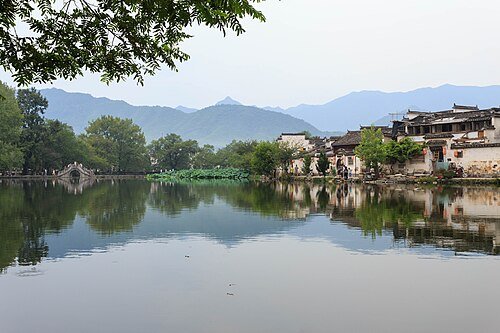
These two pools give the village its most recognisable open spaces, but the smaller channels beside the lanes are equally important to understanding its layout. Merchant residences such as Chengzhi Hall add carved interiors and enclosed courtyards to the waterside scenery. Move from the lake into the lanes to see how shared water spaces and private family buildings fit together.
Hongcun was founded in 1131, during the Shaoxing era of the Southern Song dynasty, by Wang Wen, a general whose clan settled there; the village was originally named Hongcun (弘村). In the Ming Yongle era the clan head had a fengshui master survey the site, redesigned its layout and channeled water into the village. Large-scale rebuilding in the mid-Qing dynasty led to its renaming, to avoid the personal name of the Qianlong Emperor, Hongli (弘历).
A channel (水圳) nearly one meter wide draws river water from the west and winds through the village, supplying households and moderating temperature; it widens into the crescent-shaped Moon Pond (月沼) at the center and the bow-shaped South Lake (南湖) to the south. The layout is likened to an ox: Leigang Hill (雷岗山) is the head, old trees are the horns, Moon Pond the heart, South Lake the belly, the channel the intestines, the houses the body, and four old bridges the legs.
Hongcun was inscribed, together with other ancient villages of southern Anhui, on the UNESCO World Heritage List as a cultural heritage site in 2000, and its historic building complex was listed as a Major Historical and Cultural Site Protected at the National Level (全国重点文物保护单位) in 2001. In 2003 it received the title of China Historical and Cultural Famous Village (中国历史文化名村).
What to look for
- Moon Pond and South Lake, linked by the village water system.
- The carved domestic architecture and courtyards of Chengzhi Hall.
Location & getting there
Getting to Hongcun
Use Hongcun’s village visitor entrance in Yi County. Huangshan North’s tourist passenger centre serves the village; Tangkou is another documented road-transfer base. Confirm the return connection and lodging location before entering the pedestrian lanes.
Combine your visit
A suggested sequence linking the specific features of this visit.
-
South Lake
Begin with the village’s broad southern water space.
-
Moon Pond
Follow the lanes towards the central communal pool.
-
Chengzhi Hall
Look inside a merchant residence to compare its carved, enclosed spaces with the village outside.
This order is editorial. Confirm access and any transfers between stops; it does not establish a walking route, same-day connection or common admission ticket.
Find Hongcun
宏村 · 黄山市
The pin marks the area, not the entrance.
More places nearby
Approximate straight-line distances between map pins, not travel distances.
Xidi西递
11 km awayXidi’s stone lanes wind among whitewashed merchant houses, with carved entrances and enclosed courtyards marking the transition from public street to private home. Three streams run through the settlement and converge near…
View guide →Mount Huangshan黄山
22 km awayHuangshan’s granite ridges and pines form a landscape made familiar by Chinese painting. Around Yuping, Welcoming-Guest Pine gives the rock-and-tree relationship a particular focus; Bright Summit opens a broader view across the…
View guide →Tiandu Peak · Yuping visitor-area reference天都峰·玉屏片区示意点
22 km awayTiandu Peak rises sharply above Huangshan’s southern mountain routes, with narrow rock passages and the exposed Carp’s Backbone ridge distinguishing it from the broader summit viewpoints. The approach is a demanding stair climb…
View guide →Sources & visit information
The sources below support the place-specific description and arrival information. Suggested combinations are editorial planning ideas; confirm current opening, entry arrangements and transport services for your date.
- Hongcun ↗
- www.hslyjt.com ↗
- Chinese Wikipedia: 宏村村 (revision 93512565, 2026-07-17) ↗
- English Wikipedia: Hongcun (revision 1366824982, 2026-07-30) ↗
Visitor information adapted and edited from Wikipedia contributors, “Hongcun” · CC BY-SA 4.0. Source revision 1366824982.
Background paragraphs translated and condensed from Wikipedia contributors, "宏村村", Chinese Wikipedia · CC BY-SA 4.0. Source revision 93512565.
Background paragraphs condensed from Wikipedia contributors, "Hongcun", English Wikipedia · CC BY-SA 4.0. Source revision 1366824982.