

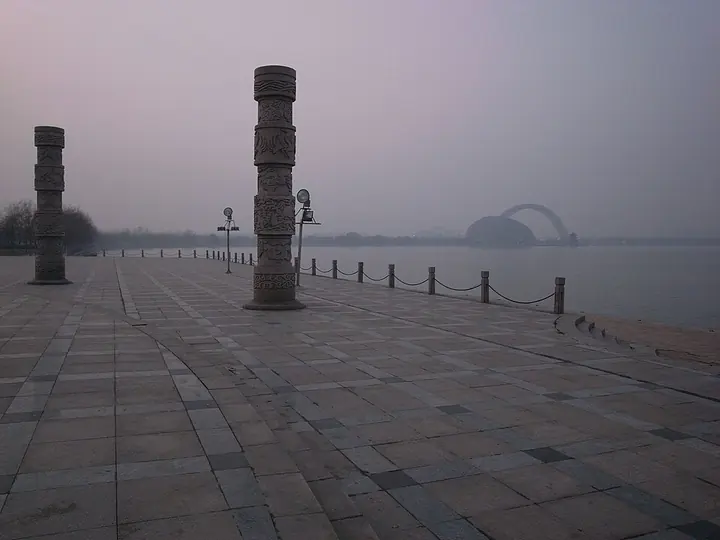
Photo adjustments
Full frame retained; proportionally resized and converted to WebP. No retouching or changes to the photographed subject. Card displays may crop the view.
Explore the region
About Dongchang Lake
It developed from the moat dug during city construction in the Northern Song period.
Its water system was later connected with the Grand Canal and subsequently modified again. The lake therefore records successive relationships between city defence, waterways and urban recreation.
Also known as Huchenghe (护城河) or Huanchenghu (环城湖), Dongchang Lake was built in the third year of the Northern Song Xining era (1070), when the digging of earth for the city wall and dikes formed the moat that became the lake. In the ninth year of Xining (1076) the dike was repaired and the waterway widened into a lake. Under the Ming and Qing, the lake was regulated by the Grand Canal, and since the founding of the People's Republic it has undergone repeated works.
The lake is made up of 10 lake areas and 20 stretches of water, with a total area of 5 square kilometers and a shoreline 16 kilometers long, making it the largest artificial lake within a city in northern China. It is now replenished with water drawn from the Yellow River through the second main canal of the Weishan irrigation district, and today forms an important scenic spot in Liaocheng.
What to look for
- The lake grew from a Northern Song moat.
- Its relationship with the Grand Canal links the waterscape with later transport and urban history.
Location & getting there
Getting to Dongchang Lake
Approach the lake around Liaocheng’s historic city, choosing the shore that serves the old-city section you intend to visit.
- Confirm the visitor entrance and access to the named areas before departure.
Combine your visit
A suggested sequence through the named features described in the source.
-
Historic-city lake edge
Examine Historic-city lake edge as a separate part of Dongchang Lake.
-
Old-city and moat relationship
Its relationship with the Grand Canal links the waterscape with later transport and urban history.
The order is an editorial suggestion. Internal opening arrangements and transfers between sectors need checking; no walking duration or access entitlement is implied.

Find Dongchang Lake
东昌湖 · 聊城市
The pin marks the area, not the entrance.
More places nearby
Approximate straight-line distances between map pins, not travel distances.
Guangyue Tower 光岳楼
2 km awayGuangyue Tower stands at the centre of Liaocheng’s historic Dongchang city. Founded in the early Ming period, it originally served watch and defence functions.
View guide →Lingyan Temple 济南灵岩寺
91 km awayLingyan Temple lies in the hills of Changqing, where a major Buddhist complex survives around halls, a pagoda and a burial stupa forest. The Thousand Buddha Hall is especially known for its painted arhat figures, whose varied…
View guide →Baotu Spring 趵突泉
98 km awayBaotu Spring rises through three outlets in a rectangular pool framed by historic halls and pavilions. Guanlan Pavilion stands to the west and Laihe Bridge to the east, giving the water a carefully composed architectural…
View guide →Sources & visit information
The linked encyclopedia sources support background and place descriptions. Current opening hours, ticket prices, booking rules and transport schedules have not been independently verified for this guide. Confirm them with the venue or operator before travelling.
Visitor information adapted and edited from Wikipedia contributors, “东昌湖” · CC BY-SA 4.0. Source revision 92210116.
Background paragraphs translated and condensed from Wikipedia contributors, "东昌湖", Chinese Wikipedia · CC BY-SA 4.0. Source revision 92210116.