

Explore the region
Tap any red Chinese text to hear it in Mandarin.
Why this museum matters
Henan Museum is a place to read the Central Plains through objects rather than through a single dynasty. The institution was founded in 1927; the present museum complex was inaugurated in 1998 after the museum moved to Zhengzhou and developed into a major collection, research and exhibition centre. Its official English overview highlights prehistoric material, Shang and Zhou bronzes, ceramics and jades among its particular strengths.
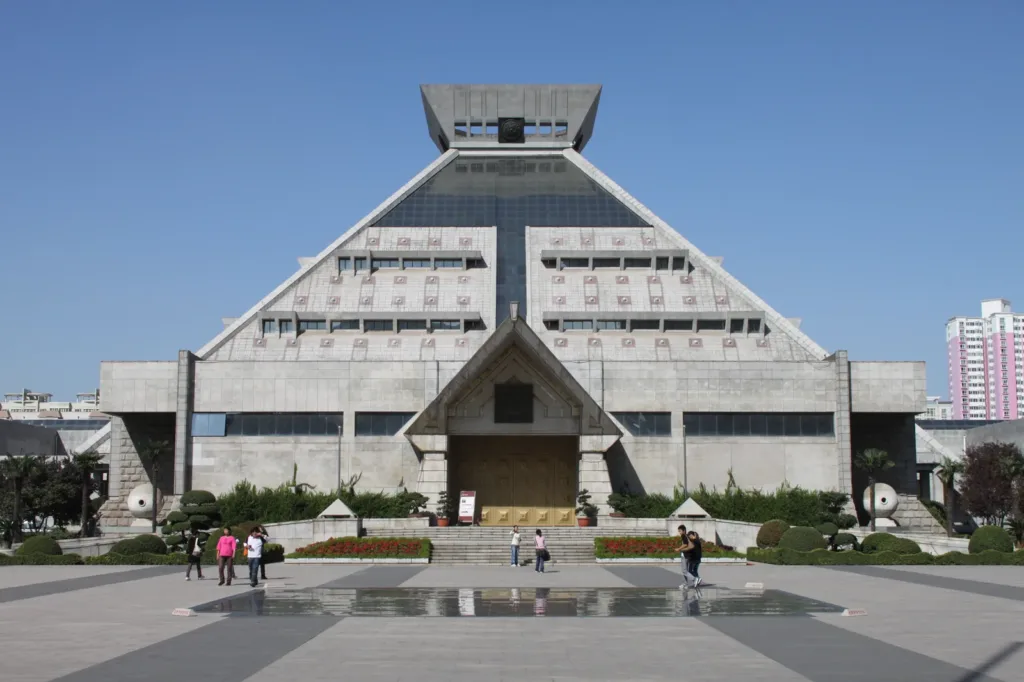
The building is part of the experience. The museum’s own institutional history describes the central exhibition hall as a pyramid-shaped structure, set within a large complex on Nongye Road. That shape is a useful preface to a visit that keeps returning to the idea of the Central Plain as a place where political centres, workshops and cultures met.
What to see
Start with the permanent exhibition Vast China: Founding a Capital at the Centre (泱泱华夏·择中建都). It occupies the first, second and third floors of the main exhibition hall and uses ten galleries to move from the Neolithic period through the Xia and Shang, Western and Eastern Zhou, Qin-Han and later imperial periods to the Song, Jin and Yuan eras. Rather than trying to memorise a list of dynasties, watch how settlement, writing, ritual vessels, burial objects, ceramics and city-building change together.
The museum’s official “treasures” list gives a practical set of names to look for when planning: the Jiahu bone flute (贾湖骨笛) for early music-making; the Duling Square Ding (杜岭方鼎), Lianhe Fanghu (莲鹤方壶), Fu Hao Owl-shaped Zun (妇好鸮尊) and Cloud-pattern Bronze Jin (云纹铜禁) for the visual and political language of bronze; and the Wuzetian Gold Tablet (武则天金简), the Four Spirits Cloud-Qi mural (四神云气图壁画) and a Ru-ware goose-neck bottle (汝窑天蓝釉刻花鹅颈瓶) for later periods. These are collection highlights, not a promise that every named object will be in the gallery on your date: loans, conservation and exhibition changes can alter what is visible.
After the chronological galleries, use the other permanent exhibitions to slow down and compare materials. The official list includes Henan in the Ming and Qing Periods, Bronze Art of the Chu State in the Central Plain, The Treasures from the Ming and Qing Dynasties and Ancient Stone Carving Art in the Central Plain, alongside the main history exhibition. Look closely at surfaces and construction—casting seams, inscriptions, glaze, carved lines and traces of use—rather than treating the museum as a checklist of “famous treasures.”
Planning your visit
The museum is at No. 8 Nongye Road, Jinshui District, Zhengzhou (郑州市金水区农业路8号). The official visitor page lists opening from Tuesday to Sunday, 09:00–20:30, with last admission at 19:30; it is closed on Mondays except when a national holiday falls on a Monday.
Admission is free but requires a real-name reservation through the official Henan Museum reservation system. The regular reservation windows are 09:00–12:00 and 12:00–16:00; the extended 16:00–19:30 slot is released on the day of the visit at 16:00 according to the English visitor page. The museum says it has not authorised third-party ticketing platforms. Visitors who reserve with a passport should bring the original passport and use the manual ticket-checking channel; a passport is not a reason to assume walk-in entry. Check the official reservation page again for the date you want.
Allow time for security screening. The English visitor guidance says that lockers, first aid, audio-guide and food-and-drink facilities are available, and that wheelchair or baby-carriage assistance can be requested at the entrance. Exhibition access and temporary displays can change, so treat the current official service and exhibition pages as the final reference.
Getting there and getting back
For the metro, the museum’s Chinese transport page lists Guanhutun Station (关虎屯站) on Line 2 and Agricultural University Station (农业大学站) on Line 7 as approaches. The Zhengzhou Metro operator confirms Guanhutun as a Line 2 station and lists trains in both directions, toward Jiahe (贾河) and Nansi-huan (南四环). The official museum pages do not establish a fixed exit number or walking time. Use the Chinese destination 河南博物院 Hénán Bó Wù Yuàn in Amap/Gaode Maps, then follow the live walking leg to the visitor entrance rather than relying on an old blog’s distance.
The museum’s official bus list names the stops Henan Museum (河南博物院站) and Nongye Road–Wenbo East Road (农业路文博东路站), served by B11, B102, B18, B2, S158 and 83. For a taxi or ride-hailing car, show or enter 河南博物院,郑州市金水区农业路8号. No fixed fare or travel time is given here because both traffic and the selected entrance can change. For the return, check the live route from the same metro station or bus stop; at Guanhutun, confirm the platform direction before boarding.
Combine your visit
A suggested sequence linking the specific features of this visit.
-
Neolithic galleries
Begin with the Jiahu flute and the material culture of early settlements.
-
Shang and Zhou bronzes
Compare the early objects with complex ritual casting and animal forms.
-
Later ceramics
Finish by tracing changes in vessel shape, glaze and use.
This order is editorial. Confirm access and any transfers between stops; it does not establish a walking route, same-day connection or common admission ticket.
Find Henan Museum
河南博物院 · 郑州市
The pin marks the area, not the entrance.
More places nearby
Approximate straight-line distances between map pins, not travel distances.
Shang Dynasty Wall Ruins 郑州商城遗址
5 km awayThe surviving earthworks of Shang Zhengzhou run through a modern city, making their scale easier to miss than that of a stone fortress. Layers of compacted earth formed an enclosure nearly seven kilometres around. Archaeologists…
View guide →Henan · Drama Fantasy City 只有河南戏剧幻城
31 km awayOnly Henan is a theatre complex built as a grid of tall, earth-coloured walls and enclosed spaces. Its 21 theatres range from large productions to smaller encounters, with stories linking Henan’s land, food and inherited memory…
View guide →Kaifeng Museum 开封博物馆
53 km awayKaifeng Museum’s collections offer a way to examine the city’s long history through particular objects. A Northern Song bronze bell inscribed Dasheng Yize connects the former capital with court music, while the stone list of…
View guide →Sources & visit information
Sources checked on 31 October 2026. Hours, tickets, reservations and transport can change; confirm with the operator before you go.
Image credits & notes (1)
- Henan Museum’s pyramid-shaped main exhibition hall and visitor entrance in Zhengzhou, photographed on 17 October 2009. Photo: Gary ToddPhoto: CC0 1.0