

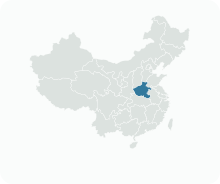
Get to know Jinshui District
- Administrative area
- District · 市辖区
- Part of
- Zhengzhou
- Chinese name
- 金水区
- Local areas
- District guide
Area & population
- Area
- 242.00 km²
- Population · 2019
- 1,764,700
Source: English Wikipedia, as of the dates shown.
A district with several scales
Jinshui District lies in the north-east of urban Zhengzhou and takes its name from the Jinshui River. The district government describes it as adjoining Zhengdong New Area to the east, Huiji District to the north, and the central districts to the south and west. Its official dimensions—up to 22.9 km east to west and 17.2 km north to south—explain why “Jinshui” is a useful area label rather than a single walkable neighbourhood.
The most rewarding way to read the district is to move between scales. Near Nongye Road, Henan Museum turns the Central Plains into a sequence of objects and galleries. Farther north-east, Dahecun Site Museum places the story on an archaeological settlement where Yangshao, Longshan, Xia and Shang cultural layers were found. Between these anchors are old factory buildings, commercial streets and everyday food rather than a single monumental centre. The district’s culture bureau’s September 2026 City Walk programme makes that mix explicit: its five themes cover the Yellow River edge, industrial heritage, museums and intangible heritage, film-related city spaces, and urban leisure.
Do not plan Jinshui as a short loop. Pick one or two stops, check their Chinese names and current opening information, and allow the return journey between them.
Start with the Central Plains collection
Henan Museum (河南博物院) at No. 8 Nongye Road is the district’s strongest all-weather cultural stop. The museum was founded in 1927 and describes itself as a major centre for collecting, preserving, researching and exhibiting the material history of the Central Plains. Its official overview highlights prehistoric objects, Shang and Zhou bronzes, ceramics, jade and stone carving.
A useful first visit is chronological rather than treasure-hunting. Look for how settlement, ritual, writing and craft change through time, then use the museum’s own treasure list to give the sequence a few fixed points: the Jiahu bone flute (贾湖骨笛), Duling Square Ding (杜岭方鼎), Lotus-and-Crane Square Hu (莲鹤方壶), Fu Hao Owl-shaped Zun (妇好鸮尊), Wuzetian Gold Tablet (武则天金简) and Four Spirits Cloud-Qi mural (四神云气图壁画) are all listed by the museum. A named object can be on loan, under conservation or absent from a particular gallery, so treat the list as a planning aid rather than a guarantee of display.
The museum’s current service page lists opening from Tuesday to Sunday, 09:00–20:30, with last admission at 19:30, and Monday closure except where a holiday arrangement applies. Admission is free but uses real-name reservation and timed entry. If you reserve with a passport, the museum says to bring the original document and complete verification through the manual channel; do not assume that a domestic-ID reservation rule applies in the same way to every visitor. Check the official reservation page again for your date.
Follow the archaeology north-east
Zhengzhou Dahecun Site Museum (郑州大河村遗址博物馆) is a different kind of visit. It is not a second general museum in the city centre: it is tied to the prehistoric settlement itself. The Zhengzhou government’s venue listing describes the original museum as a site museum with an excavation-remains hall, an excavated-object display hall and temporary exhibition space. It gives the location as about 700 metres east of the Zhongzhou Avenue–Lianhuo Expressway junction and lists a 09:00–17:00 schedule with Mondays closed.
The newer museum changes the scale of the presentation. Xinhua reported that the new building began trial operation on 14 June 2025, with 7,292 square metres of display space and more than 1,600 objects from over 30 sites. Its story is built around the Dahecun settlement and the wider development of Yangshao culture; the painted pottery double-linked pot (彩陶双连壶) is a particularly useful object to look for because the report connects it directly with the site.
Because the government venue page and the later new-museum reporting describe different stages of the institution, confirm the current official reservation channel, opening hours and which park or museum entrance is operating before you travel. The published materials I could read do not establish a current passport-specific admission procedure. Do not transfer Henan Museum’s passport rule to Dahecun by assumption.
Industrial memory and the ordinary city
For a shorter urban stop, the Zhengzhou government’s Jinshui itinerary describes Zhengzhou Memory·1952 Oil Chemical Plant (郑州记忆·1952油化厂) as an old factory complex converted in place into a creative and leisure district. The same page places it north of the Shaokou Road–Huanghe Road junction and describes a mix of cultural-creative work, food, performances and evening activity. This is best approached as an industrial-memory walk—brick factory buildings, reused spaces and the changing city around them—not as a museum with a fixed collection. Current tenants and event schedules can change, so check the destination in Amap/Gaode Maps on the day.
The district’s official 2026 route announcement also links urban leisure with museum-going and along-Yellow-River landscapes. That is useful as a menu of ideas, but it is not evidence that every listed stop shares one timetable, entrance or transport connection.
What to eat without chasing a “famous shop”
Jinshui is a practical place to try familiar Henan dishes, but the food is regional rather than a Jinshui-only invention. Start with the exact Chinese names 河南烩面 / 郑州烩面 (Henan or Zhengzhou huimian) and 胡辣汤 (peppery soup with chewy gluten). The Henan provincial culture and tourism department describes huimian as a hot soup with pepper and chewy gluten, and huimian as broad noodles served in a rich lamb-bone broth with ingredients such as quail egg, kelp and sliced tofu skin. Recipes and
meat choices vary; ask whether the broth contains lamb or beef, whether chilli or pepper can be adjusted, and whether the bowl contains gluten, egg or other ingredients relevant to you.
For nearby options, search the Chinese dish name—not a claimed “best restaurant”—in Meituan (美团) or Amap/Gaode Maps (高德地图). Open the current menu, read recent reviews for actual supply, check today’s business hours, and confirm that the named dish is available before ordering. Platform ranking is only a way to find possibilities; it is not an endorsement, proof of authenticity or a promise that a particular shop still serves the dish.
Getting around a district without a single entrance
Jinshui has no one visitor gate. Use the exact Chinese destination for the stop you have selected and plan the return from that stop.
For Henan Museum, the official transport page lists Guanhutun Station (关虎屯站) on Metro Line 2 and Agricultural University Station (农业大学站) on Line 7. It also names the bus stops Henan Museum (河南博物院站) and Nongye Road–Wenbo East Road (农业路文博东路站), served by B11, B102, B18, B2, S158 and 83. The museum page does not fix an exit number or walking time. Enter 河南博物院,郑州市金水区农业路8号 in Amap/Gaode Maps, follow the live walking leg to the visitor entrance, and check the return direction before boarding.
Dahecun is farther out and should be treated as a separate trip. The government listing gives the destination as 郑州市中州大道与连霍高速交叉口东700米. A 15 June 2025 report from Zhengzhou People’s Radio, republished by Guangming, recorded two special shuttle lines opened with the new museum: one from Liulin Metro Station’s A exit and another from Qinghua Affiliated High School Metro Station’s D exit via Forest Park North Station’s D exit. It also gave opening-period departure and return windows. Those details are historical evidence of a real connection, not proof that the shuttles still run in 2026; only use them after same-day confirmation from the museum or transit operator. Otherwise, use a taxi or ride-hailing car with the Chinese destination, and verify the entrance and return route in Amap/Gaode.
For the 1952 Oil Chemical Plant, use 郑州记忆·1952油化厂 or the Chinese road description in the official itinerary, then confirm the current entrance and return route in Amap/Gaode. Do not turn the district’s separate museums, industrial spaces and northern landscape into a walkable sequence just because they share the same administrative name.
Explore Jinshui District
Core places to explore, with English and Chinese names.
Places to explore around Jinshui District
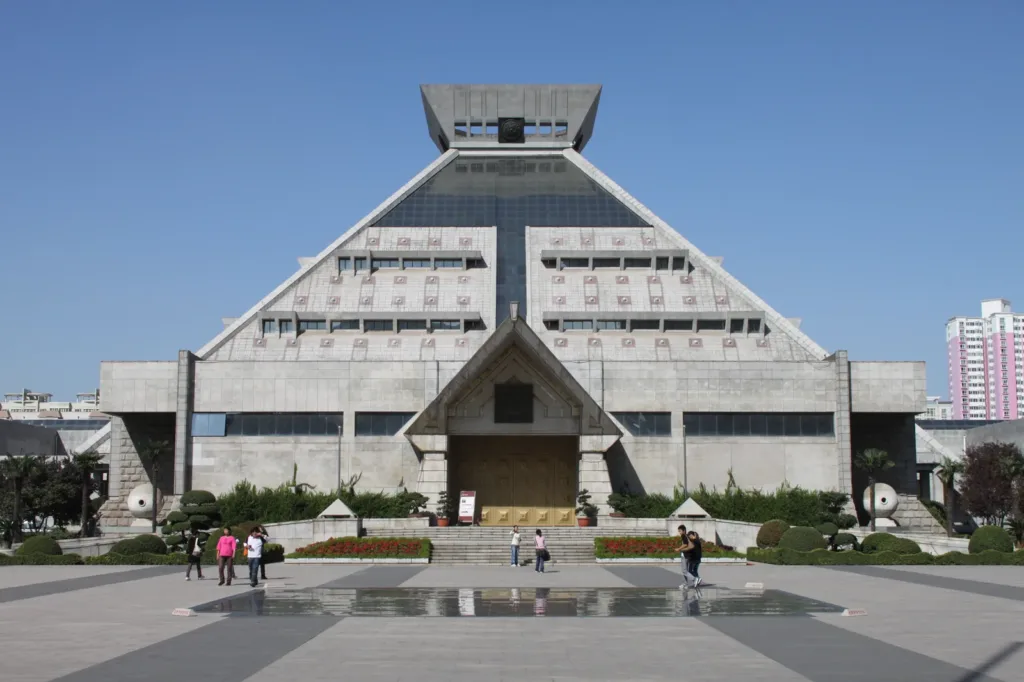 Henan Museum’s pyramid-shaped main exhibition hall and visitor entrance in Zhengzhou, photographed on 17 October 2009. Photo: Gary Todd · CC0 1.0
Henan Museum河南博物院
Henan Museum is Zhengzhou’s principal museum for the archaeology of the Central Plains: a chronological visit connects Neolithic craft, Shang and Zhou ritual bronzes, imperial-era objects and the later history of Henan in one large museum complex.
Read the place guide → The entrance facade of Dahecun Site Museum in Zhengzhou, photographed in November 2024. Photo: Windmemories · CC BY-SA 4.0
Zhengzhou Dahecun Site Museum郑州大河村遗址博物馆
An archaeological-site museum in Zhengzhou’s Jinshui District, where Yangshao painted pottery, a long settlement sequence and immersive interpretation make the Dahecun site legible to visitors.
Read the place guide →Plan your visit
Getting there
Jinshui District is about 3 km (straight-line distance) from central Zhengzhou. Search for 金水区 in a map app to find stations and your accommodation.
Where to stay →Build your route
Henan Museum and Zhengzhou Dahecun Site Museum are about 7 km apart (straight-line distance). The linked place guides have entrance and visit details.
Continue with Zhengzhou →More in Zhengzhou
Sources & geographic information
Administrative names and parent areas: Official geographic directory (dmfw.mca.gov.cn) · Reference date 2026-09-06.
Background text adapted from Jinshui, Zhengzhou — Wikipedia contributors, under CC BY-SA 4.0. Text has been shortened and reorganized; source revision 1366341871.
Map data © OpenStreetMap contributors. Pins mark approximate centres, not entrances or boundaries.
Image credits & notes (1)
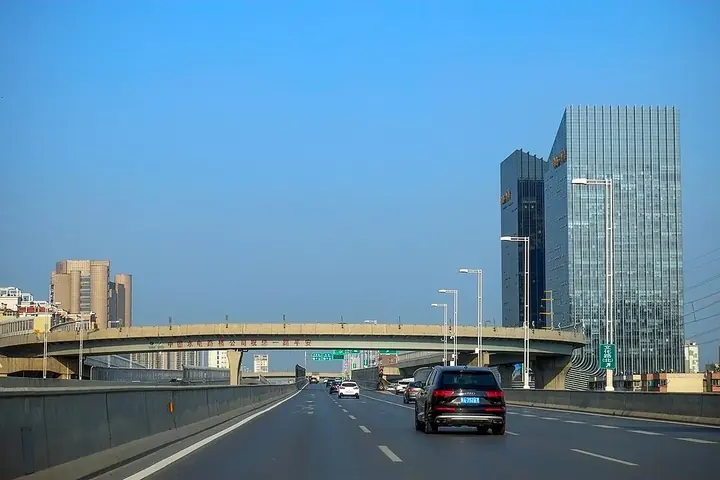
- North Third Ring Road in Jinshui District, Zhengzhou. Photograph date recorded by the source: 2020-05-01 17:22:49.Photo: Windmemories · CC BY-SA 4.0Resized for the web; the photo itself has not been edited. Thumbnails may show a cropped view.
