

Explore the region
Tap any red Chinese text to hear it in Mandarin.
In brief: A compact cemetery of brick-and-stone memorial pagodas west of Shaolin Temple, where changing forms, dates and inscriptions make the history of the Shaolin community visible.
The Pagoda Forest is on the foothill west of Shaolin Temple in Dengfeng City, within the wider Zhengzhou municipality—not in central Zhengzhou and not a synonym for all of Mount Song. The Zhengzhou municipal heritage register places the main forest about 300 metres west of the monastery and records 228 dated and undated brick-and-stone tomb pagodas from 791 to 1803, with another 15 pagodas around the monastery compound. It is part of the Shaolin Temple architectural complex in UNESCO’s Historic Monuments of Dengfeng in “The Centre of Heaven and Earth”, inscribed in 2010.
What to look for
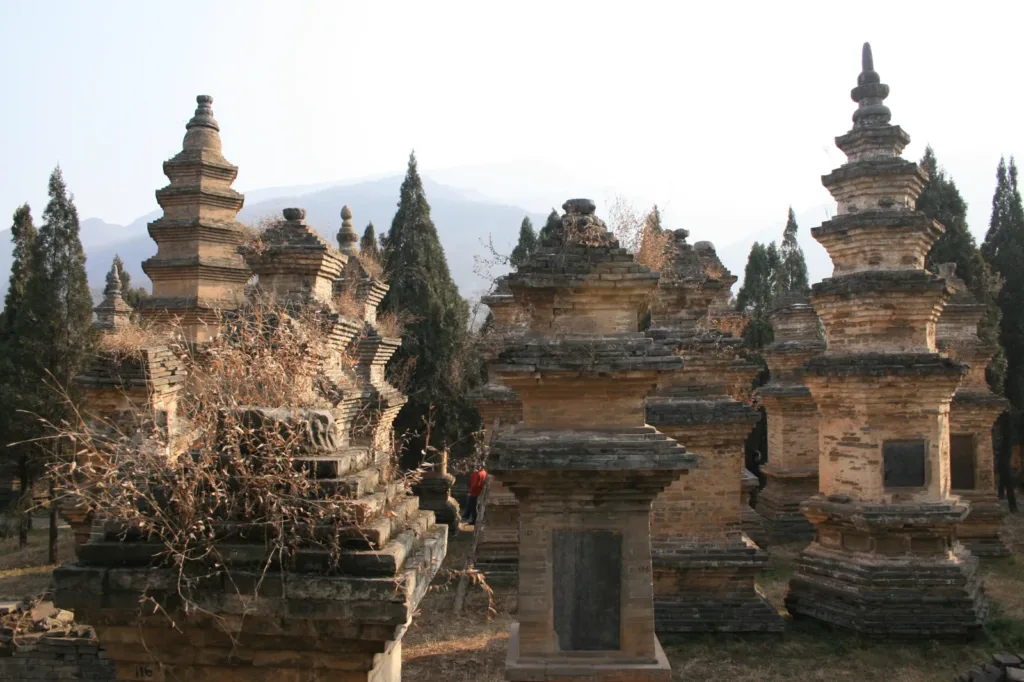
The name “forest” describes the density of the monuments. Start with the group as a landscape: notice how the towers gather at the foot of the mountain rather than forming one repeated architectural type. Then choose a few examples and compare their materials, profiles, number of tiers and carved or inscribed surfaces. The municipal description says the towers generally have one to seven tiers, remain below 15 metres and usually carry a tower inscription or other record.
These are memorial and burial monuments for generations of Shaolin monks. Their dates and inscriptions turn the visit into a readable record of a religious community, while the range of square, polygonal, cylindrical, conical and other forms shows how brick and stone building changed across dynasties. UNESCO describes the Shaolin complex as including a stone pagoda forest whose towers commemorate eminent monks and whose group reflects the development of tomb-pagoda styles over many centuries.
Give the site a quiet, close-looking visit rather than treating it as a backdrop for a quick photograph. Read what is legible from the path, compare one small tower with a taller or more elaborate neighbour, and keep clear of the monuments. The forest is a cemetery as well as a protected historic site: do not climb, touch carved surfaces, or enter areas marked off for conservation.
Planning the visit
Use the Chinese destination 少林寺塔林 Shàolínsì Tǎ Lín in your map app. The address to show locally is 河南省郑州市登封市嵩山少林风景区,少林寺常住院西约300米山脚下. The forest belongs to the Shaolin scenic-area visit, so do not plan it as an isolated roadside attraction or assume that its gate, ticket and opening hours are separate from the monastery’s arrangements.
Current entry details need a date-specific check. A 27 July 2025 notice carried by 21财经 reported that the operator planned online reservation and ticket purchase for the Shaolin Scenic Area from 31 July 2025; it said visitors using foreign passports or other non-mainland documents would reserve online and then take their documents to an on-site service window for verification and an entry credential. The report also says the original notice was later deleted, so this is historical operational evidence, not a promise of the 2026 workflow. In July 2026, the Dengfeng government said that the 漫游嵩山 Màn Yóu Sōng Shān mini-program was running and could be used to reserve a Shaolin Temple, Zhongyue Temple and Songyang Academy combined ticket, but that page does not publish a current passport-specific procedure or opening timetable.
Before setting out, check the current notices in the official 嵩山旅游 Sōng Shān Lǚ Yóu account or 漫游嵩山 Màn Yóu Sōng Shān mini-program, and confirm the exact admission product, opening window, foreign-passport entry steps and any temporary closure. Do not assume that a domestic-ID reservation flow accepts a passport, and do not carry a past seasonal schedule into a future trip. No future festival, night visit or seasonal performance is assumed here.
Getting there and back
From Zhengzhou, the Dengfeng municipal government lists the Zhengzhou–Shaoluo Expressway or S316 as road approaches to Dengfeng. From Dengfeng, its visitor guide directs travellers to the Dengfeng West Coach Station (登封西客车站) for a Dengfeng–Shaolin service (登封至少林班车), or west along G207 toward Shaolin. The guide does not give a current route number, timetable or last departure. Ask at the coach station for the day’s service and, before entering the scenic area, confirm the next 少林—登封 Shàolín — Dēng Fēng return option rather than assuming that a late bus will be available.
For a taxi or ride-hail, show 少林寺塔林 Shàolínsì Tǎ Lín and the full Chinese scenic-area address, then confirm the current visitor drop-off and pick-up point. Amap’s name search is useful for matching the destination, but a map result is not proof of an entrance. There is no metro step to the forest in the official route information reviewed; the practical public-transport plan is a road transfer to Dengfeng followed by the Dengfeng–Shaolin leg. Keep the Chinese name saved for the return journey.
What to eat after the visit
Food around a mountain scenic area changes by day and season, so search by dish rather than accepting a ranked restaurant list. Three useful Chinese search terms are:
- 登封焦盖烧饼(芝麻盖烧饼) — a wheat-flour flatbread with a sesame-covered, crisp browned top and a softer interior. CCTV identifies 焦盖烧饼 as a Zhengzhou intangible-cultural-heritage project, while a Henan tourism feature describes the sesame crust and tender layers.
- 烩羊肉 Huì Yáng Ròu — mutton served in a hot, savoury broth. Ask whether a flatbread is served alongside, and note that this is a substantial meat dish, not a vegetarian option.
- 登封烩面 Dēng Fēng Huì Miàn — broad wheat noodles in a rich soup. The related 登封刀削面 Dēng Fēng Dāoxiāomiàn or 椒炒刀削面 Jiāo Chǎo Dāoxiāomiàn uses sliced noodles and a more heavily seasoned, sometimes hot version; ask about chilli before ordering.
In Meituan (美团) or Amap/Gaode Maps (高德地图), paste the Chinese dish name, set the search area near your accommodation or the route back from Shaolin, and inspect several current results without treating platform order as a recommendation. Open each menu to confirm that the dish is actually listed; check recent reviews for current supply, the latest opening hours and whether a seasonal or limited item is available. Ask about lamb, wheat, sesame, chilli and other allergens, and do not infer that a dish is vegetarian from a temple-related name.
Combine your visit
A suggested sequence linking the specific features of this visit.
-
Pagoda Forest overview
See how the towers form a memorial landscape before concentrating on details.
-
Tower inscriptions and profiles
Compare selected examples from the designated visitor route.
-
Shaolin Temple少林寺
Relate the monks’ memorials to the community’s working religious buildings.
This order is editorial. Confirm access and any transfers between stops; it does not establish a walking route, same-day connection or common admission ticket.
Find Pagoda Forest at Shaolin Temple
少林寺塔林 · 郑州市
The pin marks the area, not the entrance.
More places nearby
Approximate straight-line distances between map pins, not travel distances.
Shaolin Temple 少林寺
Less than 1 km awayShaolin Temple occupies the foot of Wuru Peak in the Songshan range. Beyond its martial-arts reputation, the visit follows a monastic axis of gates and halls, with buildings from different periods and later reconstructions…
View guide →Mount Song 嵩山
4 km awaySongshan is a mountain range with distinct Taishi and Shaoshi sectors, rather than one summit path. Its exposed rock sequences are important to geology, while temples and academies occupy the lower slopes. Shaolin belongs to the…
View guide →Zhongyue Temple 中岳庙
13 km awayZhongyue Temple lies below the eastern side of Taishi Mountain at Dengfeng. It is a Taoist temple associated with the sacred Central Mountain and imperial mountain worship.
View guide →Sources & visit information
Sources checked on 31 October 2026. Hours, tickets, reservations and transport can change; confirm with the operator before you go.
Image credits & notes (1)
- Wide view of Shaolin's Pagoda Forest in Dengfeng, with clustered memorial pagodas and the Songshan foothills behind them. Photo: Gary Lee Todd, Ph.D. (Gary Todd)Photo: CC0 1.0