

Explore the region
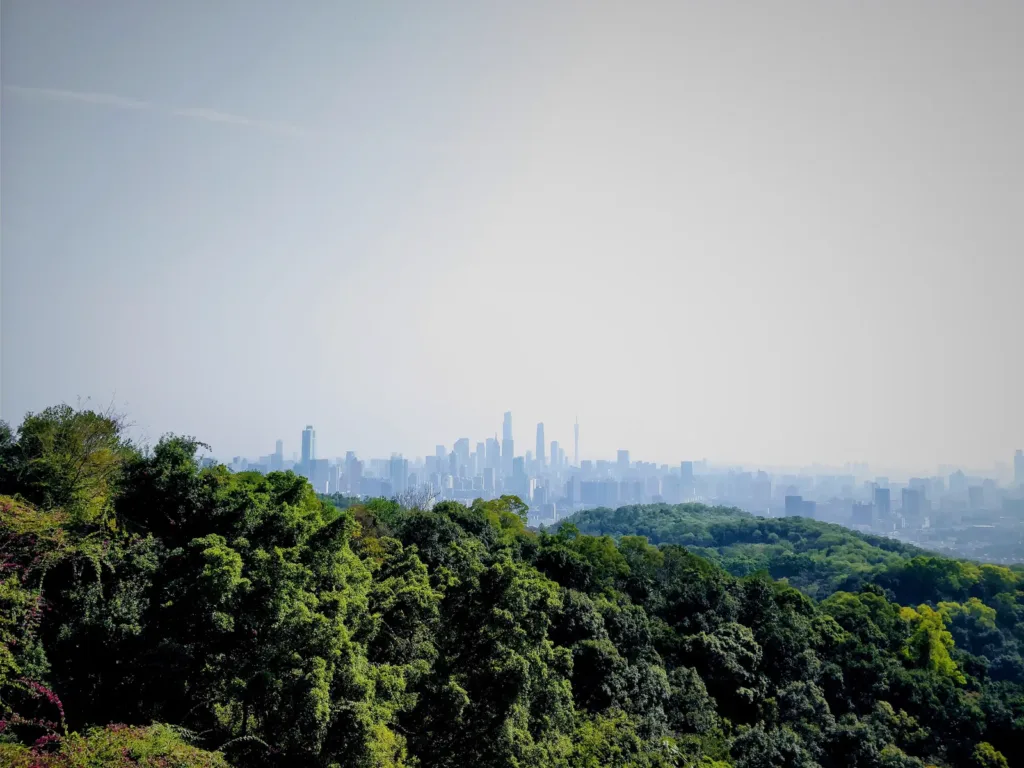
Baiyun Mountain is a scenic area rather than a single lookout: its chain of more than 30 hills includes Moxing Ridge, whose summit reaches 382 metres. On clear days, higher viewpoints look across Guangzhou toward the Pearl River. The landscape of ridges, streams and planted slopes makes this a different outing from the formal gardens at its foot.
Choose a southern approach
For a garden-focused visit, begin at Yuntai Garden (云台花园), on the mountain’s southern San Tai Ling area. The garden is laid out around ornamental plants valued across the seasons; take time to look at how planted beds and designed garden views shape the visit before deciding whether to continue uphill.
If you want a mountain walk, use the South Gate (南门) and follow the signed southern route. The scenic-area operator’s South Gate visitor-vehicle route lists Nengren Temple (能仁寺), the “First Peak in South China” area and the summit-park area among its stops and sights. Treat the temple and the higher viewpoints as successive parts of a hillside visit, not as a guaranteed walking-time itinerary; choose how far to go according to conditions and energy.
Moxing Ridge (摩星岭) is the mountain’s highest peak. The broader area also includes Mingchun Valley (鸣春谷), a large natural-style aviary described by Guangzhou’s municipal tourism page, and the summit-park area. Check which individual areas you intend to enter rather than assuming every named attraction has the same access arrangements.
Getting there and back
Take Guangzhou Metro Line 11 to Yuntai Garden (云台花园) for the South Gate/Yuntai Garden approach. The scenic-area operator lists that station for the South Gate area; the metro line began initial operation in December 2024. Follow station signs for the garden and South Gate, and do not assume an exit number or a precise walking time. For the West Gate (西门), use a separate approach; it serves a different part of the mountain. Return to Yuntai Garden station from the southern approach and check live metro service information for your travel time.
For a taxi or ride-hailing car, set the destination as 白云山南门(云台花园). The official English visitor page gives the general location as Guangyuan Central Road, Baiyun District, Guangzhou, without a street number; confirm that the driver is taking you to the South Gate, not the West Gate.
The mountain route involves uphill terrain, so allow time for the climb and changing weather. The operator lists internal sightseeing vehicles and a cableway, but their current operation can change; check the scenic area’s latest notices before relying on either service.
Combine your visit
Suggested order for the visit:
-
Yuntai Garden
Start with the glasshouse and themed planting areas if included in your visit.
-
Nengren Temple
Continue on the signed southern mountain route.
-
Summit park
Add the uphill park circuit in suitable conditions.
This is an editorial sequence of named spaces or places. It does not imply a verified walking connection or promise opening, ticket availability or a journey time.
Find Baiyun Mountain (Guangdong)
白云山 · 广州市
The pin marks the area, not the entrance.
More places nearby
Approximate straight-line distances between map pins, not travel distances.
Yuexiu Park 越秀公园
6 km awayYuexiu Park spreads over the hills that once marked the northern edge of Guangzhou’s walled city. It combines wooded slopes and lakes with landmarks that explain the old city, including the Five Rams sculpture and Zhenhai Tower…
View guide →Museum of the Mausoleum of the Nanyue King 南越王博物院
7 km awayThis museum preserves the excavated tomb of Zhao Mo, a ruler of the Nanyue kingdom during the Western Han period. The burial chamber lies beneath Elephant Hill and is divided into a front chamber, side rooms, a coffin chamber…
View guide →Chen Clan Ancestral Hall 陈家祠
8 km awayThe Chen Clan Ancestral Hall was built by related Chen families as a place for education and preparation for the imperial examinations. Its southern-facing complex is arranged along a north–south axis, with halls and courtyards…
View guide →Sources & visit information
Sources checked on 22 October 2026. Hours, tickets, reservations and transport can change; confirm with the operator before you go.
Image credits & notes (1)
- Wooded ridges of Baiyun Mountain frame Guangzhou's skyline on a hazy day. Photo: StephenLauQTPhoto: CC BY-SA 4.0