


Get to know Baiyun District
- Administrative area
- District · 市辖区
- Part of
- Guangzhou
- Chinese name
- 白云区
- Local areas
- District guide
Area & population
- Area
- 825.00 km²
- Population · 2020 census
- 3,742,991
Source: English Wikipedia, as of the dates shown.
How the district fits into a Guangzhou visit
Baiyun is a large, varied district rather than a single attraction or a walkable extension of central Guangzhou. A useful broad orientation is the district government’s “east hills, west water, south city, north airport” frame. It describes a planning pattern, not a ready-made visitor route.
The terrain changes across the district: hills cluster around Baiyun Mountain and farther east near Taihe, while flatter river and delta landscapes lie toward the south and southwest. This makes it more practical to choose one area for a half-day or day than to try to “see Baiyun” in one sweep.
Pick a cluster
For a mountain-focused visit, use Baiyun Mountain as its own outing. Yuntai Garden (云台花园) has a metro station on Line 11 and was described by Guangzhou’s government as a convenient approach for visitors heading to the mountain. Allow the walk itself to set the pace; this is a hill visit, not a quick stop between distant district sites.
For a greener, more outlying day, consider Maofeng Mountain in eastern Baiyun. It is a separate mountain landscape, not another entrance to Baiyun Mountain. The district’s landform guide describes a network of hills and reservoirs there, so plan it as a distinct excursion rather than combining both mountains on foot. The government also identifies Baiyun Lake and the Liuxi River among the district’s ecological assets; they belong to different parts of a broad district and should be planned as separate stops.
For an urban visit, use the southern and central parts of Baiyun as a base for city-facing places and services. The district’s current development plan identifies Baiyun New Town and Baiyun Lake Digital Technology City among its major southern platforms, while its wider spatial strategy also includes northern airport-oriented areas. Treat these as different neighborhoods, not one compact sightseeing zone.
Getting around
Guangzhou Metro Line 11 is an operating loop line. Yuntai Garden (云台花园) is a useful station name for a Baiyun Mountain outing; check the live metro map for the current direction and any transfers from your starting point. Guangzhou’s government reported Line 8 as a transfer option for a return journey in its opening-day coverage, but that report does not verify today’s best exit or mountain entrance.
The district includes two different intercity gateways: Guangzhou Baiyun International Airport and Guangzhou Baiyun Railway Station. They serve air and rail travel respectively; do not treat them as interchangeable or assume that arrival at either puts you near a chosen attraction. For a taxi or ride-hail, enter the exact Chinese name of the specific destination, not just “Baiyun District” (白云区). The district has no single visitor drop-off point.
A simple way to plan
Choose one anchor—Baiyun Mountain, Maofeng Mountain, a Baiyun Lake-area visit, or an urban district stop—then check its own current access and return route. Add a second stop only if it lies in the same part of Baiyun. For another day, pair a central Guangzhou neighborhood with a single Baiyun excursion rather than crossing the district repeatedly.
Explore Baiyun District
Core places to explore, with English and Chinese names.
Places to explore around Baiyun District
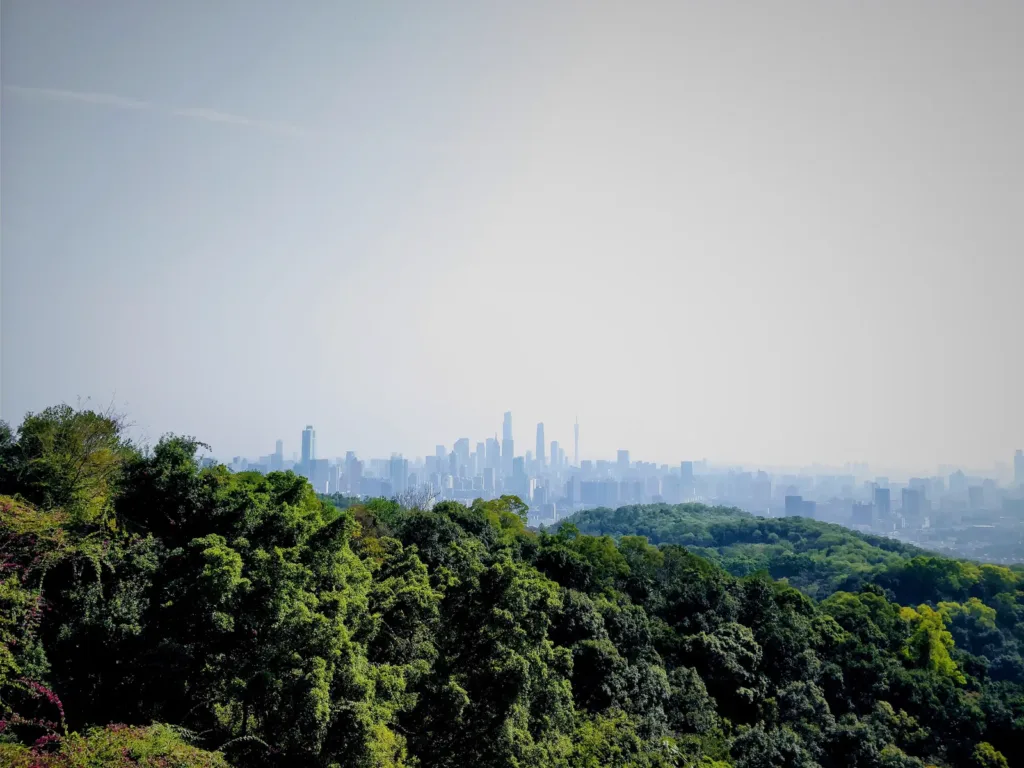 Wooded ridges of Baiyun Mountain frame Guangzhou's skyline on a hazy day. Photo: StephenLauQT · CC BY-SA 4.0
Plan your visit
Getting there
Baiyun District is about 3 km (straight-line distance) from central Guangzhou. Search for 白云区 in a map app to find stations and your accommodation.
Where to stay →Build your route
Start with Baiyun Mountain (Guangdong). The linked place guides have entrance and visit details.
Continue with Guangzhou →More in Guangzhou
Sources & geographic information
Administrative names and parent areas: Official geographic directory (dmfw.mca.gov.cn) · Reference date 2026-09-06.
Background text adapted from Baiyun, Guangzhou — Wikipedia contributors, under CC BY-SA 4.0. Text has been shortened and reorganized; source revision 1353051661.
Map data © OpenStreetMap contributors. Pins mark approximate centres, not entrances or boundaries.
Image credits & notes (1)
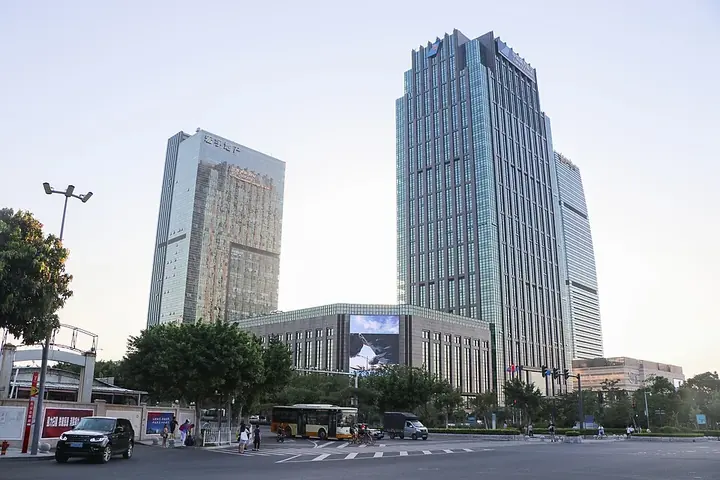
- China Southern Airlines headquarters in Baiyun District, Guangzhou. Photograph date recorded by the source: 2018-10-04 17:30:54.Photo: Nissangeniss · CC BY-SA 4.0Resized for the web; the photo itself has not been edited. Thumbnails may show a cropped view.
