

Explore the region
Seven Star Park takes its name from seven karst peaks arranged across Putuo Mountain and Crescent Mountain, traditionally likened to the Big Dipper. Rather than treating it as one viewpoint, explore it as a sequence of landscapes: a waterside bridge, wooded hill paths, a cave within the limestone and a collection of inscriptions carved into the rock. The combination makes the park a compact introduction to Guilin’s city-side karst scenery and cultural history.
What to see and how to explore
Begin at Flower Bridge (花桥), a stone-arched crossing at the meeting of local waterways. The bridge’s arches and their reflection are the point to pause for; its present four-arch form was rebuilt in 1965 in the earlier style, so it is better understood as a historic design kept alive in a later structure than as untouched medieval masonry. The celebrated “Flower Bridge rainbow reflection” depends on the water and light, and is not guaranteed in every visit.
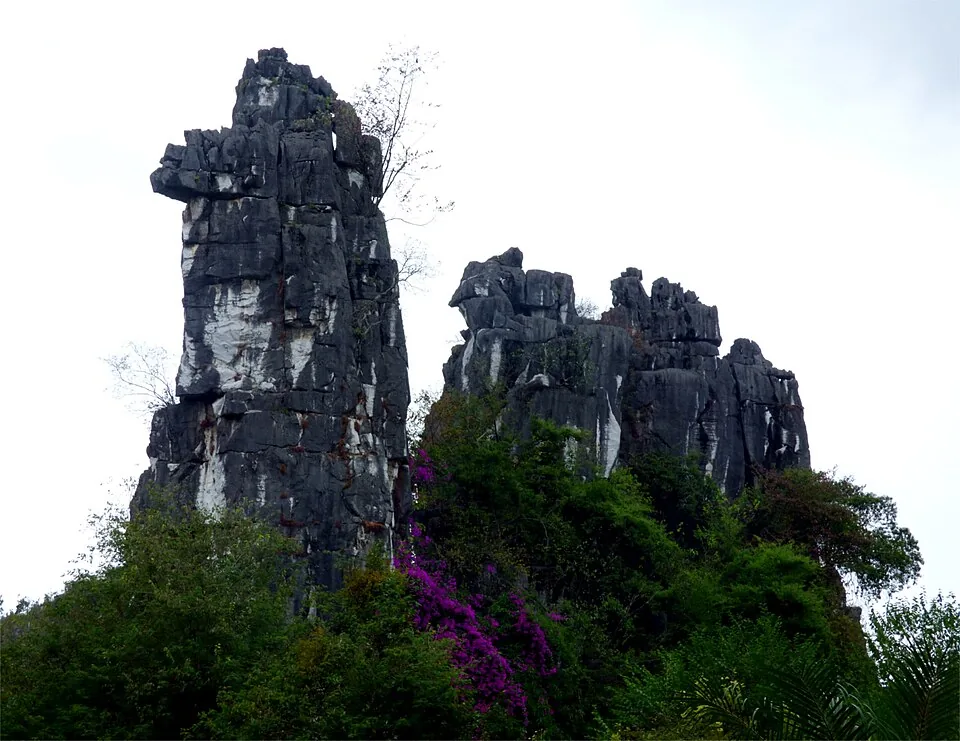
From the bridge, choose a hill walk that suits your time and energy. Putuo Mountain (普陀山) has stone paths, shaded pavilions and views back across the city. Its limestone rises from the green park canopy, making the relation between Guilin’s urban streets and its distinctive karst outcrops easy to see. Camel Hill (骆驼山) is a separate, recognizable rock profile deeper in the park; look at its outline from the open lawns rather than expecting a single fixed viewpoint. The seven peaks are grouped between Putuo and Crescent mountains, not seven unrelated park attractions.
Seven Star Cave (七星岩), also called Qixia Cave (栖霞洞), is a natural limestone cave in Putuo Mountain. Rainwater dissolves limestone and, over long periods, mineral-rich water deposits calcite forms such as stalactites, stalagmites, columns and draperies. The visitor route is through the middle level; colored lighting picks out the formations, so notice their shapes and textures as well as the illumination. Cave access is a separate attraction within the park and can have its own admission or operating arrangements. Check the current park booking notice before planning around it.
On the park’s southwest side, Guihai Stele Forest (桂海碑林) brings together inscriptions on Longyin Rock and in Longyin Cave. Poems, records and other carved writing turn the limestone surface into a historical text as well as a natural feature. Give yourself time to look closely at the calligraphy and its different scripts, rather than treating the site as a quick photo stop. It is a distinct named cultural area inside the wider park, not a separate similarly named park.
A simple visit can focus on Flower Bridge and the nearby park paths. If you have more time and the relevant facilities are open, add the cave, the hill paths or the stele area. These are suggested areas to explore, not a guaranteed continuous route; gates, slopes and separately ticketed interiors may affect what is accessible on your day.
A glimpse of everyday Guilin
The park is also used by Guilin residents for ordinary leisure. In the morning you may see people walking, exercising, practising tai chi or dancing in shared spaces; these are observations, not scheduled shows, and no particular activity or time is guaranteed. Watch from the side, keep paths clear, and ask before photographing identifiable people. Give groups and private conversations room, and do not photograph personal papers or close-up portraits without permission.
Getting there
Guilin has no operating urban metro, so there is no metro line or station to use for this visit. City bus is the practical public-transport option. Bus 11 runs to the stop named 七星公园 and its route follows 自由路 (Ziyou Road) to that terminus; the current visitor listing also shows Line 11 serving the Flower Bridge Gate. From the stop, follow signs for the park’s main/Flower Bridge entrance (正门 / 花桥大门).
Other bus routes are listed for the different gates: Lines 10, 14, 18, 25, 30 and 31 for Flower Bridge Gate; Lines 14, 25, 28, 30 and 31 for the east-side Camel Hill Gate; Lines 10 and 24 for Qixia Gate; and Lines 14, 25, 28, 30 and 31 for Longyin Gate. Routes and nearby stops can change; check the destination and direction shown on the bus on the day, and choose a gate for the area you intend to visit. No exact walking time from each stop is stated here.
For a taxi or ride-hail, show the driver 七星公园正门(花桥大门),桂林市七星区自由路. The listed street address for the park is 桂林市七星区七星路1号; it identifies the venue, not a verified curbside drop-off point. Ask to be let out only at a lawful public stopping area by the entrance approach, not in a bus lane or across a gate.
A current visitor listing gives seasonal park entry hours of 06:30–21:00 from 1 April through 31 October and 07:00–21:00 from 1 November through 31 March, with last entry at 21:00. The same listing says advance booking is needed through the scenic area’s WeChat service. These are third-party listing details, not a park notice independently confirmed here; verify the official account and day-of opening before travel. The cave and other paid attractions may follow separate access rules. No current standard price is stated here.
Combine your visit
Suggested order for the visit:
-
Flower Bridge
Start with the stone-arch crossing.
-
Camel Hill
Continue to the distinct limestone silhouette.
-
Guihai inscriptions
Finish with the rock-carving collection if its entry is available.
This is an editorial sequence of named spaces or places. It does not imply a verified walking connection or promise opening, ticket availability or a journey time.
Find Seven Star Park
七星公园 · 七星区
The pin marks the area, not the entrance.
More places nearby
Approximate straight-line distances between map pins, not travel distances.
Guihai Stele Forest Museum 桂海碑林博物馆
Less than 1 km awayGuihai’s inscriptions are part of the limestone landscape around Longyin Rock and Longyin Cave, on the southwestern side of Seven Star Park. The carved texts include poems, names and political writing, turning the rock face into…
View guide →Xiaoyao Tower 逍遥楼
1 km awayXiaoyao Tower is a modern reconstruction of a historic Guilin landmark beside the Li River. Its two storeys and three eave levels give the pavilion a layered roofline, with rows of columns below and a surrounding upper gallery…
View guide →Sun and Moon Pagodas 日月双塔
1 km awayThe Sun and Moon Pagodas rise from Shan Lake in central Guilin as a paired waterside landmark. Both have octagonal plans, but their finishes and proportions differ: the Sun Pagoda is faced in bronze, while the Moon Pagoda uses…
View guide →Sources & visit information
Sources checked on 21 October 2026. Hours, tickets, reservations and transport can change; confirm with the operator before you go.
Image credits & notes (1)
- Camel Hill in Seven Star Park, Guilin. Photo: 2016-11-01 09:21:04.Photo: Rcdewiki · CC BY-SA 4.0Resized for the web; the photo itself has not been edited.
