

Explore the region
A landmark rebuilt beside the river
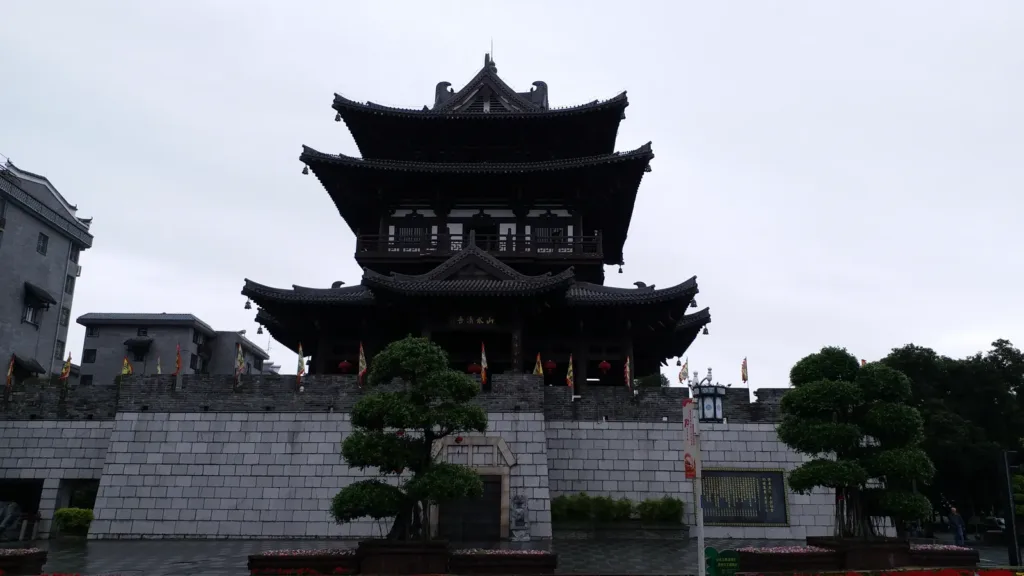
Xiaoyao Tower was a historic tower associated with Guilin’s old eastern city wall. The surviving record and the Tang poet Song Zhiwen’s poem of 711 place the tower in Guilin’s early history, but the exact original form and foundation are not certain. The building visitors see today is a modern reconstruction completed beside Jiefang Bridge in 2016, on a riverside plaza near—not precisely on—the former site. It is a two-storey pavilion with three tiers of eaves, a columned lower level and an upper gallery.
Approach from the public riverside platform and look first at the roofline and the large supporting columns. If the upper floor is open, walk around its gallery for views over the Li River toward the Qixing and Putuo hills. The setting is as important as the structure: the bridge, riverbank and nearby historic quarter show how the tower sits within Guilin’s compact old centre.
A stone inscription bearing the name “Xiaoyao Tower” is associated with the reconstructed landmark. Accounts of the inscription’s attribution and of its relationship to the separately named Xiangnan Tower are debated. Treat the stele as an object with a layered local history, rather than assuming its authorship or the old tower’s exact appearance is settled.
Getting there
Guilin has no metro stop serving this riverside area. A local Guilin bus guide lists route 10 and sightseeing loops 1 and 2 at Jiefang Bridge (解放桥). Get off at that stop, walk toward the bridgehead, then follow the riverside promenade signs onto the pavilion’s public plaza. Check the current city-bus notice before setting out, especially for the sightseeing loops.
A Guilin-themed osmanthus bus trial route announced in September 2026 also lists a stop at Jiefang Bridge (East–West Alley / 桂花公社 / 王城历史文化街区). Treat it as a temporary option, not a dependable daily service, unless the operator confirms it is running on your date.
For a taxi or ride-hail, enter 逍遥楼,桂林市秀峰区滨江路北段、解放桥桥头滨水生态广场 as the destination. Ask to be set down at the nearest lawful curb on Binjiang Road and walk to the platform; do not stop on the bridge. No separately marked attraction taxi bay was confirmed. The current visitor listing describes free entry, but reliable current hours and day-to-day access to the upper gallery were not confirmed. Check the entrance notice; if the building is closed, the exterior and riverside setting remain viewable from the public approach.
Combine your visit
Suggested order for the visit:
-
Riverside frontage
See the pavilion’s columns and layered eaves.
-
Upper gallery, when open
Look across the Li River and eastern hills.
-
Xiaoyao stele
Compare the older inscribed object with the reconstructed building.
This is an editorial sequence of named spaces or places. It does not imply a verified walking connection or promise opening, ticket availability or a journey time.
Find Xiaoyao Tower
逍遥楼 · 秀峰区
The pin marks the area, not the entrance.
More places nearby
Approximate straight-line distances between map pins, not travel distances.
East–West Alley 东西巷
Less than 1 km awayEast-West Alley is a restored commercial quarter beside the Jingjiang palace walls. Its three principal lanes—Zhengyang East Alley, Jiangnan Alley and Lanjing Alley—give the area a finer grain than the main roads around it. Old…
View guide →Jingjiang Princes' Palace 靖江王府
Less than 1 km awayJingjiang Princes' Palace and Jingjiang Prince City refer to the same historic royal complex in central Guilin, with Solitary Beauty Peak rising inside its grounds. The Ming princely seat combines an enclosed palace layout with…
View guide →Duxiu Peak 独秀峰
Less than 1 km awayDuxiu Peak rises abruptly inside the Jingjiang palace enclosure, creating a limestone landmark in the middle of Guilin. A stair route climbs towards the summit pavilion and city views, while the rock at its base preserves…
View guide →Sources & visit information
Sources checked on 21 October 2026. Hours, tickets, reservations and transport can change; confirm with the operator before you go.
Image credits & notes (1)
- Xiaoyao Tower viewed from its riverside plaza in Guilin. Photo: 神樂坂秀吉Photo: CC0 1.0