

Photo adjustments
Resized and WebP compressed; subject not altered.
Explore the region
About Ciyun Temple
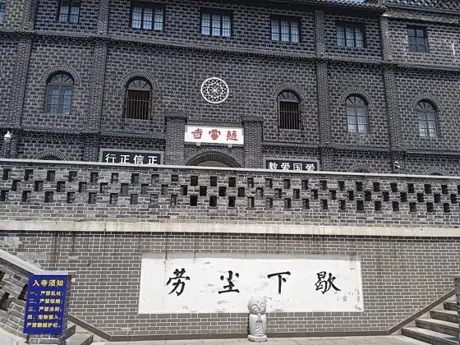
Its succession of Buddhist halls includes the Heavenly Kings Hall, Mahavira Hall and shrines devoted to Guanyin, Manjushri and Samantabhadra. Groups of arhat figures add smaller details to the main religious images. Move from the entrance towards the principal hall, then compare one of the subsidiary halls; this reveals the temple’s varied devotional spaces without treating it as a single facade.
The original temple on the site dates back to the Tang dynasty (618-907). The present temple was founded in 1757, during the Qianlong era of the Qing dynasty, and was first called the Temple of Guanyin (观音庙). It was enlarged in 1927 by the Chan master Yunyan (云岩) and later took the name Ciyun Temple. It was designated a National Key Buddhist Temple in Han Chinese Area by the State Council in 1983, and the whole temple complex underwent a modern restoration in April 2016.
Most of the temple's halls and rooms still keep the architectural style of the Tang dynasty. Its main hall, the Mahavira Hall, enshrines a jade statue of Sakyamuni 1.87 metres high and weighing 1,500 kilograms, bought from Myanmar in 1931; it is one of the four largest jade statues of Sakyamuni in China.
What to look for
- The Mahavira Hall provides the principal architectural and devotional focus.
- The Guanyin, Manjushri and Samantabhadra halls present distinct groups of Buddhist images.
Location & getting there
Getting to Ciyun Temple
Approach from Nanbin Road near Xuantanmiao, then follow the temple entrance at the foot of Lion Hill in Nan’an district.
Combine your visit
Suggested order for the visit:
-
Shanmen and Heavenly Kings Hall
Enter through the temple’s formal approach.
-
Mahavira Hall
Observe the main devotional space.
-
One subsidiary hall
Compare its images with the principal hall.
This is an editorial sequence of named spaces or places. It does not imply a verified walking connection or promise opening, ticket availability or a journey time.
Find Ciyun Temple
慈云寺 · 南岸
The pin marks the area, not the entrance.
More places nearby
Approximate straight-line distances between map pins, not travel distances.
Chaotianmen 朝天门
2 km awayChaotianmen marks the meeting of the Yangtze and Jialing rivers at the end of the Yuzhong peninsula. The public square gives an open view of waterborne traffic and the banks facing the city, including the Grand Theatre. Raffles…
View guide →Nanshan 南山
2 km awayNanshan is a group of wooded hills and visitor areas on Chongqing’s southern side, rather than one summit attraction. The One Tree viewing area looks back towards the layered city, while Nanshan Botanical Garden offers…
View guide →Raffles City Chongqing 重庆来福士
2 km awayRaffles City occupies the tip of Chongqing’s Yuzhong peninsula where the Jialing meets the Yangtze. Eight towers rise above the waterfront, with the long glass-covered Crystal spanning four of them. Moshe Safdie’s design draws…
View guide →Sources & visit information
The sources below support the place-specific description and arrival information. Suggested combinations are editorial planning ideas; confirm current opening, entry arrangements and transport services for your date.
- Ciyun Temple (Chongqing) ↗
- Chongqing Science and Technology Daily: Ciyun Temple ↗
- English Wikipedia: Ciyun Temple (Chongqing) (revision 1368260420, 2026-08-08) ↗
Visitor information adapted and edited from Wikipedia contributors, “Ciyun Temple (Chongqing)” · CC BY-SA 4.0. Source revision 1368260420.
Background paragraphs condensed from Wikipedia contributors, "Ciyun Temple (Chongqing)", English Wikipedia · CC BY-SA 4.0. Source revision 1368260420.