

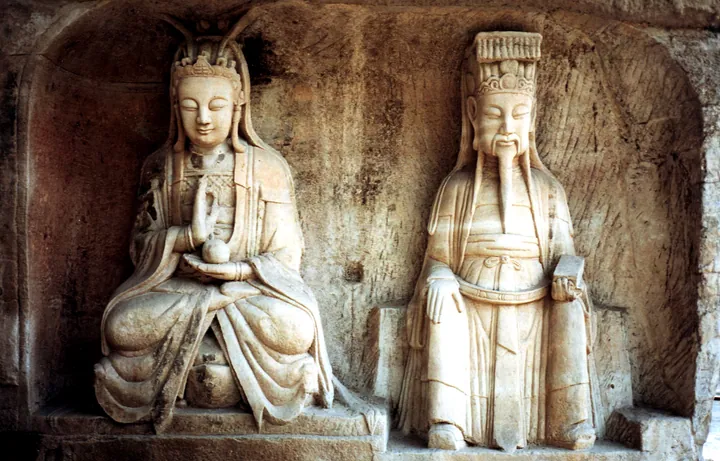
Photo adjustments
Full frame retained; proportionally resized and converted to WebP. No retouching or changes to the photographed subject. Card displays may crop the view.
Explore the region
About Dazu Baodingshan carvings
Large devotional images alternate with scenes about conduct, suffering and spiritual practice. The reclining Buddha, Thousand-Armed Guanyin and ox-herding sequence show the range of scale and subject. Begin with the museum interpretation, then take time with a few complete scenes instead of treating the entire carved valley as one photographic backdrop.
Baodingshan's carvings were made chiefly during the Southern Song dynasty (1127-1279), constructed within about 70 years under the supervision of one man, Zhao Zhifeng. The site remained largely unknown outside the area afterward; the earliest documented research on it dates to 1944, and it was not reopened to the public until the 1980s. It lies on a limestone outcrop at an elevation of 500 metres, 15 kilometres north of the centre of Dazu District. Baodingshan forms part of the Dazu Rock Carvings, which were inscribed on the World Heritage List in 1999.
The site consists of two main parts joined by a temple, Shengshousi (圣寿寺); it holds more than 6,000 carvings across a mile and a half, representing a range of Buddhist schools of thought, including Huayan, Chan, Pure Land and Esoteric Buddhism, together with extensive carved Buddhist texts. Unlike cave sites such as Dunhuang and Yungang, Baodingshan has no caves or cave-like niches for its statues; at Great Buddha Bend the carved tableaux instead follow the natural curve of the rock, with reliefs as large as 26 feet high by 66 feet wide.
What to look for
- The reclining Buddha and Thousand-Armed Guanyin are major devotional images.
- The ox-herding sequence uses linked scenes to express Buddhist practice.
Location & getting there
Getting to Dazu Baodingshan carvings
Use the Dazu Rock Carvings Visitor Centre and its managed uphill transport to Baodingshan. The institute’s published route continues through the museum to Dafowan, or Great Buddha Bend, before returning through the designated exit.
Combine your visit
Suggested order for the visit:
-
Dazu Rock Carvings Museum
Learn the main subjects and conservation context.
-
Great Buddha Bend
Follow the connected reliefs.
-
Ox-herding scenes
Pause to read one narrative sequence closely.
This is an editorial sequence of named spaces or places. It does not imply a verified walking connection or promise opening, ticket availability or a journey time.
Find Dazu Baodingshan carvings
大足宝顶山石刻 · 大足
The pin marks the area, not the entrance.
More places nearby
Approximate straight-line distances between map pins, not travel distances.
Dazu Rock Carvings 大足石刻
11 km awayThe Dazu Rock Carvings are a group of separate hillside sites, where Buddhist, Daoist and Confucian imagery appears alongside scenes of ordinary life. At Baodingshan, a long sequence of reliefs follows a curved valley; Beishan…
View guide →Wanling Ancient Town 万灵古镇
33 km awayWanling, formerly Lukong, steps down towards the Laixi River through a stone-paved trading street. Its immigrant associations are visible in Huguang Guild Hall, where a shrine, meeting rooms and a stage served newcomers from…
View guide →Anju Ancient Town 安居古城
34 km awayAnju’s stepped streets preserve the outline of a small riverside trading town. Xinghui Gate leads into Huoshenmiao Street, where stone paving and wooden shopfronts establish the scale of the old settlement. Huguang Guild Hall…
View guide →Sources & visit information
The sources below support the place-specific description and arrival information. Suggested combinations are editorial planning ideas; confirm current opening, entry arrangements and transport services for your date.
- Mount Baoding Buddhist Sculptures ↗
- Dazu Rock Carvings Research Institute: visitor route ↗
- English Wikipedia: Mount Baoding Buddhist Sculptures (revision 1337590728, 2026-02-10) ↗
Visitor information adapted and edited from Wikipedia contributors, “Mount Baoding Buddhist Sculptures” · CC BY-SA 4.0. Source revision 1337590728.
Background paragraphs condensed from Wikipedia contributors, "Mount Baoding Buddhist Sculptures", English Wikipedia · CC BY-SA 4.0. Source revision 1337590728.