

Explore the region
Tap any red Chinese text to hear it in Mandarin.
Explore the old town
Anju Ancient Town (安居古城) is in Anju Town, Tongliang District, within Chongqing Municipality. It is a distinct historic settlement and visitor area, not the unrelated Huguang Guild Hall in central Chongqing. Its identity grew from its position beside the Qiong and Fu rivers: Anju became a northern Chongqing port town, while its streets climbed the surrounding slopes.
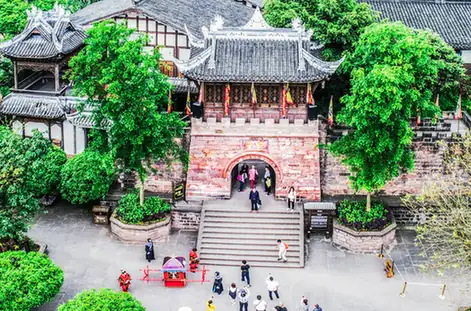
Begin at the visitor reception area below Xinghui Gate (星辉门). The approach rises through the stone gateway into Huoshenmiao Street (火神庙街), so expect steps and changing levels rather than a flat promenade. From there, take time to notice the close-set shopfronts and upper-floor homes, then continue toward Huguang Guild Hall (湖广会馆), West Street (西街) and the Qiong River edge. This sequence connects the old settlement’s gate, commercial lanes, communal architecture and former wharf landscape.
At the guild hall, look for the courtyard arrangement and its theatrical stage, signs of the associations that supported communities and trade. Across the core, temples and halls such as the Town God Temple (城隍庙), Wanshou Palace (万寿宫) and Mazu Temple (妈祖庙) show different religious and architectural traditions; several historic buildings remain preserved, though not every structure is necessarily open to enter.
The town is best explored slowly, pausing to read the slope, lanes and river together rather than treating each building as an isolated photo stop. Anju’s long-standing residential and commercial character is part of the experience: keep voices low in narrow lanes, do not enter private courtyards or photograph residents at close range without permission, and be especially considerate around doorways and homes.
The river was central to Anju’s historic port life. The waterfront and old wharf setting are worth seeking out, but do not assume a regular sightseeing boat is operating: a current public sailing schedule was not confirmed. Seasonal dragon-boat festivals, folk performances and other cultural programs have been documented, but they are event-based, not a guaranteed daily timetable.
Getting there
Anju is in outlying Tongliang District, well beyond central Chongqing. From the central city, take Chongqing Rail Transit Line 1 to Bishan (璧山), transfer inside Bishan Station to the Bishan–Tongliang suburban railway (璧铜线), and ride to Tongliang West (铜梁西). From Tongliang’s urban area, local bus 302 serves Anju; a current route listing gives its endpoints as Tongliang South Bus Station (铜梁汽车南站) and Anju Quanxi Bridge (安居泉溪大桥). The 2026 Tongliang transport guide also names route 302 for travel to Anju Ancient Town. The exact walking path from the Anju terminus to the visitor reception area was not reliably established, so confirm the stop and final approach locally before setting out. For the return, take route 302 back toward Tongliang South Bus Station, then reverse the rail connection via Tongliang West and Bishan.
For a taxi or ride-hail, enter 安居古城游客接待中心,重庆市铜梁区安居镇 Ānjū Gǔchéng Yóukè Jiēdài Zhōngxīn, Chóngqìng Shì Tóngliáng Qū Ānjū Zhèn (Anju Ancient Town Visitor Reception Center, Anju Town, Tongliang District, Chongqing). The source-verified visitor approach is at the reception area below Xinghui Gate; ask to be dropped at the signed visitor-center or designated parking/drop-off area, not inside the narrow historic lanes. No verified street-number address is available.
Practical notes
The historic core and the visitor reception area are documented, but current routine opening hours, admission arrangements for individual halls and temples, and reservation requirements were not verified. Check the official Anju Ancient Town channels before travelling if you plan to enter a specific building. Event announcements and festival ticket offers should not be treated as ordinary daily access terms.
Combine your visit
A suggested sequence through the documented features.
-
Xinghui Gate
Enter through the stone gateway into the old street.
-
Huguang Guild Hall
Look at the communal and performance space along Huoshenmiao Street.
-
Xijie and Qiong River edge
Follow the settlement’s connection from shop-houses towards the former wharf.
This is an editorial sequence. Check local access and required road or boat transfers; it does not promise a walking route or common ticket.
Find Anju Ancient Town
安居古城 · 铜梁
The pin marks the area, not the entrance.
More places nearby
Approximate straight-line distances between map pins, not travel distances.
Fishing Town Fortress 钓鱼城
28 km awayDiaoyucheng occupies a steep, river-bound hill at Hechuan, where a Southern Song fortress resisted Mongol forces. Surviving walls and gates reveal how the builders exploited the terrain, while administrative ruins show that this…
View guide →Tongnan Giant Buddha Temple · Yuhuang Hall 潼南大佛寺·玉皇殿
31 km awayYuhuang Hall is one of the historic timber buildings within Tongnan's Giant Buddha Temple, at the foot of Dingming Hill beside the Fu River. It stands next to Guanyin Hall on a higher platform, with a hip-and-gable roof and a…
View guide →Dazu Baodingshan carvings 大足宝顶山石刻
34 km awayBaodingshan’s Great Buddha Bend follows a curved rock face with connected reliefs that read like a long visual narrative. Large devotional images alternate with scenes about conduct, suffering and spiritual practice. The…
View guide →Sources & visit information
Sources checked on 22 October 2026. Hours, tickets, reservations and transport can change; confirm with the operator before you go.
Image credits & notes (1)
- Anju Ancient Town · 安居古城Photo: m.12371.gov.cnResized for the web; the photo itself has not been edited.