

Photo adjustments
Wikimedia thumbnail; fitted to the ranking-card frame.
Explore the region
About Huaqing Palace
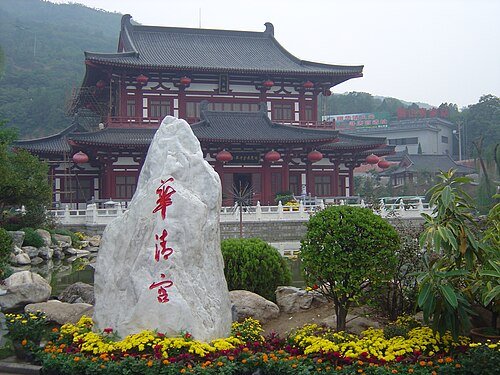
The Tang palace itself survives mainly through archaeology, while later garden buildings frame the excavated bathing pools. Lotus Pool and Begonia Pool make the imperial use of the springs tangible, and the Pear Garden remains introduce the court’s music and performance culture. Looking at these physical remains first helps separate the Tang site from the later architecture and modern performances inspired by Xuanzong and Yang Guifei.
The palace originated as the Tangquan Gong (汤泉宫), a hot-spring palace that Emperor Taizong (唐太宗) had built at the foot of Mount Li in 644, the eighteenth year of the Zhenguan era, under the supervision of Yan Lide (阎立德). In 747, the sixth year of the Tianbao era, Emperor Xuanzong (唐玄宗) renamed it Huaqing Palace and expanded it into a large palace and garden complex used by Tang emperors for tours, residence and court events. The site was listed among the fourth group of Major Historical and Cultural Sites Protected at the National Level in 1996.
The palace complex covered about 1,300 mu (亩), built along the contours of Mount Li and enclosed within an outer wall that was itself divided into courtyards by inner walls. The palace city at its center had a trapezoidal layout, flanked to the east and west by administrative buildings and the residences of nobles and officials; a garden area lay to its south, following a 'front palace, rear garden' arrangement. To the north lay grounds for ball games, horse racing and military drills, including the Hall for Discussing Military Affairs (讲武殿), the Dancing Horse Platform (舞马台), and both a large and a small ball court.
What to look for
- The excavated Lotus and Begonia bathing pools, associated with Xuanzong and Yang Guifei.
- The Pear Garden archaeological displays, introducing music and performance at the Tang court.
- The garden setting below Mount Li, which explains the choice of the hot-spring retreat.
Location & getting there
Getting to Huaqing Palace
Take Metro Line 9 to Huaqingchi station and follow the B or C exit approach to the scenic area at 3 Huaqing Road, Lintong.
- Check the entry arrangements separately for daytime visiting and any evening performance.
Combine your visit
Suggested order within this visit:
-
Imperial bath remains
Begin with the excavated physical evidence of the retreat.
-
Pear Garden site museum
Continue to the archaeological evidence of court performance.
-
Garden and Mount Li outlook
Finish with the landscape that surrounded the palace.
This sequence is an editorial suggestion based on the features described in the sources. Access to individual buildings or areas should be checked locally; no travel time or shared admission is implied.
Find Huaqing Palace
华清宫 · 西安
The pin marks the area, not the entrance.
More places nearby
Approximate straight-line distances between map pins, not travel distances.
Mount Li 骊山
Less than 1 km awayMount Li rises directly behind Huaqing Palace in Lintong. Its paths connect wooded slopes with shrines, the Beacon Tower and memorials to the 1936 Xi’an Incident. Bingjian Pavilion marks the mountainside story of Chiang…
View guide →Qin Shi Huang Mausoleum 秦始皇陵
5 km awayThe emperor’s burial mound is the center of a much larger funerary landscape at Lishanyuan, separate from the familiar Terracotta Army halls. The main underground chamber remains unexcavated. A visit instead combines the mound’s…
View guide →Terracotta Army 秦始皇兵马俑
6 km awayThe Terracotta Army is an excavated part of Qin Shi Huang’s burial complex, where life-size soldiers, horses and chariots were arranged in underground military formations. The roofed pits show both reconstructed figures and the…
View guide →Sources & visit information
The sources below support the place-specific description and arrival information. Suggested combinations are editorial planning ideas; confirm current opening, entry arrangements and transport services for your date.
- Wikipedia: 华清宫遗址 ↗
- Huaqing Palace operator: imperial bathing pools ↗
- Huaqing Palace operator: Pear Garden museum and arrival guide ↗
Visitor information adapted and edited from Wikipedia contributors · CC BY-SA 4.0. Source revision 94116098.
Background paragraphs translated and condensed from Wikipedia contributors, "华清宫遗址", Chinese Wikipedia · CC BY-SA 4.0. Source revision 94116098.