

Explore the region
Mount Li (骊山), in Lintong District, is the mountain landscape within the Huaqing Palace scenic area—not a separate, adjacent attraction with an unrelated entrance. The operator describes Huaqing Palace as including both the palace grounds and Lishan National Forest Park, and lists Bingjian Pavilion among the core sights covered by its scenic-area ticket. The setting is best understood as a climb from the hot-spring palace gardens into wooded slopes, where religious sites and historical landmarks are spaced along an uphill route.
What to see and how to explore
From the palace’s Wangjingmen (望京门, West Gate), first follow the garden route if you want the full transition from the Tang-era imperial resort landscape to the mountain. The operator’s full-day route then continues by its scenic vehicle or on foot uphill to Bingjian Pavilion (兵谏亭), Laomu Hall (老母殿) and the Beacon Tower (烽火台), before leaving through Jinyangmen (津阳门, East Gate). These are distinct stops on a rising route, not a cluster of buildings immediately beside the metro entrance. Walking the climb means sustained uphill effort; use the vehicle option only if it is operating and available on your visit day. Check locally for access to each building and trail conditions, and allow time for the separate descent or onward route from the East Gate.
At Bingjian Pavilion, the mountain itself supplies important context: during the Xi’an Incident of 12 December 1936, Chiang Kai-shek escaped from Huaqing Pool’s Five-Room Hall onto Mount Li and was found in a cave during a search. The pavilion is a memorial landmark associated with that episode; it should not be mistaken for the cave or the precise place where he was found. Continue uphill to the religious precinct at Laomu Hall and the Beacon Tower, where the operator identifies the old beacon-fire story among the area’s historical associations. On clear days, pauses along the slope open views over Lintong.
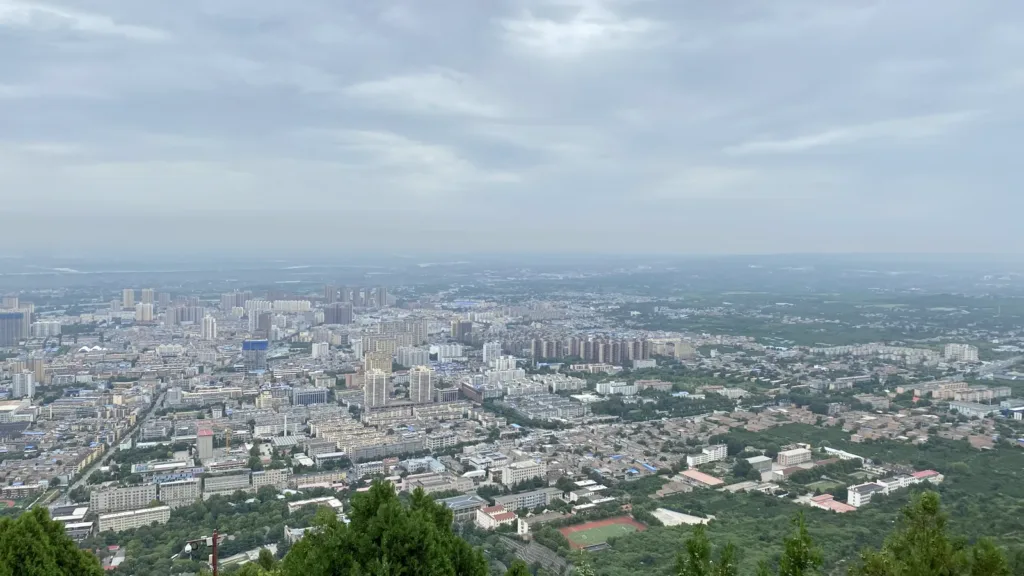
The Commons file page describes the view as Lintong, photographed on Mount Li at approximately 800 metres elevation.
The mountain is steep and the route changes elevation. Choose either the operator’s uphill vehicle option, if confirmed on the day, or a walk suited to your ability; do not assume every visitor can or should complete the whole route. The official itinerary ends at the East Gate, so check which gate is open and how you will reconnect with public transport before setting out.
Access and visiting
Address: Huaqing Palace scenic area, No. 3 Huaqing Road (华清路3号), Lintong District, Xi’an. Use “华清宫景区(望京门/西门)” as the destination when beginning at the West Gate; alight at the signed public visitor entrance, not on the road or at a restricted mountain path.
Metro: Xi’an Metro Line 9 to Huaqingchi (华清池) Station. The operator directs visitors from Exit B or C to Wangjingmen (West Gate), a stated 3–5-minute walk.
Bus: The operator’s guide lists city-centre tourist bus No. 5 (306) to Huaqingchi (华清池) stop beside the scenic-area entrance. It does not specify a current boarding point or return service in the guide; confirm that route and the stop serving your chosen exit before relying on it.
Taxi or ride-hail: Enter “华清宫景区(望京门/西门)” and the address “陕西省西安市临潼区华清路3号.” Use only the signed, authorized passenger drop-off point at the public visitor entrance; the operator’s page does not name a particular curb, and vehicles should not stop on the roadway or attempt to reach a restricted mountain path.
Within the site and return: The published mountain route describes going uphill by scenic vehicle or on foot, then exiting at Jinyangmen (East Gate). The page does not establish the current shuttle timetable or the East Gate’s onward bus connection. Confirm both with the operator on arrival; do not assume the return uses the West Gate.
The operator currently lists the scenic area as open 07:30–17:30, with ticket sales and entry ending at 17:00. It cautions that hours may change with season, weather, visitor volume or special events. Its official ticket information lists Bingjian Pavilion among the included core sights and directs visitors to official booking channels; verify the product, mountain access and latest hours before travel.
Combine your visit
Suggested order within this visit:
-
Bingjian Pavilion
Start with the lower mountain’s modern-history landmark.
-
Laojun temple area
Continue uphill to the religious sites if the open path suits your ability.
-
Beacon Tower
Use the upper landmark as an optional turning point rather than assuming every visitor completes the climb.
This sequence is an editorial suggestion based on the features described in the sources. Access to individual buildings or areas should be checked locally; no travel time or shared admission is implied.
Find Mount Li
骊山 · 临潼区
The pin marks the area, not the entrance.
More places nearby
Approximate straight-line distances between map pins, not travel distances.
Huaqing Pool 华清池
Less than 1 km awayHuaqing Pool is the hot-spring and palace complex at the foot of Mount Li, also called Huaqing Palace. The excavated Tang bathing pools are its most distinctive remains: their different shapes connect the site with imperial…
View guide →Qin Shi Huang Mausoleum 秦始皇陵
5 km awayThe emperor’s burial mound is the center of a much larger funerary landscape at Lishanyuan, separate from the familiar Terracotta Army halls. The main underground chamber remains unexcavated. A visit instead combines the mound’s…
View guide →Sources & visit information
Sources checked on 21 October 2026. Hours, tickets, reservations and transport can change; confirm with the operator before you go.
Image credits & notes (1)
- View across Lintong from Mount Li, photographed at about 800 metres elevation. Photo: LiuboyoupeterPhoto: CC BY-SA 4.0