

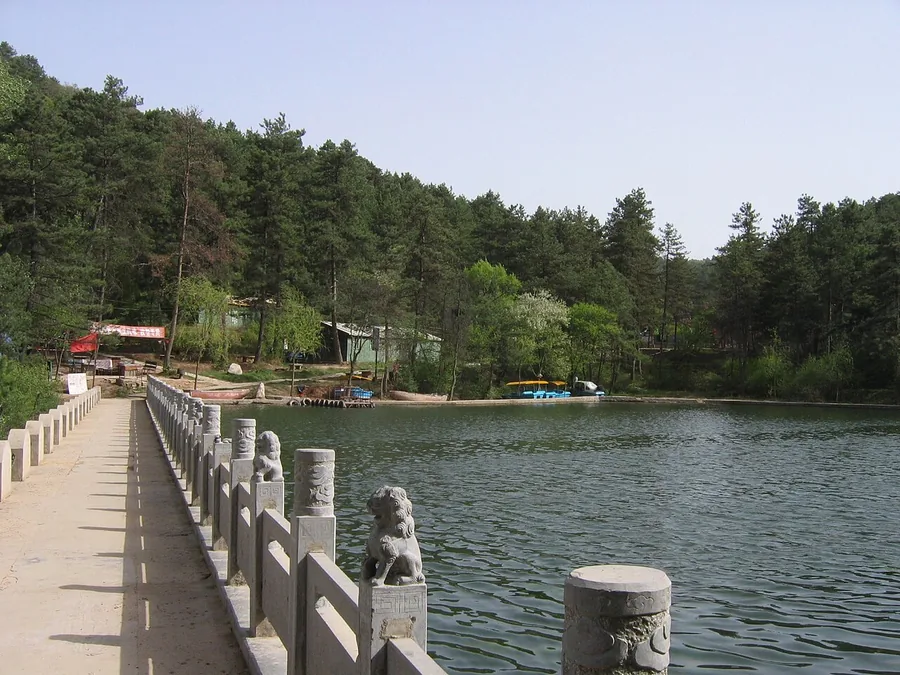
Photo adjustments
Proportionally resized and converted to WebP without cropping, retouching or changing the photographed subject.
Explore the region
About Yuhua Palace
Xuanzang spent his final years here translating scriptures. The surviving archaeological site is therefore best understood through its palace foundations and the places associated with his work, rather than as an intact royal residence. Sucheng Courtyard and the Xuanzang memorial displays connect the mountain setting with this unusually specific chapter of Buddhist translation history.
Yuhua Palace was first built in 624, during the Wude era of the Tang dynasty's founding emperor Gaozu (唐高祖), under the name Renzhi Palace (仁智宫), confined to the Fenghuang Valley (凤凰谷). Emperor Taizong (唐太宗) expanded it on this foundation, completing the work in 647; contemporary records describe its main gate as the South Feng Gate (南凤门) and note that its halls were tiled but its outer structures thatched with reeds to keep the emperor's intended frugality. A separate hall was built in Shanhu Valley (珊瑚谷), and the Sucheng Hall (肃成殿) was built to the north in Lanzhi Valley (兰芝谷), later converted into a temple.
In 648 Taizong visited the completed palace and composed an inscription for it, and that year he also summoned the monk Xuanzang (玄奘) to discuss the progress of his scripture translations there. In 651, under Emperor Gaozong (唐高宗), the palace was converted into a temple called Yuhua Temple (玉华寺), and in 659 Xuanzang moved there from Chang'an's Ci'en Temple to continue translating Buddhist scriptures, telling the resident monks that he could finally work without the distractions of the capital. The palace later fell into decline, and by the Tianbao era (742-755) of Emperor Xuanzong's (唐玄宗) reign it had become a ruin.
What to look for
- Sucheng Courtyard, associated with Xuanzang’s residence, translation work and final years.
- The Xuanzang memorial museum’s excavated and Buddhist objects, alongside the palace-site remains.
Location & getting there
Getting to Yuhua Palace
Use Yuhua Village in Yuhua Town, Yintai District, Tongchuan, as the road destination for the palace scenic area.
- The access road is reached from the Yuhua Palace exit of the G65 expressway; confirm the open visitor entrance on arrival.
Combine your visit
Suggested order within this visit:
-
Xuanzang memorial displays
Establish the connection between the palace site and his translation work.
-
Sucheng Courtyard
Continue to the part of the complex associated with his later life.
-
Palace-site valley
Finish with the foundations and wooded setting where access is open.
This sequence is an editorial suggestion based on the features described in the sources. Access to individual buildings or areas should be checked locally; no travel time or shared admission is implied.
Find Yuhua Palace
玉华宫 · 铜川
The pin marks the area, not the entrance.
More places nearby
Approximate straight-line distances between map pins, not travel distances.
Yaozhou Kiln Museum 耀州窑博物馆
39 km awayYaozhou Kiln Museum stands over the historic pottery-production area at Huangbao in Tongchuan. The main interest is the connection between finished ceramics and the workshops that made them. Celadon with carved or impressed…
View guide →Zhaojin 照金
39 km awayZhaojin’s central visitor area brings together the Shaanxi–Gansu revolutionary base memorial, 1933 Square and the nearby commemorative monument. The museum explains the base established in 1933 through historical photographs…
View guide →Huangdi Mausoleum 黄帝陵
43 km awayHuangdi Mausoleum at Qiaoshan is a long-established place of commemoration for the legendary Yellow Emperor. The visit has two distinct settings: Xuanyuan Temple below the hill, with memorial inscriptions and ancient cypresses…
View guide →Sources & visit information
The sources below support the place-specific description and arrival information. Suggested combinations are editorial planning ideas; confirm current opening, entry arrangements and transport services for your date.
- Wikipedia: 玉华宫遗址 ↗
- Yuhua Palace visitor information ↗
- Shaanxi cultural heritage authority: Yuhua Palace conservation plan ↗
Visitor information adapted and edited from Wikipedia contributors · CC BY-SA 4.0. Source revision 92597569.
Background paragraphs translated and condensed from Wikipedia contributors, "玉华宫遗址", Chinese Wikipedia · CC BY-SA 4.0. Source revision 92597569.