

Explore the region
Tap any red Chinese text to hear it in Mandarin.
Han Yangling is the shared burial complex of Western Han Emperor Jingdi (Liu Qi) and Empress Wang, whose separate tomb chambers sit within one mausoleum precinct. Work began in 153 BCE and continued until 126 BCE. The site is in Xianyang’s Weicheng District, not within Xi’an city proper; treat it as a cross-city trip rather than a Xi’an municipal attraction.
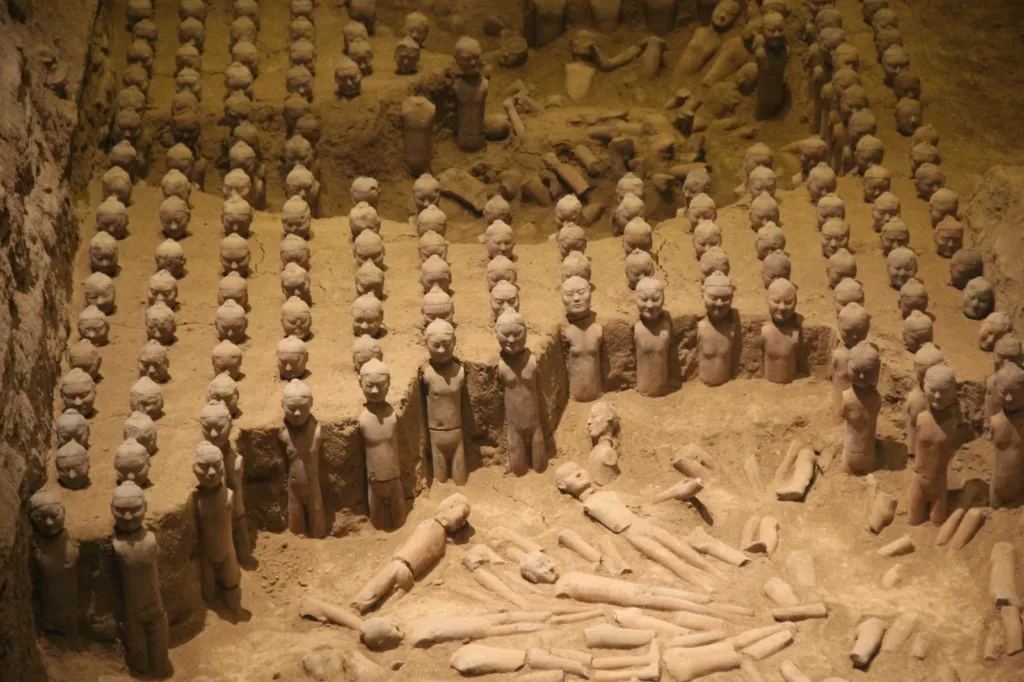
Begin in the Archaeological Exhibition Hall to orient yourself to the tomb complex and its finds. Then go to the underground protected display over the emperor’s outer burial pits: glazed barriers let you look down into excavated spaces and at the small terracotta people and animals placed as an imperial household in miniature. The figures’ intimate scale makes a striking contrast with the broad mound landscape outside.
Continue outdoors to the Southern Gate display and the Deyang Temple remains. These are not interchangeable “Han-style” reconstructions: the southern gate marks an actual ceremonial entrance to the imperial precinct, while the temple site helps explain the ritual buildings associated with the tomb. The museum’s open areas also include paths around the imperial mound and seasonal gardens; the gardens are worth a quiet look, but flowering and foliage conditions are not guaranteed for a particular visit.
A useful order is the exhibition hall first, the underground pits next, and the southern gate and temple remains afterward. Finish with the perimeter walk if time and mobility allow. Follow posted visitor routes and stay on the protected paths; visitors see the site through its conservation displays rather than entering the sealed burial chamber.
Opening and admission
The museum’s current visitor notice lists year-round opening. From March through November, ticketing is listed as 08:30–17:00 and visiting as 08:30–18:30, with entry stopping at 17:00. From December through February, ticketing is listed as 08:30–16:30 and visiting as 08:30–18:00, with entry stopping at 16:30. The notice lists adult admission at ¥70 in the March–November season and ¥55 in December–February; student admission is listed at half those rates. It requires real-name advance booking through the museum’s official channels or named booking platforms. Recheck the official booking channel for the date you choose, eligibility and any temporary changes.
Getting there from Xi’an
Han Yangling has no metro station at the museum. On weekends and statutory public holidays, the museum currently lists an unnumbered visitor shuttle between Xi’an’s Administrative Center metro area and the museum. Take Metro Line 2 or 4 to Administrative Center (行政中心站) and use Exit D3 for the museum-bound boarding point. The museum lists departures at 10:20 and 13:30. Return services leave east of the Imperial Mound Square (帝陵广场东) for Administrative Center Exit A3 at 12:30 and 15:40. The posted notice does not give a numbered bus route or a more precise walking description from the station exit; follow the shuttle signs and confirm the service and same-day boarding details before setting out. It is not a daily weekday bus.
For a weekday visit, arrange a taxi or ride-hail directly. Give the driver 汉景帝阳陵博物院 Hàn Jǐngdì Yánglíng Bówùyuàn, address 陕西省西安经济技术开发区泾河工业园机场路东段 Shǎnxī Shěng Xī’ān Jīngjì Jìshù Kāifāqū Jīnghé Gōngyèyuán Jīchǎng Lù Dōngduàn. The museum’s general visitor information recommends the Airport Road entrance. Its 2026 travel notice also lists official east, south and north gates depending on the approach, so confirm which public gate is admitting visitors that day and use the legal entrance or parking drop-off rather than asking to stop on the airport road.
Combine your visit
Suggested order within this visit:
-
Archaeological collection displays
Understand the people, animals and objects represented in the pits.
-
Underground pit museum
See the objects within their excavated setting.
-
Southern gate and mound landscape
Relate the small figures to the scale of the mausoleum.
This sequence is an editorial suggestion based on the features described in the sources. Access to individual buildings or areas should be checked locally; no travel time or shared admission is implied.
Find Han Yangling
汉阳陵 · 咸阳近郊行程
The pin marks the area, not the entrance.
More places nearby
Approximate straight-line distances between map pins, not travel distances.
Hancheng Lake Park 汉城湖
15 km awayHancheng Lake is a long urban water park beside the Han Chang’an ruins in northwestern Xi’an. It reuses the former Tuanjie Reservoir corridor and combines flood-management functions with a modern Han-themed landscape. Dafeng…
View guide →Xi'an Xianyang Airport 西安咸阳国际机场
17 km awayXi’an Xianyang International Airport has an expanded terminal layout following the opening of Terminal 5 in February 2025. Terminals 2, 3 and 5 serve different flights, making the terminal on the current booking the first detail…
View guide →Zhaohui Pagoda 昭慧塔
17 km awayZhaohui Pagoda rises over a square in Gaoling, northeast of central Xi’an. Also known as the Sanyang Temple Pagoda, this octagonal brick tower has thirteen closely spaced eaves. Its form is best read from outside: the narrowing…
View guide →Sources & visit information
Sources checked on 21 October 2026. Hours, tickets, reservations and transport can change; confirm with the operator before you go.
- Han Jingdi Yangling Museum: Visitor Information ↗
- Han Jingdi Yangling Museum: 2026 Dragon Boat Festival Visitor Notice ↗
- Han Jingdi Yangling Museum: Online Visitor Replies ↗
- Shaanxi Provincial Cultural Heritage Department: Museum Profile ↗
- Shaanxi Provincial Cultural Heritage Department: 2024 Visitor Guide ↗
- Administrative Center Metro Station ↗
- Han Yangling Museum: Site Location and Archaeology ↗
Image credits & notes (1)
- Rows of small terracotta figures in an excavated burial-pit display at Han Yangling. Photo: Gary Lee Todd, Ph.D.Photo: CC0 1.0