

Explore the region
Tap any red Chinese text to hear it in Mandarin.
Why this town matters
Danggar is in Huangyuan County, within Xining’s prefecture-level city but outside central Xining. Its position between farming valleys and the plateau made it a meeting point for agricultural and pastoral economies, and a historic route town associated with the Tang–Tibet and tea-and-horse trade corridors. That setting explains why the old streets bring together civic buildings, temples, merchant premises and northern courtyard houses rather than presenting one isolated monument.
The town is best understood as a lived historic quarter. The main street is a compact walk of roughly 800 metres, while the present visitor area combines surviving historic buildings with protective restoration and newer cultural and commercial uses. Treat the street plan and the relationship between buildings as part of the experience; do not assume that every shopfront or decorative surface is an untouched Ming or Qing relic.
What to look for
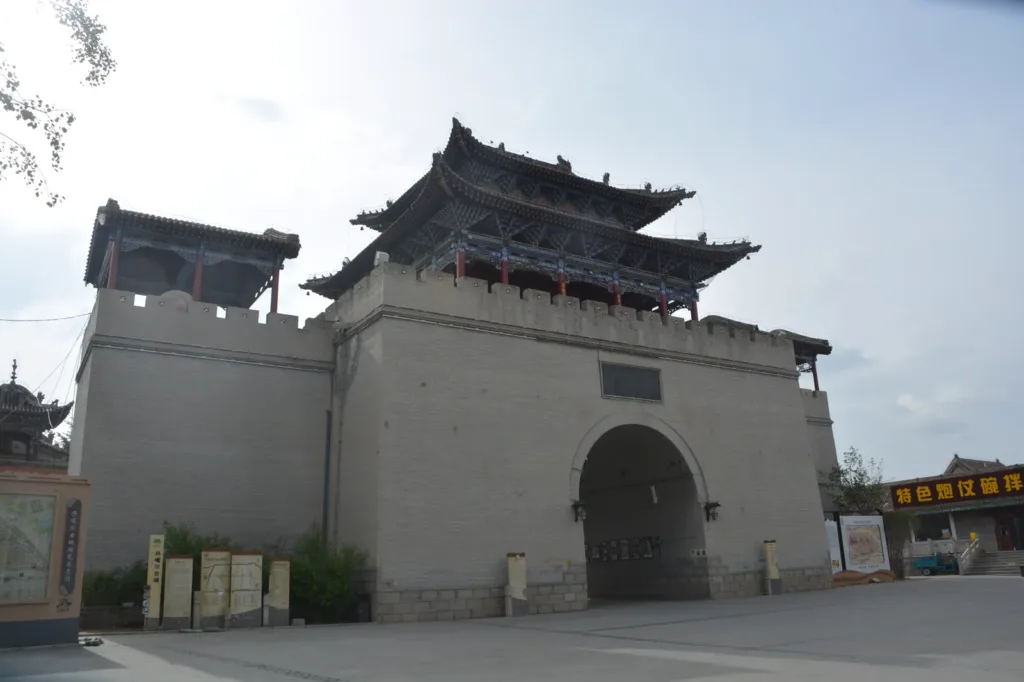
Begin at Yingchun Gate 迎春门 on the eastern side and walk the old commercial axis towards Gonghai Gate 拱海门. The two gates give the town a legible east–west structure. Along the way, look for the lanes, courtyard entrances and changes between public street, temple forecourt and merchant premises rather than trying to rush from one named building to the next.
The City God Temple 城隍庙 is the most substantial religious and architectural stop. The county’s account dates it to 1776 and describes a sequence of screen wall, gate, bell and drum towers, opera stage, archway, main hall and rear hall, with large Qing-period murals inside. If a hall is closed, respect the boundary and treat the exterior layout as the part available to visitors.
Other useful stops include Renji Firm 仁记商行, whose Western-style columns and dome windows recall the town’s international wool and livestock trade; the Confucian Temple 文庙, built in 1918–1920; the former Danggar Administrative Office 丹噶尔厅署; and Huozu Pavilion 火祖阁. The Huangyuan County Museum and the leather-embroidery displays add material evidence of the region’s older communities and craft traditions. The county also identifies Pai-deng lanterns, leather embroidery and Chen vinegar among the local cultural products associated with the town.
How to visit
Use 丹噶尔古城·明清老街 Dāngá’ěr Gǔchéng · Míng-Qīng Lǎojiē as the destination, rather than entering only “Xining” in a map app. A current Trip.com listing gives the address as Mingqing Old Street, Chengguan Town, Huangyuan County, Xining City, and currently lists the public ancient-town area as free and open year-round. Those are third-party listing details, not a substitute for an operator notice: confirm the day’s entrance arrangements, any separate charges or opening restrictions for museums, temples and performances, and whether the gate you want is open.
The old street is a public urban quarter with residents and businesses as well as visitor sites. Keep to public routes, ask before entering a courtyard or photographing people, and remember that temples remain religious spaces. Uneven paving and changing weather on the plateau make shoes with a firm sole and a warm outer layer more useful than a tightly timed itinerary.
Getting there from Xining
The Huangyuan County tourism page advises travelling from urban Xining by 湟源高速大巴 Huángyuán Gāosù Dàbā or driving along the 西湟一级公路 Xī-Huáng Yījí Gōnglù. The site is outside central Xining, so plan the outward and return legs as a county excursion rather than as a walkable city-centre stop.
An older Qinghai government transport notice explicitly listed 湟源高客 Huángyuán Gāokè at 新宁路客运站 Xīnníng Lù Kèyùnzhàn. Because that notice is dated 2016 and station assignments and departures can change, confirm the current departure terminal and service before setting out. After arriving in Huangyuan, use the exact Chinese destination 丹噶尔古城·明清老街 Dāngá’ěr Gǔchéng · Míng-Qīng Lǎojiē or 拱海门 Gǒnghǎi Mén for the final walk or taxi leg. For the return, leave enough time to reach the current Huangyuan departure point and confirm the last 湟源→西宁 Huángyuán → Xīníng coach on the same day; do not rely on an unverified timetable.
Combine your visit
Choose from these complementary stops when planning your visit.
-
Yingchun Gate迎春门
Begin on the eastern approach.
-
Old-town street and City God Temple古城街巷与城隍庙
Follow the historic commercial axis.
-
Gonghai Gate拱海门
Finish at the western gate if the route is open.
This is a suggested combination, not a timed route; confirm the opening and transport arrangements for your date.
Find Danggar Ancient Town
丹噶尔古城 · 西宁
The pin marks the area, not the entrance.
More places nearby
Approximate straight-line distances between map pins, not travel distances.
Sun and Moon Mountain 日月山
28 km awayRiyue Mountain marks a transition between the farming valleys around Xining and the pastoral landscapes towards Qinghai Lake. The pass is associated with the historical Tang–Tibet route and with legends of Princess Wencheng’s…
View guide →Kumbum / Ta'er Monastery 塔尔寺
37 km awayKumbum, known in Chinese as Ta’er Temple, grew around a memorial to Tsongkhapa, founder of the Gelug school of Tibetan Buddhism. Its buildings follow the folds of the valley rather than a single straight axis. The Great Golden…
View guide →Xining Wildlife Park 西宁野生动物园
41 km awayXining Wildlife Park, also called Qinghai–Tibet Plateau Wildlife Park, combines animal displays with rescue, breeding and conservation work. Its hillside setting on the western part of Dananshan distinguishes it from a compact…
View guide →Sources & visit information
Sources checked on 24 October 2026. Hours, tickets, reservations and transport can change; confirm with the operator before you go.
Image credits & notes (1)
- The main gate building of Danggar Ancient Town (丹噶尔古城), photographed from the visitor plaza in Huangyuan County, Xining. Photo: JonashtandPhoto: CC BY-SA 4.0