

Explore the region
Tap any red Chinese text to hear it in Mandarin.
Why this pass matters
Sun and Moon Mountain is in 日月藏族乡, 湟源县, within Xining’s prefecture-level city but well outside urban Xining. It is a pass rather than a city-centre hill: the road west from the Huangshui valley reaches the eastern approach to Qinghai Lake here. The official local description places the mountain in the Qilian range and identifies the 3,520-metre road pass as the point crossed by the Qinghai–Tibet highway.
Its geography is the main thing to notice. From the pass, the east looks towards the cultivated Huangshui valley, while the west opens towards grassland and the Qinghai Lake basin. Local government descriptions also use the ridge to explain the contrast between monsoon and non-monsoon zones, agricultural and pastoral areas, and outward-flowing and inland waters. These are landscape relationships, not a painted boundary on the ground.
The route gives the mountain its historical weight. The Tang–Tibet Ancient Road linked Chang’an with Lhasa through the Hexi and Huangshui corridors; after passing Xining and Huangyuan, it crossed Riyue Mountain towards the plateau. The road carried envoys, trade and religious exchange, so the site is best read as a crossing point between regions rather than as an isolated viewpoint.
The story of Princess Wencheng leaving a sun-and-moon mirror here is a local legend associated with the pass and its commemorative landscape. It is a way to understand why the pavilions and sculpture were built, not a geological explanation for the mountain or the rivers.
What to look for
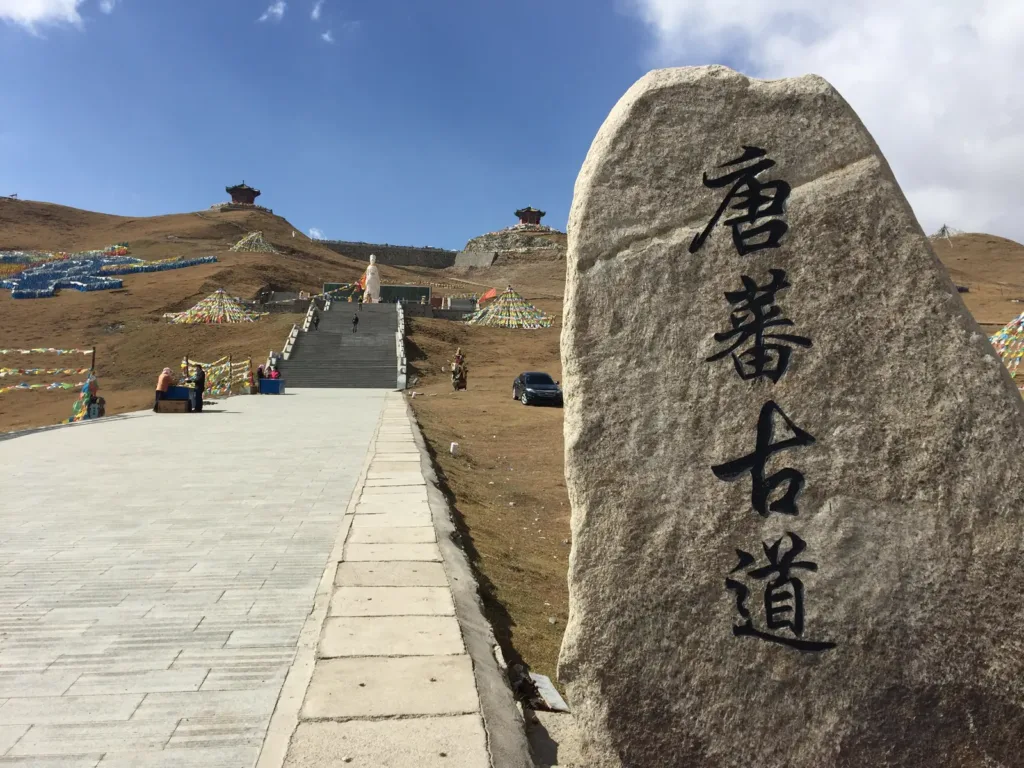
The Sun Pavilion and Moon Pavilion stand on separate rises above the pass. Compare the two outlooks rather than treating either building as the whole visit: the paired structures frame the road, the valley, the grassland and the remembered Tang–Tibet route. A 2024 government report also describes commemorative texts and murals, the Princess Wencheng sculpture, and a Tang–Tibet Red Ridge boundary stele in the visitor area.
Recent visitor reporting from May 2025 described a wooden walkway, a visitor service centre and an intelligent guide system, as well as the Princess Wencheng Memorial Hall, Sun Pavilion and Moon Pavilion. The same report mentioned a new south car park and south gate at that time. Treat those details as recent operational context, not a promise that every facility or entrance remains unchanged; follow the venue’s current signs when you arrive.
The most rewarding observation is the change of scale: look east for fields, villages and folded valley terrain, then west for the more open plateau. The road and the pavilions help you understand the transition even on a short stop. At the 3,520-metre pass, walk slowly, keep a warm layer and allow weather or altitude to change how long you stay.
Planning the visit
Use the Chinese destination 日月山景区 Rìyuè Shān Jǐngqū and the address 青海省西宁市湟源县日月藏族乡 Qīnghǎi Shěng Xīníng Shì Huángyuán Xiàn Rìyuè Zàngzú Xiāng when checking a map. This is a mountain-pass scenic area in Huangyuan County, not an attraction inside central Xining. Recent official reporting confirms regular public visitors and managed visitor facilities, but current opening hours, ticket prices, reservation procedures and passport-specific booking or entry rules should be confirmed with the venue before you set out. Do not assume that a domestic identity-card booking route also applies to a foreign passport.
The scenic area is on a high, exposed road. Bring water, sun protection and a windproof layer, and do not treat a pass visit as a flat city walk. Stay on marked paths and do not enter closed slopes, roadside works or unmanaged grassland.
Getting there
By road. The local government has described the approach from Huangyuan along the 湟倒一级公路; a later road report places Riyue Mountain on the G109 Qinghai–Tibet road between 湟源县 and 恰卜恰, with 倒淌河 to the west. In a car or hired vehicle, search for 日月山景区 or its current marked south gate rather than relying on a broad mountain pin.
Public transport. A local travel guide dated 22 October 2024 describes this public-transport chain: take a coach from 西宁新宁路汽车站 Xīníng Xīnníng Lù Qìchēzhàn to 湟源县 Huángyuán Xiàn, take 湟源8路 to 日月乡 Rìyuè Xiāng, then arrange the final local connection to 日月山景区 Rìyuè Shān Jǐngqū. The guide does not provide a current timetable, final-leg operator or dependable return departure, so treat this as a route lead and confirm all three legs before leaving Xining.
A Qinghai government notice dated June 2024 recorded a tourist shuttle from 西宁客运中心站 Xīníng Kèyùn Zhōngxīn Zhàn via 日月山 Rìyuè Shān and 倒淌河 Dàotǎnghé to 青海湖二郎剑景区 Qīnghǎi Hú Èrlángjiàn Jǐngqū, returning to Xining after the stop at Erlangjian. That notice is useful evidence that a sightseeing route has served this corridor, but it is not a 2026 timetable and does not establish a guaranteed drop-off at the Riyue Mountain entrance. Check the current 西宁汽车站 Xīníng Qìchēzhàn listing before relying on it.
For a same-day public-transport visit, arrange the return before entering the scenic area. If no current through service is shown, a pre-arranged car or a clearly agreed pick-up at 日月山景区 Rìyuè Shān Jǐngqū is safer than expecting a passing coach to stop. No metro route reaches this rural pass.
Combine your visit
Choose from these complementary stops when planning your visit.
-
Sun Pavilion日亭
View the pass and its commemorative setting.
-
Moon Pavilion月亭
Compare the outlook from the other rise.
-
Huangyuan old town丹噶尔古城
Consider a separate stop in Huangyuan on the same road journey.
This is a suggested combination, not a timed route; confirm the opening and transport arrangements for your date.
Find Sun and Moon Mountain
日月山 · 西宁
The pin marks the area, not the entrance.
More places nearby
Approximate straight-line distances between map pins, not travel distances.
Danggar Ancient Town 丹噶尔古城
28 km awayDanggar in Huangyuan grew as a town on the routes between the farming valleys and the plateau. Its east and west gates, Yingchun and Gonghai, provide a clear way to understand the old street axis. Temples dedicated to the City…
View guide →Atomic City Memorial Museum 原子城纪念馆
44 km awayAtomic City Memorial explains the history of the former nuclear-research base on the Jinyintan grassland. Its exhibition follows the base from planning and construction through research and retirement. Photographs and objects…
View guide →Erlangjian Scenic Area 二郎剑景区
45 km awayErlangjian is a developed visitor area on Qinghai Lake’s southern shore, associated with a narrow landform extending into the lake. It offers a clearer arrival point than the lake’s broad regional pin, with open water, shoreline…
View guide →Sources & visit information
Sources checked on 24 October 2026. Hours, tickets, reservations and transport can change; confirm with the operator before you go.
Image credits & notes (1)
- Sun and Moon Mountain's paired pavilions, Princess Wencheng statue and Tang–Tibet Ancient Road marker viewed from the visitor approach. Photo: 慕尼黑啤酒Photo: CC BY-SA 3.0