

Explore the region
What to see and how to visit
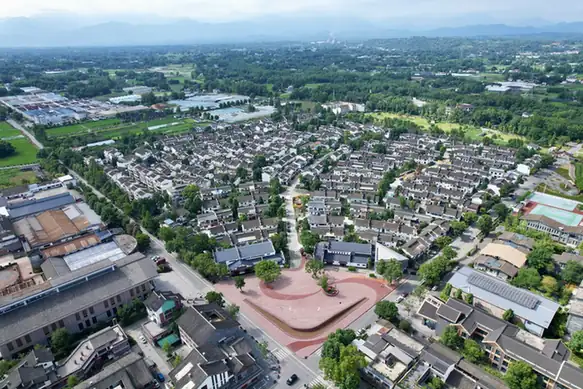
Zhanqi is a living village, not a single enclosed monument. Its visitor experience combines productive agriculture, village spaces and curated cultural stops. Walk the village roads to see fields, greenhouses and Sichuan-style courtyard homes; the farming landscape and irrigation setting help explain why agricultural production remains central to the place rather than just a backdrop. The village’s contemporary identity also reflects its reform and rural-development history: it was named after a model effort during land and water works in 1965, and became a prominent example of collective-economy and rural-revitalization initiatives.
For a more interpretive visit, make Rural Eighteen Workshops (乡村十八坊) a main stop. A 2025 local report describes it as a production, learning, demonstration and exhibition project using a “front shop, back workshop” arrangement. It reported more than 30 craft workshops, including Pixian broad-bean-paste making, Shu embroidery and Tangchang cloth shoes; demonstrations and participation depend on the individual workshop’s current operation. Look for the visible sequence from tools and materials to making and finished goods, rather than treating the workshops as a single guaranteed live show.
The Tianfu Farming Culture Museum (天府农耕文化博物馆) and the village’s red-culture and rural-study venues offer additional context. A 2026 report also describes a 12-kilometre sightseeing-train loop through the wider Zhanqi countryside, passing rice fields and Sichuan forested homesteads, as well as a hands-on bamboo-weaving activity at a study base. These are distinct facilities or activities, not necessarily included in a village-wide admission. Check locally whether the museum, train and workshops are open, taking visitors and charging a fee on your date.
A practical self-guided sequence is to begin at the village’s visitor-oriented core, visit the workshops or museum that are open, then continue on public village roads to observe the agricultural landscape. Allow a half day if you want time for workshops and a meal; this is a planning suggestion, not a published tour duration. Be considerate around homes and working fields: keep to public paths, do not enter private yards or crops, and ask before photographing residents or workers.
Tickets and opening status
No current, authoritative consolidated ticket price, reservation rule or opening-hours schedule for the village and its separate venues was located. The 2026 district account confirms that visitor facilities and tourism services are being developed, but does not publish these details. Do not assume that a free-to-enter village road means every museum, workshop, train or experience is free or open. Confirm directly with the particular venue before setting out.
Getting there
Metro and bus: There is no metro station at the village. Travel by Metro Line 2 or Line 6 to Xipu (犀浦), then use the Pidu rural bus connection. The Ministry of Culture and Tourism’s published itinerary describes the Xipu-to-village leg on P212, naming Tangchang Zhanqi Village (唐昌战旗村) as the destination stop. A 2026 Pidu District government response confirms P212 among routes covering the area, but also says special connections from Xipu and a Wangcong Temple–Zhanqi blossom-season line operate on holidays or during the blossom season. Because the published itinerary is from 2022 and the district does not give a live timetable or confirm that a special line runs daily, check the current operator notice before travel. No reliable metro exit number or exact walk from the bus stop to a chosen venue was verified.
Taxi or ride-hailing: Use the Chinese destination “成都市郫都区唐昌镇战旗村(乡村十八坊)”. A dedicated taxi rank, named visitor gate or designated drop-off bay was not verified. Ask to be let out only at a signed, lawful stopping point on a public road, without blocking village traffic; follow any on-site traffic controls. If visiting another facility, enter its Chinese name as the destination instead of assuming that “Zhanqi Village” will place you at its door.
Combine your visit
Choose from these complementary stops when planning your visit.
-
Eighteen Workshops street乡村十八坊
Begin with the range of local crafts.
-
Cloth-shoe workshop唐昌布鞋坊
Watch the making process when a demonstration is available.
-
Douban workshop郫县豆瓣坊
Connect the condiment with its production and local uses.
This is a suggested combination, not a timed route; confirm the opening and transport arrangements for your date.
Find Zhanqi Village
战旗村 · 郫都区
The pin marks the area, not the entrance.
More places nearby
Approximate straight-line distances between map pins, not travel distances.
Sichuan Cuisine Museum 川菜博物馆
14 km awayThe Sichuan Cuisine Museum treats food through the utensils and material culture used to prepare and serve it. Its collection includes Han-period ceramic spoons and a red-pottery stove, alongside later decorated bowls and…
View guide →Chen Family Courtyard 陈家桅杆
14 km awayThe Chen Family Courtyard in Shou’an is a western-Sichuan residential complex combining living quarters, an ancestral hall and garden spaces. It is also called Chenjia Weigan, after the paired mast-like structures associated…
View guide →Sandaoyan Ancient Town 三道堰古镇
14 km awaySandaoyan is shaped by the Baitiao and Xuyan rivers and the water-trade history of the Chengdu Plain. Around Yongding Bridge, waterside buildings and public paths create an easy walking area, with tea and food businesses facing…
View guide →Sources & visit information
Sources checked on 21 October 2026. Hours, tickets, reservations and transport can change; confirm with the operator before you go.
- National Development and Reform Commission profile of Zhanqi Village ↗
- Sichuan Online report on Zhanqi Village in 2026 ↗
- Pidu District report on the Zhanqi countryside zone ↗
- Pidu District government response on rural-tourism routes ↗
- Ministry of Culture and Tourism Chengdu rural-tourism itinerary ↗
- Sichuan Online Line 2 restoration report ↗
Image credits & notes (1)
- Zhanqi Village · 战旗村Photo: sichuan.scol.com.cnResized for the web; the photo itself has not been edited.