


Get to know Pidu District
- Administrative area
- District · 市辖区
- Part of
- Chengdu
- Chinese name
- 郫都区
- Local areas
- District guide
Area & population
- Area
- 437.50 km²
- Population · 2020 census
- 1,672,025
- Administrative seat
- Pitong Subdistrict
Source: English Wikipedia, as of the dates shown.
A district of distinct visits
Pidu is the present-day district formed from Pi County in 2016. Its local story connects the ancient Shu rulers remembered as Wangdi and Congdi with the irrigated Chengdu Plain, while its modern identity also includes Sichuan cuisine, embroidery and rural tourism. The district government describes four visitor-oriented themes: a Shu-embroidery and creative corridor, a waterside countryside area, a Sichuan-cuisine and rural-heritage area, and a science-fiction and horticulture area. These are broad planning themes, not a promise that every listed site is open or connected by one continuous route.
Begin in Pitong, the district’s urban core, at Wangcong Shrine (望丛祠). The shrine commemorates Wangdi Du Yu and Congdi Bieling, figures in ancient Shu tradition. The district reports that its recent improvement works added themed landscape elements and that museum displays are being updated; allow time to walk the grounds and read the cultural interpretation rather than expecting a single stand-alone monument. The government has published the gate address as No. 5 Wangcong Middle Road, Pidu District (郫都区望丛中路5号). Current ticket, reservation and daily opening details were not confirmed in the accessible official notices, so check with the venue before making a special trip.
For a different pace, head to Sandaoyan (三道堰) and Qinggangshu (青杠树), where the district’s waterways, irrigation landscape and village visitor facilities make a riverside walk a more fitting way to explore than a checklist of monuments. Further out, Tangchang Ancient Town (唐昌古镇) and Zhanqi Village (战旗村) can be paired with rural stops such as Guangfu Village and the Farmer’s Memory attraction. The district reports a spring seasonal excursion connecting Wangcong Shrine with Tangchang and Zhanqi; it is seasonal, and its current departures and timetable are not established here. Do not assume that a seasonal shuttle runs on an ordinary day.
Pidu also has contemporary stops: the Chengdu Science Fiction Museum (成都科幻馆) and Florence Village Chengdu (佛罗伦萨小镇) appear in the district’s 2026 visitor itineraries. A same-day plan can combine one of these with the historic or rural cluster, but the district’s scale means that cross-cluster transfers need separate planning.
Sichuan food and practical planning
The Sichuan Cuisine Museum (成都川菜博物馆) is presented in a Ministry of Culture and Tourism food route as a hands-on food-culture visit, with Sichuan-cuisine history, tasting and a cooking experience. However, the museum’s current contact page gives a San Daoyan address, while an older district-government description places it in Gucheng. Confirm the current visitor entrance and route directly with the museum (19111999976) before travelling; do not rely on an unverified taxi pin or legacy bus directions.
Getting around
There is no single district arrival gate. For the Pitong/Wangcong area, Chengdu Metro Line 6 reaches Wangcongci (望丛祠) station; the official rail operator lists it as the line’s north end. The reliable official information reviewed did not establish an exit number for the shrine gate, so follow station signs toward Wangcong Middle Road rather than relying on an unverified exit. Line 2 reaches Xipu (犀浦), a useful western-district rail gateway, but it is not at the outlying village attractions.
For a taxi or ride-hail to the shrine, enter 望丛祠(郫都区望丛中路5号) and use the lawful drop-off or parking area indicated by local signs; drivers should not stop in a travel lane or block the gate. Outlying sites such as Sandaoyan, Tangchang and Zhanqi have distinct destinations, and a single district address will not serve them all. The district’s current tourism notice lists Pidu visitor routes including P212 and P09 and notes seasonal shuttles, but does not provide stop-by-stop instructions or a timetable in that notice. Check the live local bus information before boarding.
The museum’s contact page publishes a Line 6-to-Wangcongci transfer followed by P23/P50, and also lists other bus links, but gives no named stop or live timetable and conflicts with the museum’s other address information. Treat it only as a lead to confirm with the venue, not as a guaranteed current connection.
Guide sources
- Pidu District profile
- Pidu District 2026 tourism development response
- Pidu District 2026 recruitment notice naming Wangcong Shrine gate
- Sichuan Chengdu food-tasting route
- Chengdu Sichuan Cuisine Museum contact and access
- Chengdu Rail Transit official site
- Pidu District official Sichuan Cuisine Museum description
Explore Pidu District
Core places to explore, with English and Chinese names.
Places to explore around Pidu District
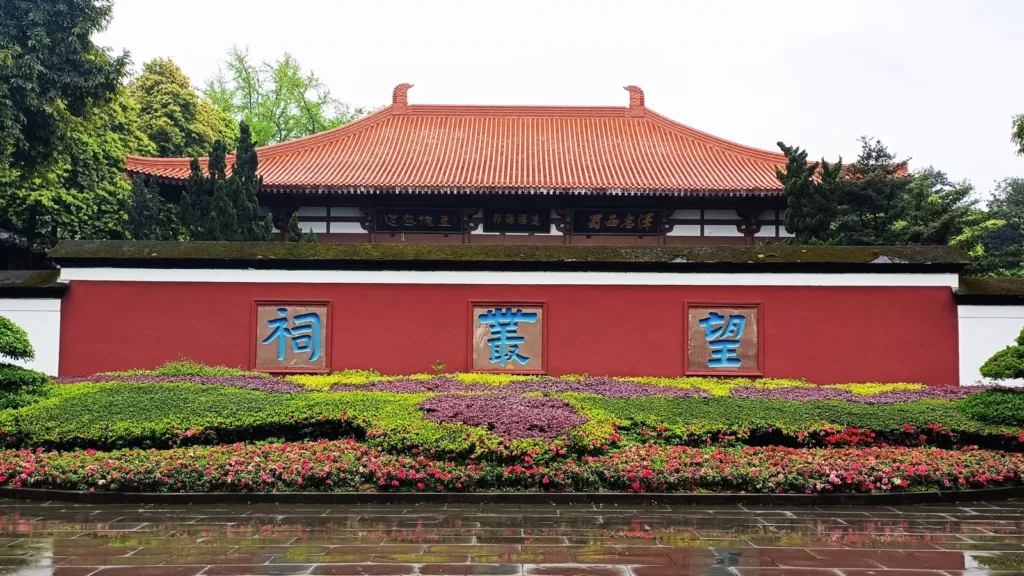 The red-walled entrance and tiled roof at Wangcong Shrine. Photo: Kcx36 · CC BY-SA 4.0
Wangcong Shrine望丛祠
In Pidu District, this memorial garden honours the legendary Shu rulers Wangdi Du Yu and Congdi Bie Ling. Visit to understand the paired tomb-and-shrine tradition and its stories of farming and flood control, then follow the garden paths at an unhurried pace.
Read the place guide → AI illustration · AI 示意图(仅供参考,非该地点实拍)
Sichuan Cuisine Museum川菜博物馆
In Pidu District, this hands-on museum interprets Sichuan food through historic kitchen objects, ingredient displays, cooking demonstrations and optional participatory activities. Its official visitor page directs visitors from Wangcongci on Metro Line 6 by bus; confirm the current route, address and activity arrangements before setting out.
Read the place guide →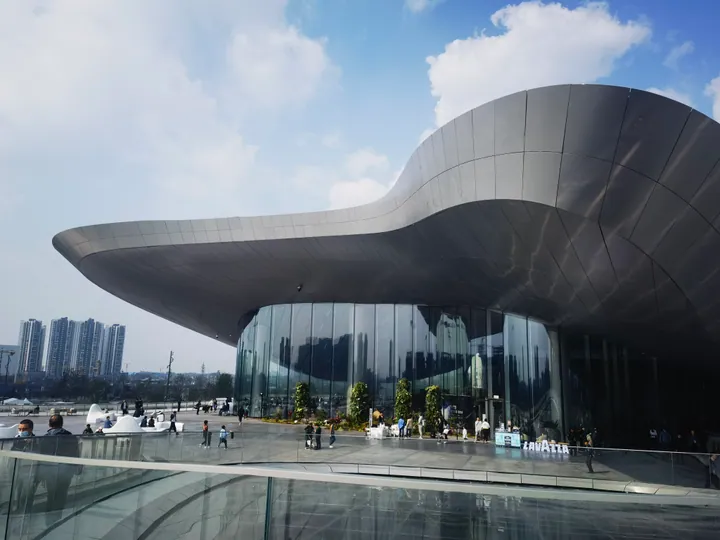 The Chengdu Science Fiction Museum's exterior: a broad silver-grey building with a sweeping curved cantilevered roof over a tall glass curtain wall, with people and model figures on the paved plaza in front, high-rise towers at the left and a blue sky with white clouds.
Chengdu Science Fiction Museum成都科幻馆
A striking, nebula-inspired venue by Jingrong Lake in Pidu District, built for the 2023 Worldcon. Visit for its futuristic architecture and science-fiction exhibition spaces; confirm current public access and booking before making the suburban trip.
Read the place guide →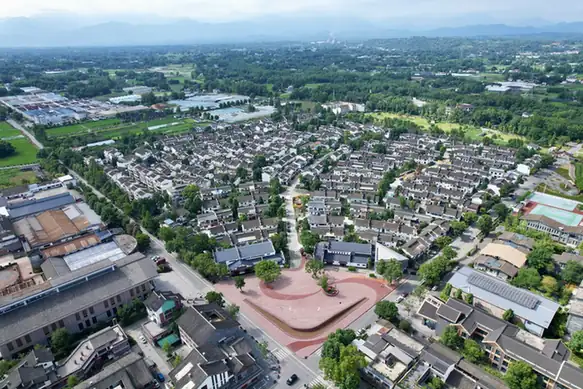 Zhanqi Village · 战旗村
Zhanqi Village战旗村
In Pidu District’s Tangchang countryside, Zhanqi Village pairs working farms and Sichuan-style village scenery with hands-on craft workshops and rural-revitalization interpretation. Explore the village at walking pace; individual venues and seasonal transport have separate operating arrangements.
Read the place guide → Sandaoyan Ancient Town · 三道堰古镇
Sandaoyan Ancient Town三道堰古镇
A riverside town in Pidu District where the Baitiao and Xuyan rivers run side by side. Walk the riverfront and bridges to see how western Sichuan town streets meet a historic waterway landscape.
Read the place guide →Plan your visit
Getting there
Pidu District is about 25 km (straight-line distance) from central Chengdu. Search for 郫都区 in a map app to find stations and your accommodation.
Where to stay →Build your route
Wangcong Shrine and Sichuan Cuisine Museum are about 10 km apart (straight-line distance). The linked place guides have entrance and visit details.
Continue with Chengdu →More in Chengdu
Sources & geographic information
Administrative names and parent areas: Official geographic directory (dmfw.mca.gov.cn) · Reference date 2026-09-06.
Background text adapted from Pidu, Chengdu — Wikipedia contributors, under CC BY-SA 4.0. Text has been shortened and reorganized; source revision 1365454620.
Photo: Chengdu Science Fiction Museum · MspreilsCN · CC0. Resized for the web; the photo itself has not been edited. Thumbnails may show a cropped view.

Photo: Zhanqi Village · sichuan.scol.com.cn. Resized for the web; the photo itself has not been edited.
Photo: Sandaoyan Ancient Town · huitu.com. Resized for the web; the photo itself has not been edited.
Map data © OpenStreetMap contributors. Pins mark approximate centres, not entrances or boundaries.
Image credits & notes (1)
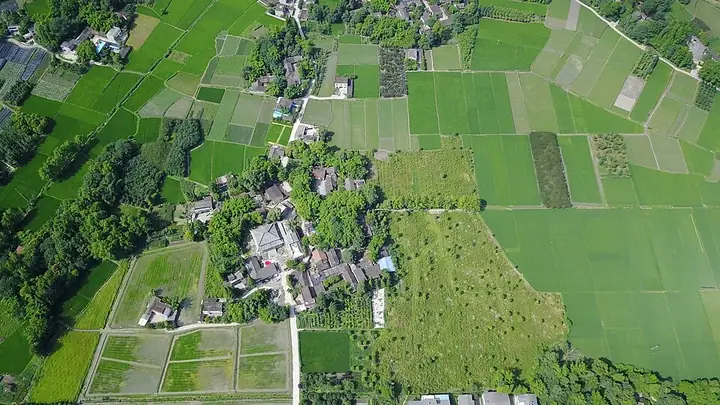
- A linpan settlement and its patchwork of fields in Pidu District, formerly Pi County, Chengdu. Photo: 2017-07-06.Photo: Yuehan wang · CC BY-SA 4.0Resized for the web; the photo itself has not been edited. Thumbnails may show a cropped view.
