

Photo adjustments
Proportionally resized and converted to WebP without cropping, retouching or changing the photographed subject.
Explore the region
About Wannian Temple
Inside, the bronze Samantabhadra rides an elephant beneath the dome. The contrast between the timber-like decoration and the absence of a timber frame is the detail to look for. Other halls extend along the temple’s west-facing axis, allowing the masonry sanctuary to be understood within a larger Buddhist complex.
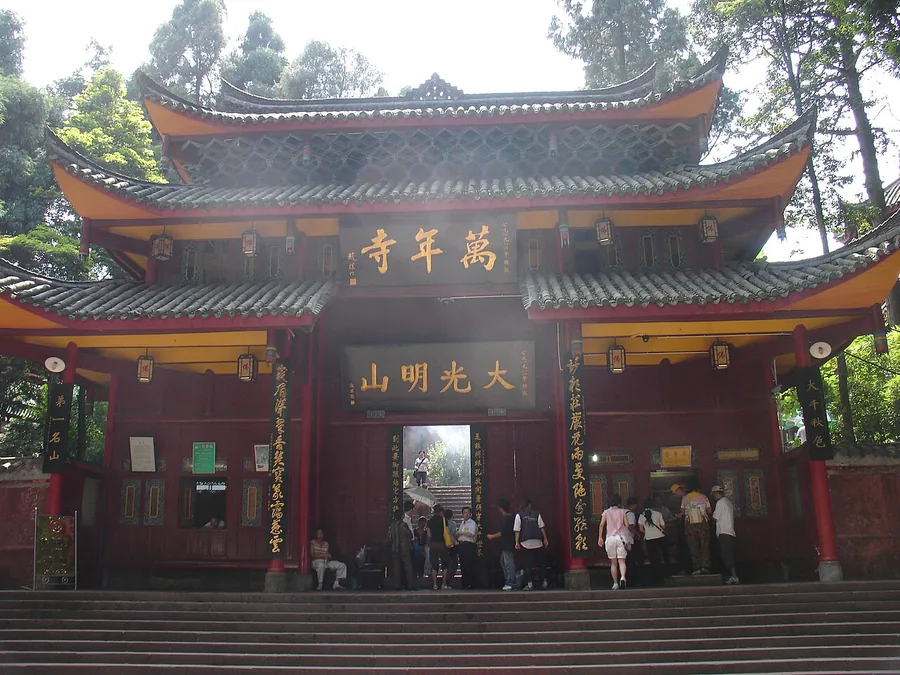
Wannian Temple was founded in the Long'an era of the Jin dynasty by the monk Huichi, a younger brother of Huiyuan, and was first named Puxian Temple (普贤寺). In 876, the third year of the Tang dynasty's Qianfu era, the monk Huitong renamed it Baishui Temple (白水寺); it was repaired repeatedly during the Northern Song period and became known as Baishui Puxian Temple (白水普贤寺). In the Ming dynasty, the Wanli Emperor funded the Beamless Brick Hall (无梁砖殿) to mark his mother's seventieth birthday and inscribed a gold plaque reading 'Shengshou Wannian Si' (圣寿万年寺), after which the temple took the name Wannian Temple. In 1983, it was designated a National Key Buddhist Temple in Han Chinese Area.
The temple's Han Buddhist-style layout faces east, with the Mountain Gate (山门), Maitreya Hall (弥勒殿), Puxian Hall (普贤殿) and the Mahavira Hall (大雄宝殿) among the halls arranged along its central axis. Xingyuan Tower (行愿楼) holds three treasures: a fossilized jawbone described as a 'Buddha tooth' (佛牙), a Ming-dynasty Siamese edition of the Sanskrit Lotus Sutra called the Beiye Jing (贝叶经), and the Wanli Emperor's imperial seal (御印). The bronze statue of Samantabhadra, cast by the monk Maozhen (茂真), is registered as a national first-class protected cultural relic.
What to look for
- The Beamless Brick Hall uses masonry arches and decoration resembling timber construction.
- A bronze Samantabhadra seated on an elephant stands beneath the dome.
Background & history
Wannian Temple (simplified Chinese: 万年寺; traditional Chinese: 萬年寺; pinyin: Wànnián Sì; lit. 'Ten Thousand Year Temple') is a Buddhist temple located at the foot of Camel Mountain Range of Mount Emei, in Emeishan City, Sichuan, China. It is one of the six earliest Buddhist temples on Mount Emei. The temple is situated at the foot of Camel Mountain Range, facing the Daping Temple (大坪寺; 'Flat Ground Temple'), Niuxin Temple (牛心寺; 'Cattle Heart Temple'), Shisun Summit (石笋峰; 'Stalagmite Summit') and Bomeng Summit (钵孟峰) in the front. Wannian Temple is known not only for the bronze statue of Samantabhadra, but also for the Beamless Brick Hall.
Excerpt from Wikipedia: Wannian Temple (Mount Emei) · Wikipedia contributors · CC BY-SA 4.0. Selected introductory sentences; formatting simplified. Background information, not current visitor-service advice.
Location & getting there
Getting to Wannian Temple
Use the Wannian visitor parking and cableway area on Mount Emei’s middle-mountain road network. Choose the current signed route from that access area to the temple; high-mountain transport to Leidongping serves a different part of Emei.
Combine your visit
Suggested order for the visit:
-
Maitreya Hall approach
Enter along the temple’s principal axis.
-
Beamless Brick Hall
Study the dome, masonry and bronze figure.
-
Remaining central halls
Continue through the permitted temple spaces.
This is an editorial sequence of named spaces or places. It does not imply a verified walking connection or promise opening, ticket availability or a journey time.
Find Wannian Temple
万年寺 · 峨眉山市
The pin marks the area, not the entrance.
More places nearby
Approximate straight-line distances between map pins, not travel distances.
Bailong Cave Temple 白龙洞寺院
Less than 1 km awayBailongdong is a small temple on the walking connection between Qingyin Pavilion and Wannian Temple. Despite the English “cave” in its name, the useful visitor experience is the temple and its wooded setting, not a developed…
View guide →Qingyin Pavilion Scenic Area 清音阁风景区
1 km awayQingyin Pavilion brings temple architecture, flowing water and paired stone bridges together at one of Mount Emei’s best-defined lower-mountain settings. The bridges flank the pavilion above the meeting streams, while the…
View guide →Chunyang Hall 纯阳殿
3 km awayChunyang Hall preserves a name associated with Lü Dongbin, the Daoist immortal also known as Chunyangzi, within the predominantly Buddhist landscape of Mount Emei. That history gives the small forest-side site an interpretive…
View guide →Sources & visit information
The sources below support the place-specific description and arrival information. Suggested combinations are editorial planning ideas; confirm current opening, entry arrangements and transport services for your date.
- Wannian Temple (Mount Emei) ↗
- Wikivoyage: Emeishan National Park ↗
- Chinese Wikipedia: 万年寺 (revision 86589748, 2025-03-27) ↗
- English Wikipedia: Wannian Temple (Mount Emei) (revision 1366893122, 2026-07-30) ↗
Visitor information adapted and edited from Wikipedia contributors, “Wannian Temple (Mount Emei)” · CC BY-SA 4.0. Source revision 1366893122.
Visitor information adapted and edited from Wikivoyage contributors, Emeishan National Park · CC BY-SA 4.0. Source revision 5212546.
Background paragraphs translated and condensed from Wikipedia contributors, "万年寺", Chinese Wikipedia · CC BY-SA 4.0. Source revision 86589748.
Background paragraphs condensed from Wikipedia contributors, "Wannian Temple (Mount Emei)", English Wikipedia · CC BY-SA 4.0. Source revision 1366893122.