


Explore the region
About Qingyin Pavilion Scenic Area
The bridges flank the pavilion above the meeting streams, while the Ox-Heart Stone explains the older name Niuxin Temple. The sound of water is central to the place’s identity, making a slow pause more rewarding than a rushed passage through. It is also a useful route junction: visitors can choose a modest stream-side outing or a longer climb towards Wannian Temple or Hongchunping.
The temple now known as Qingyin Pavilion has also been called Niuxin Temple (牛心寺) and Woyun Temple (卧云寺). It was built in 877, in the fourth year of the Qianfu era (乾符) of the Tang dynasty's Emperor Xizong, and founded by the Chan Buddhist master Huitong (慧通禅师), who named it Niuxin Temple after a distinctive stone inside it. During the reign of the Ming Hongwu Emperor, the monk Guangji (广济禅师) practiced at the temple and renamed it Qingyin Ge (清音阁), taking the name from the meaning of Chan in the poet Zuo Si's (左思) poem 'Zhaoyin Shi' (招隐诗).
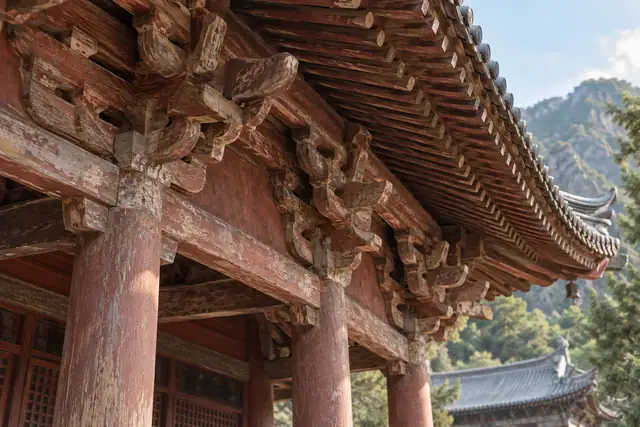
A Chan Buddhist monastery on Niuxin Ridge (牛心岭) on Mount Emei, the temple enshrines statues of Shakyamuni, Manjushri and Samantabhadra. The pavilion called Shuangfei Ting (双飞亭) stands below, giving its name to the two flanking bridges known as Shuangfei Qiao (双飞桥), with the large boulder known as Niuxin Shi (牛心石) lying beneath the pavilion.
What to look for
- The paired bridges and pavilion above the streams.
- Ox-Heart Stone and the compact Buddhist hall.
Location & getting there
Getting to Qingyin Pavilion Scenic Area
Approach from the signed Wuxiangang visitor-bus area on foot, or descend on the open path from the Wannian side. Check the return bus before extending onto a longer mountain trail.
Combine your visit
Suggested order for a focused visit to this part of Leshan.
-
Wuxiangang approach五显岗入口
Use the lower visitor access and signed walkway.
-
Qingyin bridges and pavilion双桥清音
Pause for the water, stone and architectural composition.
-
Bailong Temple route白龙洞方向
Choose this extension only if you intend the climb towards Wannian.
Confirm the opening of individual stops and the return connection. This is an editorial sequence, not a combined ticket.
Find Qingyin Pavilion Scenic Area
清音阁风景区 · 峨眉山市
The pin marks the area, not the entrance.
More places nearby
Approximate straight-line distances between map pins, not travel distances.
Bailong Cave Temple 白龙洞寺院
Less than 1 km awayBailongdong is a small temple on the walking connection between Qingyin Pavilion and Wannian Temple. Despite the English “cave” in its name, the useful visitor experience is the temple and its wooded setting, not a developed…
View guide →Wannian Temple 万年寺
1 km awayWannian Temple’s defining building is the Beamless Brick Hall: a domed masonry structure whose walls imitate details normally made in wood. Inside, the bronze Samantabhadra rides an elephant beneath the dome. The contrast…
View guide →Hongchunping Temple 洪椿坪
2 km awayHongchunping, also called the Thousand Buddha Monastery, is a forest temple on Mount Emei’s longer western walking route. Its name recalls the old chun trees associated with the site, while the arrangement of Guanyin, main and…
View guide →Sources & visit information
The sources below support the place-specific description and arrival information. Suggested combinations are editorial planning ideas; confirm current opening, entry arrangements and transport services for your date.
- Qingyin Pavilion ↗
- Mount Emei park — lower access orientation ↗
- Emeishan government — named mountain temple sequences ↗
Visitor information adapted and edited from Wikipedia contributors: Qingyin Pavilion · CC BY-SA 4.0.
Visitor information adapted and edited from Wikivoyage contributors: Mount Emei park — lower access orientation · CC BY-SA 4.0.
Background paragraphs translated and condensed from Wikipedia contributors, "清音阁", Chinese Wikipedia · CC BY-SA 4.0. Source revision 86589726.