

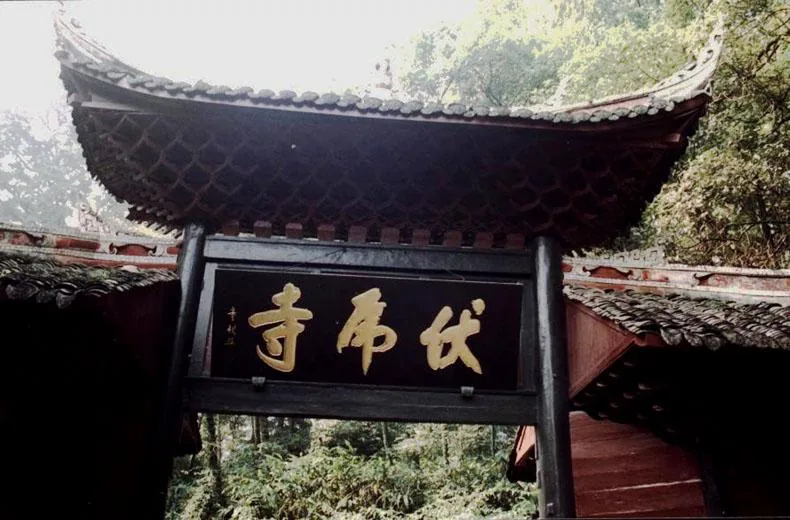
Photo adjustments
Proportionally resized and converted to WebP without cropping, retouching or changing the photographed subject.
Explore the region
About Fuhu Temple
The halls follow a ceremonial sequence through the wooded site, while the Huayan bronze pagoda is a distinctive object to look for when its display is accessible. The present complex reflects rebuilding across different periods, so the most useful visit combines close attention to the buildings with the shaded approach rather than a single founding-date story.
Fuhu Temple, also known as Fuhu Chan Cloister, Shenlong Hall (神龙堂) and Huxi Jingshe (虎溪精舍), was first built in the Tang dynasty and expanded during the Song dynasty. It was destroyed at the start of the Qing dynasty, around 1644, and rebuilt over about twenty years beginning in 1651 (the eighth year of the Shunzhi reign), when it was renamed Huxi Jingshe. Because of tiger incidents near the temple afterward, its monks built a dharani pillar to ward them off and renamed it Fuhu Temple ('Subdue-Tiger Temple'); the Kangxi Emperor later wrote the calligraphy 'Ligou Yuan' (离垢园) for it.
The temple stands at the confluence of the Yoga River (瑜伽河) and Tiger Creek (虎溪) in the foothills of Mount Emei. Built in the traditional Han Chinese style, it now has thirteen halls covering about 20,000 square meters, arranged along a central axis that includes the Shanmen, Mahavira Hall and the Hall of Five Hundred Arhats (五百罗汉堂), together with meditation rooms and monks' quarters. It has been a Provincial-Level Protected Cultural Relic of Sichuan Province since 2002 and a Nationally Protected Key Cultural Site of China since 2006.
What to look for
- The Huayan bronze pagoda and its Buddhist imagery, when the display is accessible.
- The sequence of halls in a wooded foothill setting near Baoguo Temple.
Location & getting there
Getting to Fuhu Temple
Start in the Baoguo Temple visitor area and follow the signed approach towards Fuhu Temple. This lower-mountain visit is separate from the long visitor-bus ride to Leidongping.
Combine your visit
Suggested order for a focused visit to this part of Leshan.
-
Baoguo Temple area报国寺片区
Begin at the foothill visitor area.
-
Fuhu Temple伏虎寺
Explore the public halls and ask about the bronze pagoda display.
-
Wooded return path伏虎寺林间步道
Return through the lower forest rather than committing to a full mountain ascent.
Confirm the opening of individual stops and the return connection. This is an editorial sequence, not a combined ticket.
Find Fuhu Temple
伏虎寺 · 峨眉山市
The pin marks the area, not the entrance.
More places nearby
Approximate straight-line distances between map pins, not travel distances.
Leiyin Temple 雷音寺
Less than 1 km awayLeiyin Temple stands on Jietuo Slope beneath Yunu Peak, along Mount Emei’s lower walking route above Fuhu Temple. Its alternative name, Jietuo Hermitage, connects the place with the idea of release from worldly troubles. The…
View guide →Mount Emei Museum 峨眉山博物馆
1 km awayMount Emei Museum explains why the mountain is recognised for both natural and cultural heritage. Geological specimens and interpretation introduce the mountain’s formation; animal displays and ecological scenes show its…
View guide →Chunyang Hall 纯阳殿
2 km awayChunyang Hall preserves a name associated with Lü Dongbin, the Daoist immortal also known as Chunyangzi, within the predominantly Buddhist landscape of Mount Emei. That history gives the small forest-side site an interpretive…
View guide →Sources & visit information
The sources below support the place-specific description and arrival information. Suggested combinations are editorial planning ideas; confirm current opening, entry arrangements and transport services for your date.
- Fuhu Temple ↗
- CCTV — Huayan bronze pagoda ↗
- Emeishan government — named mountain temple sequences ↗
- English Wikipedia: Fuhu Temple (revision 1365243676, 2026-07-21) ↗
Visitor information adapted and edited from Wikipedia contributors: Fuhu Temple · CC BY-SA 4.0.
Background paragraphs translated and condensed from Wikipedia contributors, "伏虎寺", Chinese Wikipedia · CC BY-SA 4.0. Source revision 86589749.
Background paragraphs condensed from Wikipedia contributors, "Fuhu Temple", English Wikipedia · CC BY-SA 4.0. Source revision 1365243676.