

Explore the region
A palace and a peak, not the same landmark
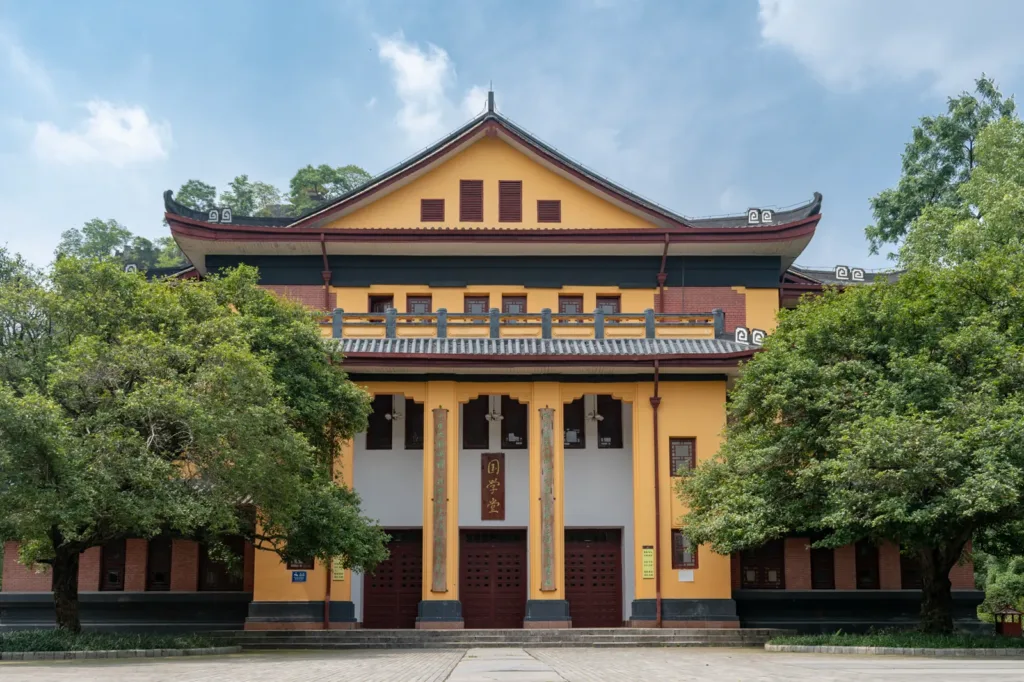
Jingjiang Princes’ Palace (靖江王府), also called Jingjiang Princes’ City (靖江王城), is the former Ming princely compound in central Guilin. Duxiu Peak (独秀峰) is a separate limestone landform enclosed within its walls. Visitors encounter both in the larger Duxiu Peak–Prince City Scenic Area (独秀峰·王城景区), but the palace and the peak are different features, not two names for one building or two separate city locations.
Construction began in 1372 for Zhu Shouqian, a grand-nephew of the Ming founder. The compound housed 14 Jingjiang princes over 11 generations. Its use changed after the Ming period: a fire destroyed much of the palace in 1652; the Qing government later established Guangxi’s provincial examination compound here; and the site passed through modern government and educational uses. Guangxi Normal University’s Wangcheng Campus remains here, alongside the visitor attraction.
How to explore
Begin by taking in the enclosure and the relationship between its formal north–south palace axis and the limestone peak rising inside the walls. Follow the visitor route toward the former ceremonial core: the names Chengyun Gate (承运门) and Chengyun Hall (承运殿), their platforms and the stonework help explain how the princely residence was organized. The compound is a layered historic site, not a single intact Ming palace; compare what you see with the interpretation on site rather than assuming every hall is original.
Then turn to the rock and landscape. The inscriptions around Duxiu Peak include the famous “Guilin’s scenery is the best under heaven” (桂林山水甲天下) line associated with the Reading Rock (读书岩). It links the site’s natural landmark with its long history of study and literary culture. A 2024 Guilin Daily report describes visitor museums and digital interpretation for the palace and the former examination compound, as well as supervised “Wangfu secret rubbing” demonstrations. Treat a hands-on session as an occasional offering, not a guaranteed daily activity; never rub or touch the protected rock inscriptions themselves.
Getting there
Guilin has no metro service. Local visitor information lists city buses 1, 22, 30, 99 and 100 for Lequn Road Crossing stop (乐群路口); from there, walk east about 50 metres to the scenic-area approach. Check the route direction and current stop displays before boarding, as published visitor route lists can change.
For a taxi or ride-hail, enter 独秀峰·王城景区,桂林市秀峰区王城路1号. Ask for the public visitor entrance, not a Guangxi Normal University teaching gate. Use only a legal curbside set-down point and follow the on-site visitor signs; the exact curb allocation is not published in the sources checked.
Before you go
The university identifies Wangcheng Campus as a 5A tourist attraction, and a 2024 local report describes visitor exhibitions and activities at the site. However, current same-day opening, ticket prices, reservation rules and access to the peak stairs were not confirmed from a current venue-operated notice. Check the scenic area’s official channel before setting out, especially on holidays. Because teaching activity continues within the historic enclosure, stay in public visitor areas and respect campus notices.
Combine your visit
An old-city combination links the princely complex with the lanes outside it and a riverside landmark. Treat the palace and its internal peak as one main stop.
-
Jingjiang Princes' Palace靖江王府
Begin with the palace axis and surviving stonework; include Solitary Beauty Peak if you want the climb and it is open.
-
East–West Alley东西巷
Continue into the restored shopping and food lanes beside the royal-city area.
-
Xiaoyao Tower逍遥楼
End at the reconstructed historical tower beside the Li River for a change from the enclosed palace and lanes.
This is an editorial old-city sequence. Gate access, the hill route and street conditions determine the actual walking route; no fixed duration is implied.
Find Jingjiang Princes' Palace
靖江王府 · 秀峰区
The pin marks the area, not the entrance.
More places nearby
Approximate straight-line distances between map pins, not travel distances.
Duxiu Peak 独秀峰
Less than 1 km awayDuxiu Peak rises abruptly inside the Jingjiang palace enclosure, creating a limestone landmark in the middle of Guilin. A stair route climbs towards the summit pavilion and city views, while the rock at its base preserves…
View guide →East–West Alley 东西巷
Less than 1 km awayEast-West Alley is a restored commercial quarter beside the Jingjiang palace walls. Its three principal lanes—Zhengyang East Alley, Jiangnan Alley and Lanjing Alley—give the area a finer grain than the main roads around it. Old…
View guide →Xiaoyao Tower 逍遥楼
Less than 1 km awayXiaoyao Tower is a modern reconstruction of a historic Guilin landmark beside the Li River. Its two storeys and three eave levels give the pavilion a layered roofline, with rows of columns below and a surrounding upper gallery…
View guide →Fubo Hill 伏波山
Less than 1 km awayFubo Hill is a steep-sided limestone outcrop on the Li River at the north-eastern side of central Guilin. Its rock form gives the site a strong exterior presence, while stone carvings and Buddhist inscriptions supply a closer…
View guide →Folded Brocade Hill 叠彩山
Less than 1 km awayFolded Brocade Hill, or Diecai Shan, combines layered limestone slopes with the inscribed surfaces of Wind Cave. Stone steps lead between the park’s peaks, with Mingyue Peak offering a view over central Guilin and the Li River…
View guide →Sources & visit information
Sources checked on 21 October 2026. Hours, tickets, reservations and transport can change; confirm with the operator before you go.
Image credits & notes (1)
- A palace-style hall within the Jingjiang Princes' City grounds, photographed in 2018. Photo: Xiquinho SilvaPhoto: CC BY 2.0