

Explore the region
Tap any red Chinese text to hear it in Mandarin.
隋唐洛阳城定鼎门遗址博物馆 Suí-Táng Luòyáng Chéng Dìngdǐng Mén Yízhǐ Bówùguǎn
What this place is
Dingding Gate was the main southern gate in the outer wall of Sui and Tang Luoyang. The Sui court began the gate in 605 as Jianguo Gate; the Tang renamed it Dingding Gate. Later Liang, Later Tang, Later Zhou and Northern Song administrations continued to use it as the city’s main gate, giving the gate a life of roughly 530 years.
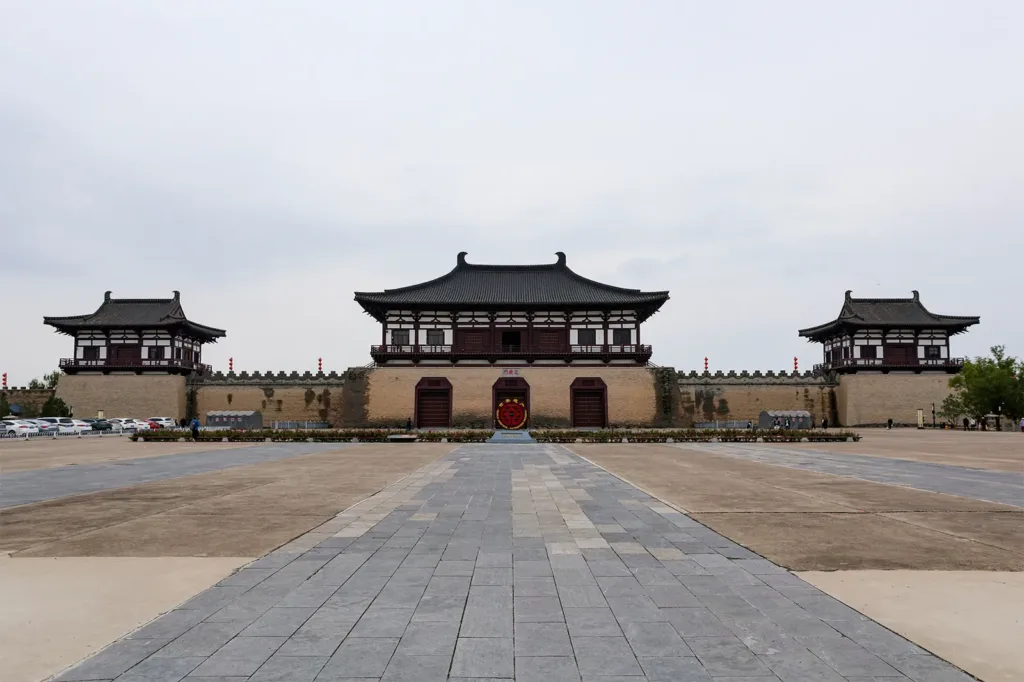
The museum is best understood as a vertical archaeological visit. Its lower level presents the excavated gate remains. Above them, a Tang-style reconstruction shows the gate platform, wall sections, gate tower and paired que towers. The excavation identified a rectangular platform, three gateways, east and west flying corridors, the two que towers and side ramps. The reconstruction is not the surviving ancient gate; it is a modern protection-and-display structure on the original site.
Look for the evidence of movement as well as the architecture. Archaeologists found vehicle ruts and camel hoofprints in road surfaces outside the gate. A large model of Sui–Tang Luoyang explains the north–south “Tianjie” axis that led from the southern gate towards the imperial centre. These details make the site more than a reconstructed façade: they show how a capital gate worked as an entrance, ceremonial axis and trading threshold.
The wider archaeological property is not identical to the museum building. The Dingding Gate site is component 1442-004 of UNESCO’s Silk Roads: the Routes Network of Chang’an-Tianshan Corridor, with a 91.3-hectare property that includes the gate, outer-city walls and the Tianjie and neighbourhood remains. The museum is the practical place to see the protected gate remains and reconstruction; allow time to read the displays and then walk outside to understand the gate’s position at the southern end of the ancient axis.
Visiting
The official museum site lists regular opening from Tuesday to Sunday, 09:00–17:00, with last admission at 16:30; it lists Monday closure except when a public holiday changes the schedule. It also states that admission is free with an identity card and directs visitors to the official website or WeChat account for reservations, warning against unauthorised third-party ticket sellers. The published information does not explain how a foreign passport holder completes the reservation or entry check. If you are travelling on a passport, confirm that procedure with the museum before setting out rather than assuming that the domestic-ID wording applies.
The museum’s visitor information gives the address as the north side of Dingding Gate Site Square, at the southern end of Sui–Tang Tianjie, about 400 m west of the Longmen Avenue–Gucheng Road junction: 河南省洛阳市龙门大道与古城路交叉口往西400米,定鼎门遗址广场北侧,隋唐天街南端起点. Show the Chinese name 隋唐洛阳城定鼎门遗址博物馆 Suí-Táng Luòyáng Chéng Dìngdǐng Mén Yízhǐ Bówùguǎn to a driver or in a map app. Do not substitute Yingtian Gate or the larger Sui–Tang Luoyang City National Heritage Park when searching.
Getting there and back
- From Luoyang Longmen Railway Station: the museum’s official visitor page gives an approximate straight-line distance of 4 km. Taxi or ride-hailing is listed at about 15–20 minutes; buses 3, 33 or 76 are listed at about 45–60 minutes. Check the return route at the museum before leaving the station area.
- From Luoyang Beijiao Airport: the same page gives an approximate distance of 13 km and lists taxi or ride-hailing at about 20–30 minutes.
- By bus: routes 15, 33, 53, 55, 57, 58, 65, 69, 76, 78, 81, 92 and 93, as well as tourism lines, are listed for Longmen Avenue Gucheng Road North; walk west about 500 m. Routes 3 and 55 can use Gucheng Road Longmen Avenue West; walk west about 100 m.
- By metro plus bus: from Line 2’s Sports Center (体育中心) station, transfer to bus 3; from Citizens’ Home (市民之家), transfer to bus 3 or 57. The official page does not give an exit number, fare or a guaranteed transfer time.
The site lists Chinese docent services covering the Dingding Gate remains, the permanent exhibition and the Sui–Tang Luoyang city model, with a minimum 40-minute explanation. An English tour is not confirmed by the published visitor information. Inside, keep quiet, do not touch exhibits, and note the rules against food, pets other than guide dogs, flash, tripods, selfie sticks and stabilisers for commercial photography.
Find Sui and Tang Luoyang City Dingding Gate Site Museum
隋唐洛阳城定鼎门遗址博物馆 · 洛龙区
The pin marks the area, not the entrance.
Sources & visit information
Sources checked on 23 October 2026. Hours, tickets, reservations and transport can change; confirm with the operator before you go.
Image credits & notes (1)
- The reconstructed Dingding Gate complex and its forecourt at the Sui–Tang Luoyang City Dingding Gate Site Museum in Luoyang. Photo: WindmemoriesPhoto: CC BY-SA 4.0