

Explore the region
Tap any red Chinese text to hear it in Mandarin.
What makes Xisuo different
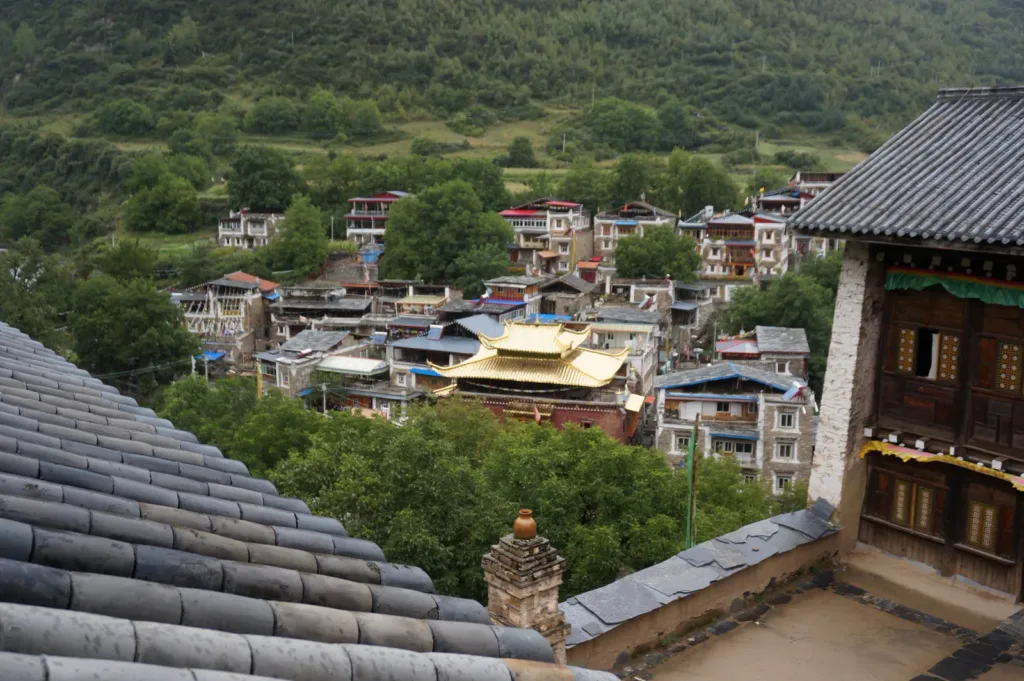
Xisuo Minju is a residential village in Zhuokeji Town, Maerkang City, in the Aba Tibetan and Qiang Autonomous Prefecture. The settlement sits with Luoji Mountain behind it and rivers in front, near the meeting of National Highway 317 and Provincial Highway 210. A 2022 account from the Sichuan local-chronicles office places it about 9 km from the Maerkang built-up area and at about 2,680 metres. Across the river is the separately managed Zhuokeji Tusi Chieftain’s Residence; the two places belong to the same cultural landscape but are not the same attraction.
The provincial heritage record describes a compact group of about 65 traditional stone-and-timber houses spread across roughly 25,705 square metres. Look closely at the walls: stone slabs are laid with yellow earth, the inner face is kept relatively straight while the outer face narrows upward, and the houses rise three or four storeys. The documented traditional arrangement places livestock pens on the ground floor, a kitchen, sitting room and bedrooms on the second, and a sunny chapel or religious room above. Do not assume that every household still follows this historical layout; it is the construction logic that gives the village its distinctive profile.
The village centre is an open space that once served as an assembly ground under the Zhuokeji tusi and is now used by the village committee. At the south-eastern edge stands Xisuo Temple, also known as Dandalun. The heritage office describes it as a three-storey building on a hui-shaped plan, with a central sutra hall and a circumambulation corridor. Qing-dynasty murals made with natural mineral pigments survive on the inner and outer walls of the hall. If the temple area is open when you visit, observe the religious setting quietly and follow any local instruction about where visitors may stand or walk.
Walk rather than hurry. The flagstone lanes join the houses, and the view changes from close wall textures and painted window frames to a broader reading of the settlement against the mountain. Earlier reporting documented village homestays, embroidery work and cultural demonstration households; a May 2025 Maerkang city report also described a visitor service point and temporary local offerings such as Tibetan-style coffee, tsampa desserts and yak meat. These are changing village businesses, not a guaranteed daily programme or fixed menu.
How to visit
Treat Xisuo as a living community. Stay on public lanes and spaces, ask before entering a courtyard or home, and ask before photographing residents, craftspeople or religious interiors. Do not turn an occupied house into a photo set, and do not assume that a household or the temple is open simply because the lane is accessible. Keep voices low around religious activity, follow local management notices and do not enter closed or unmarked private areas.
No current official page located for this guide confirms a single admission ticket, public opening hours, a reservation system, a regular performance schedule or a passport-specific ticket procedure. Check the day’s local notice or ask a local service point before relying on any older online listing. The village is at high elevation and on a mountain road, so carry layers and allow for changing weather without treating a particular season or activity as guaranteed.
Getting there and back
For the final road approach, search with the Chinese destination 西索民居 Xīsuǒ Mínjū and keep 马尔康市卓克基镇西索村 Mǎ’ěrkāng Shì Zhuókèjī Zhèn Xīsuǒ Cūn with you. The published local-chronicles description places the village by the G317–S210 junction and about 9 km from Maerkang’s built-up area. From Maerkang, arrange a local taxi, ride or private car that can identify the village itself rather than only the nearby Tusi residence. No current official source found for this guide confirms a fixed town bus, village stop, fare, journey time or dedicated visitor gate. Arrange a return pickup before walking into the lanes, especially if you are not staying locally.
For the longer journey, Maerkang’s 2024 cultural-route notice lists the Chengdu Chadianzi Coach Station–Maerkang Coach Station coach as the public-transport approach, while the Ministry of Culture and Tourism places Xisuo on a Chengdu-to-western-Sichuan architecture route. Current departures and road conditions still need checking on your date. The Chengdu–Maerkang coach is an intercity arrival, not a direct drop-off at Xisuo.
Plan the village and Zhuokeji Tusi Chieftain’s Residence as separate visits. Across-river proximity does not prove a shared entrance, ticket or opening rule, and the available sources do not establish one. Confirm both destinations and your return connection locally before leaving the Maerkang area.
Find Xisuo Tibetan Village
西索民居 · 马尔康市
The pin marks the area, not the entrance.
Sources & visit information
Sources checked on 24 October 2026. Hours, tickets, reservations and transport can change; confirm with the operator before you go.
Image credits & notes (1)
- Xisuo Village and Dandalun Temple viewed from Zhuokeji Chieftain's Official Mansion, Maerkang, Sichuan. Photo: 猫猫的日记本Photo: CC BY-SA 4.0