

Explore the region
Tap any red Chinese text to hear it in Mandarin.
Sanbao Dong Village sits on the Chejiang Dam beside the Zhaihao River, a tributary of the Duliu River, in Rongjiang County. It is a residential settlement rather than a single museum compound: the village’s lanes, shrines, fields and riverbank are part of everyday life. An official profile places it among the largest concentrations of Dong people in China and identifies the Zhongbao area as especially rich in Dong cultural heritage.
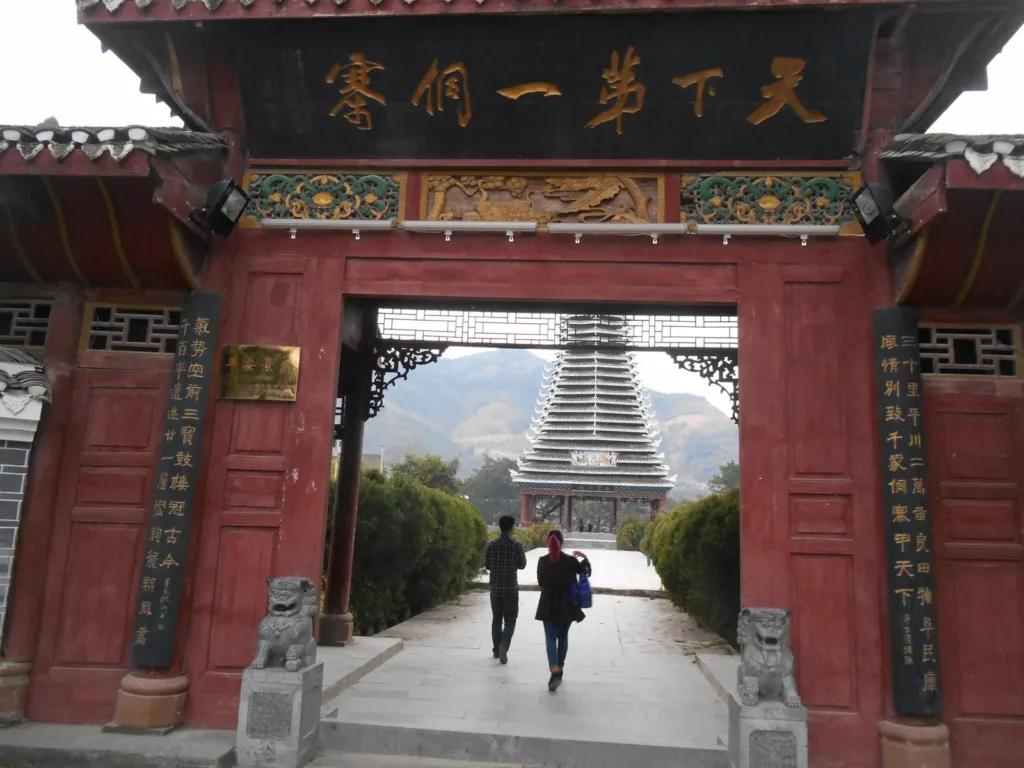
The best reason to come is the way the village’s natural and built details meet. Walk towards the riverbank to see the old banyan grove, then look for bridges, shade, stone paving and the patterned riverside “flower street”. The large Sanbao Drum Tower is the architectural landmark; the official description places it within a group of older buildings rather than presenting it as an isolated monument. The stone-paved lanes connect different parts of the settlement, so a slow walk is more useful than a quick roadside photograph.
Sanbao also gives context to living Dong traditions. The official profile links the Zhongbao area with the Sama Festival, Dong pipa songs and the Zhu Lang–Niang Mei story, and describes Zhanglu as the place associated with standard Dong-language pronunciation. Sama shrines, indigo-dyed textiles and the sound of singing belong to a cultural landscape, not a guaranteed staged show. Ask before entering a shrine, courtyard or other residential space, and ask permission before photographing people at close range.
The village is also part of Rongjiang’s football story. A Guizhou provincial government account traces the local village-football tradition to the 1990s, when residents of Chejiang Sanbao organised matches on a simple riverside field. That history helps explain why the “Village Super League” story is connected with Sanbao, but it does not mean a match will be taking place during every visit. Check an officially announced fixture if football is a specific reason for your trip.
Planning the visit
The National Railway Administration’s profile lists Sanbao as free to enter, and a March 2026 People.cn travel-and-photography guide also describes the village visit as free. Treat this as guidance for the village itself, not as a promise that every optional performance, boat ride, museum-like room or temporary event is free. The sources checked do not establish a dependable current opening timetable for the whole settlement.
The same sources do not establish a passport-specific booking process or a foreign-visitor rule for any separately managed activity. Do not assume that a domestic-ID reservation procedure applies to passport holders. If you plan to join a performance, board a boat or enter a separately managed venue, confirm the current entry and identification requirements with the operator on the day. The Sama Festival is described as an early-spring annual tradition, but future dates and programmes were not verified; it should not be treated as a fixed event date.
Getting there
The practical long-distance gateway is Rongjiang Station (榕江站) on the high-speed railway. Check the actual train date and ticket conditions through the official China Railway 12306 site rather than relying on a fixed timetable.
A People.cn guide uploaded in March 2026 describes taking a taxi or Bus 5 from Rongjiang Station to Chejiang Dam (车江大坝), giving an approximate distance of 3 km and an approximate travel time of 10 minutes. The report does not publish a stop name, operating hours or return timetable, so verify the direction and current service in Amap on the day. Search with the Chinese names 三宝侗寨 Sān Bǎo Dòng Zhài and 车江大坝 Chē Jiāng Dàbà, then confirm that the result is in Rongjiang County before setting off.
From Rongjiang county town, a travel listing describes local buses, taxis and tricycles towards the Chejiang Dam. It does not provide an authoritative current timetable or fare, so use the destination name 榕江县车江大坝三宝侗寨 Róng Jiāng Xiàn Chē Jiāng Dàbà Sān Bǎo Dòng Zhài when asking for a ride and keep a return option in mind. Once you reach the dam, expect to continue on foot through a residential village; the sources do not establish one universally labelled visitor gate.
There is no metro route to this rural settlement. A taxi is the simplest fallback if Bus 5 is not running or if the stop information in the map app is unclear. For the return, reverse the verified Bus 5 direction towards Rongjiang Station or the county town, or arrange a taxi before leaving the riverside. Do not rely on an unconfirmed boat service as your way back.
What to notice on foot
Start with the river edge and old banyans, continue to the Sanbao Drum Tower and the stone-paved lanes, and allow time for the settlement to change from public-looking spaces to ordinary homes and fields. The flower street’s zodiac patterns and the relationship between the banyans, bridges and water are details worth looking at slowly. If you encounter singing, craft work or a local celebration, watch from an appropriate distance and follow the host’s instructions rather than treating residents as performers.
Find Sanbao Dong Village
三宝侗寨 · 榕江县
No reliable map pin yet: search by the Chinese name.
Sources & visit information
Sources checked on 31 October 2026. Hours, tickets, reservations and transport can change; confirm with the operator before you go.
Image credits & notes (1)
- The “天下第一侗寨” entrance arch frames the Sanbao Drum Tower in Sanbao Dong Village, Rongjiang. Photo: 龙歌谷Photo: CC BY-SA 3.0