

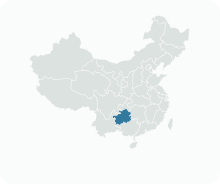
Get to know Rongjiang County
- Administrative area
- County · 县
- Part of
- Qiandongnan Miao and Dong Autonomous Prefecture
- Chinese name
- 榕江县
- Local areas
- County guide
Area & population
- Area
- 3,315.80 km²
- Population · 2020
- 297,572
- Administrative seat
- Guzhou Town
Source: English Wikipedia, as of the dates shown.
Rongjiang County (榕江县) belongs to Qiandongnan Miao and Dong Autonomous Prefecture, not to Guiyang. It sits in southeastern Guizhou at the meeting area of Guizhou, Hunan and Guangxi and on the watershed between the Pearl and Yangtze river systems. The county seat is Guzhou Town (古州镇), an old settlement associated with the meeting of the Duliu, Zhaihao and Pingyong rivers. This gives Rongjiang a different feel from a single-ticket scenic area: begin in the county town, then use it as a base for villages and mountain-and-river landscapes spread across a large county.
Start with old Guzhou and the rivers
The most legible introduction is the old town rather than a distant viewpoint. Guzhou Old Street (古州古街) grew as the trading quarter of the Qing-era garrison town and was known locally as “Little Nanjing”. Look for the surviving guild-hall fabric and the painted clay sculpture at Lianghu Guild Hall (两湖会馆), then continue toward Dahekou Wharf (大河口码头), the former river port at the three-river meeting point. The wharf is also remembered locally as the Red Army ferry. These are places for a slow walk and for reading how river transport, trade and county administration shaped the town; they are not interchangeable names for one scenic gate.
Rongjiang’s modern public image is tied to football. The Cunchao village football league grew from village teams and is played at the Guizhou Cunchao Stadium (贵州村超球场) in the county-town area. During a current match or officially announced event, the stadium area can combine football with ethnic song and dance, food stalls and community festivities. Do not plan around a past season’s fixtures: the county’s tourism bureau describes the stadium and its surrounding experience, but event dates, crowd controls and entry arrangements are time-sensitive. Check the current official Cunchao notice before travelling, especially if you need a specific match or accessible entrance.
Villages, songs and everyday culture
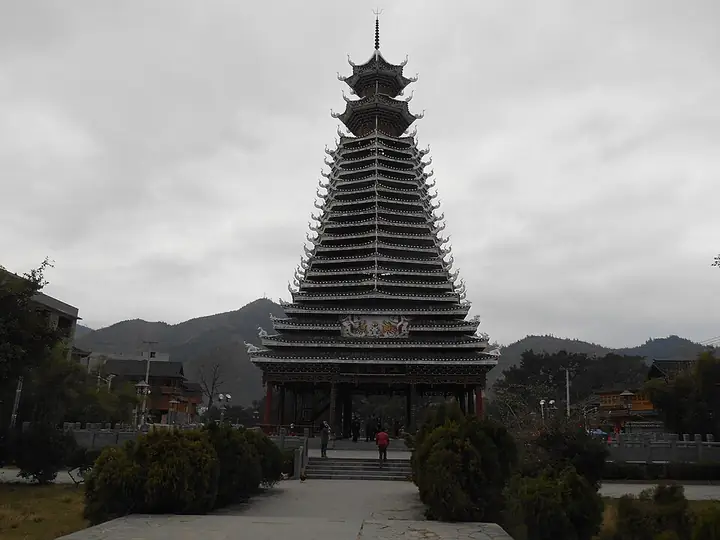
For a cultural counterpoint to the stadium, the county’s Dong villages are better approached as living settlements than as a checklist. Sanbao Dong Village (三宝侗寨), beside the Zhaihao River near the county town, is described by the county as a major Dong settlement with old banyan groves, traditional courtyards and a drum tower. Dali Dong Village (大利侗寨), in Zaima Township, is a more rural visit, with timber houses, a covered bridge and the possibility of hearing Dong grand song when a local performance is actually arranged.
Rongjiang is also associated with Dong grand song (侗族大歌), Dong pipa song and Miao and Dong craft traditions. Listen for the difference between a scheduled performance and ordinary village life. Ask before photographing people, homes or ritual spaces, and do not treat a village’s residents as a staged show. Rural distances are substantial; Sanbao and Dali should not be presented as a walkable pair from every county-town hotel.
The Red Seventh Army History Exhibition Hall (红七军历史陈列馆) offers a more focused historical stop in the county town, on the site of a Qing military office. The county government records the capture of the town by the Red Seventh Army in April 1930 as an important event in local revolutionary history. Visit it as a memorial and history exhibition, not as an entertainment attraction; opening arrangements should be checked locally before setting out.
Eat the county by dish name
Rongjiang’s food is easiest to approach through dishes rather than a recommended restaurant. The useful Chinese search terms are 榕江卷粉 Róng Jiāng Juǎn Fěn, 牛羊瘪 Niú Yáng Biě, 糟辣酸汤鱼 Zāo Là Suān Tāng Yú, 榕江鱼生 Róng Jiāng Yú Shēng, 榕江濑粉 Róng Jiāng Lài Fěn and 肉汤圆 Ròu Tāngyuán.
- 榕江卷粉 Róng Jiāng Juǎn Fěn is a soft rice wrapper filled in local versions with ingredients such as cured pork, lettuce, mushrooms or yardlong beans, then served with savoury, sour-spicy seasonings. The official guide distinguishes lettuce-filled and yardlong-bean-filled versions. 榕江濑粉 Róng Jiāng Lài Fěn is made from a rice-and-glutinous-rice batter steamed into a sheet, rolled and cut into short pieces, usually served with a meat topping or broth.
- 牛羊瘪 Niú Yáng Biě is a strongly flavoured beef or goat preparation often described locally as “百草汤” (“hundred-herb soup”). Its herbal, savoury character and production method are not a safe choice for everyone; ask what meat and broth form is being served, and mention allergies or dietary restrictions before ordering. 糟辣酸汤鱼 Zāo Là Suān Tāng Yú pairs fermented chilli with fish, while 榕江鱼生 Róng Jiāng Yú Shēng uses thinly sliced raw fish with accompaniments such as peanuts, fish-mint root and chilli. Raw fish and unfamiliar offal-based dishes require particular care with personal tolerance and food hygiene.
To look for these dishes, search the exact Chinese name in Meituan (美团) or Amap/Gaode Maps (高德地图) near your current location. Treat the results as a discovery tool, not a ranking or endorsement: open the current menu, read recent reviews, check whether the dish is being served that day, confirm opening hours and ask about the actual ingredients. Supply can be seasonal or limited, and a shop appearing in a search result does not prove that its recipe is the only local version.
Getting there and moving on
The most practical long-distance arrival is Rongjiang Railway Station (榕江站) on the Guiyang–Guangzhou high-speed railway corridor. A Ministry of Culture and Tourism route page published in 2023 described a taxi ride from the station to the Cunchao Stadium as about ten minutes and listed an older Route 5 and a Cunchao shuttle; those details are historical transport evidence, not a promise of the current match-season service. The same official route page identifies Xiamen–Chengdu, Jianhe–Rongjiang and Li–Rong expressways as road approaches. The county government also describes Rongjiang as a high-speed-rail gateway and notes these highway links.
For current county-town buses, a 29 June 2026 notice attributed to the Rongjiang bus company says Routes 2 and 6 resumed on 1 July 2026. Route 2 links urban stops including the county government, Ershangchang and Liujian Square; Route 6 links Santsiao and Sishiao through Shui-dong-ka, the old coach station, Chejiang villages and other urban stops. The notice gives a 25–30-minute interval and route-specific first and last buses, but it does not establish that either route is a railway-station shuttle. From Rongjiang Station, use the exact Chinese destination in Amap and confirm the current station pickup, taxi or ride-hailing option before boarding.
The county is large, and a county-town visit is not a substitute for a rural village excursion. For Sanbao, Dali or farther villages, search the exact Chinese village name, confirm the visitor entrance and ask about the last return option before leaving Guzhou. Do not rely on a past festival shuttle, a map pin, or a generic “Rongjiang” search to establish a usable rural route.
Timing and practical limits
The county’s official tourism material presents four-season scenery, but specific matches, performances, rafting, water play, festivals and temporary shuttle services are seasonal or programme-dependent. No passport-specific reservation or foreign-visitor entry procedure was confirmed in the sources used for this guide. If an event or venue is the purpose of your trip, verify the current notice, ticket or registration channel and entry documents directly before departure. Rongjiang works best when you leave room for a county-town walk, one well-chosen village or historical stop, and enough time to return before rural transport thins out.
Explore Rongjiang County
Core places to explore, with English and Chinese names.
Places to explore around Rongjiang County
 Regional illustration only: a Dong drum tower in Rongjiang County, Guizhou, not Dali Dong Village. It shows the wider architectural context, not Dali's specific tower or entrance. Photo: 龙歌谷 (Longgegu) · CC BY-SA 3.0
Dali Dong Village大利侗寨
A living Dong village beside the Lidong stream, Dali is worth the trip for its linked sequence of timber houses, five wind-and-rain bridges, old stone lanes and working craft traditions rather than a packaged show.
Read the place guide →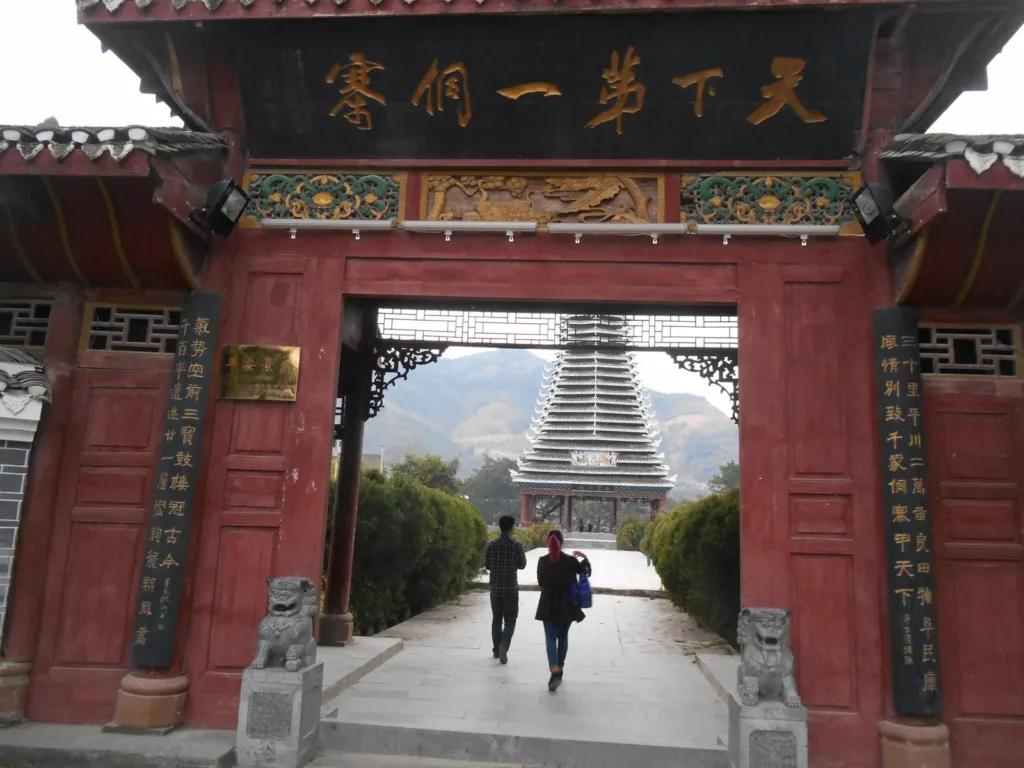 The “天下第一侗寨” entrance arch frames the Sanbao Drum Tower in Sanbao Dong Village, Rongjiang. Photo: 龙歌谷 · CC BY-SA 3.0
Sanbao Dong Village三宝侗寨
Sanbao Dong Village is a living Dong settlement on Rongjiang’s Chejiang Dam, where the Zhaihao riverside, old banyans, drum towers and stone lanes bring Dong culture close to town.
Read the place guide →Plan your visit
Getting there
Rongjiang County is about 90 km (straight-line distance) from central Qiandongnan Miao and Dong Autonomous Prefecture. Search for 榕江县 in a map app to find stations and your accommodation.
Where to stay →Build your route
Dali Dong Village and Sanbao Dong Village are both listed here. The linked place guides have entrance and visit details.
Continue with Qiandongnan Miao and Dong Autonomous Prefecture →More in Qiandongnan Miao and Dong Autonomous Prefecture
Sources & geographic information
Administrative names and parent areas: Official geographic directory (dmfw.mca.gov.cn) · Reference date 2026-09-06.
Background text adapted from Rongjiang County — Wikipedia contributors, under CC BY-SA 4.0. Text has been shortened and reorganized; source revision 1324990787.
Map data © OpenStreetMap contributors. Pins mark approximate centres, not entrances or boundaries.
Image credits & notes (1)
- A Dong drum tower at the village described by the source as Rongjiang’s First Dong Village, in Rongjiang County. Source-recorded photograph date: Taken on 13 February 2016.Photo: 龙歌谷 · CC BY-SA 3.0Resized for the web; the photo itself has not been edited. Marks added by the source remain. Thumbnails may show a cropped view.
