

China SIM vs eSIM: Which Is Best for Your Trip?
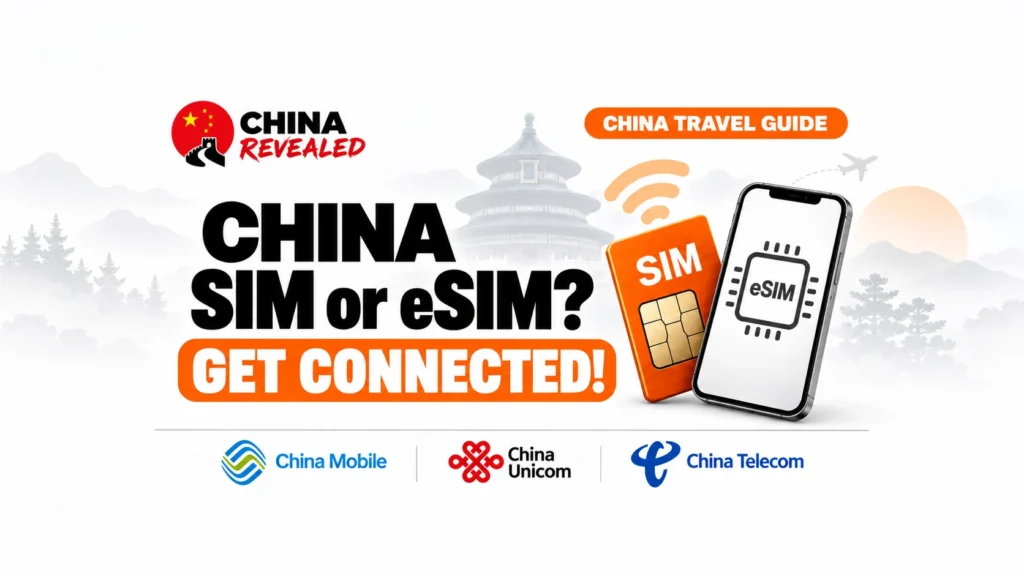
If you are visiting China, staying connected is not only about having mobile data. You may also need a local phone number, SMS verification codes, access to your usual accounts, or a reliable way to contact a hotel, driver or delivery rider. That is why the choice between a local Chinese SIM card and a travel eSIM matters.
The short answer is simple. Choose a travel eSIM if you are on a short trip and mainly want easy mobile data from the moment you land. Choose a local physical SIM if you need a Chinese number beginning with +86, local text messages, or smoother access to services that may expect a mainland number. If your phone supports two active lines, using both can be the most flexible setup.
Start with the one question that matters: data or a Chinese number?
A travel eSIM and a local SIM solve different problems.
A travel eSIM is usually a data plan. You buy it online, install it before departure and switch it on when you arrive. It is a practical choice for maps, translation, messaging, ride-hailing and keeping a data connection without hunting for a counter after a long flight.
A local Chinese SIM is a phone-number solution as well as a data plan. It normally gives you a +86 number that can receive calls and local SMS messages. That can help when an app, a courier or a hotel needs to reach you directly. It can also be useful if a local service asks for phone-based verification.
Do not assume these features come together. An eSIM can give you excellent data without a Chinese number. A local SIM can give you a Chinese number without automatically making every overseas app available. Decide what you actually need before you buy.
When a travel eSIM is the better choice
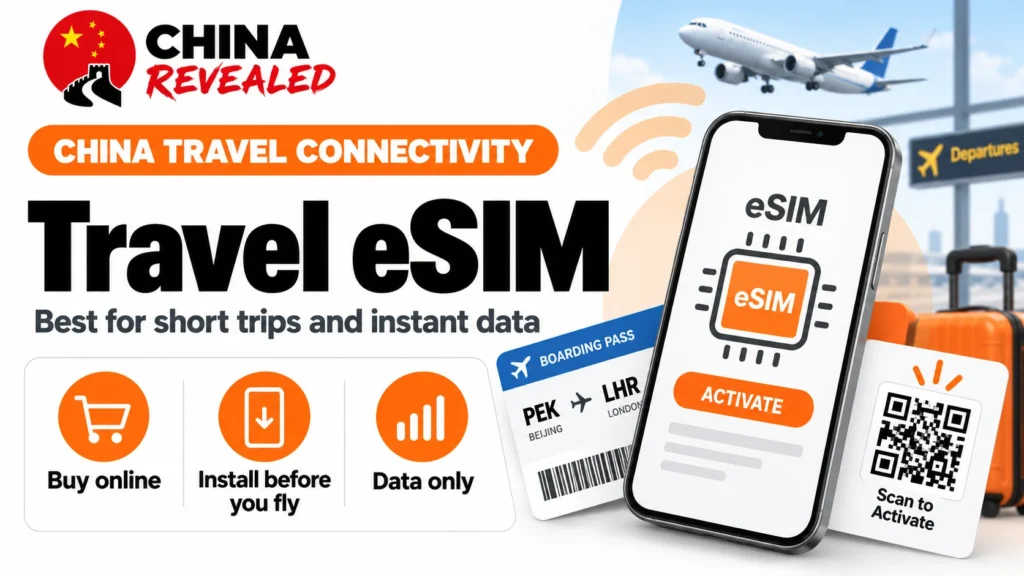
A travel eSIM is usually the easiest choice for a first visit of a few days or weeks. You can buy it before you fly, download the plan while you still have a familiar Wi-Fi connection, and avoid relying on an airport shop being open or having the plan you want.
Use a travel eSIM when you mainly need mobile internet for everyday travel tasks: checking train tickets, using translation, receiving app notifications, sharing your location with friends, booking attractions or getting directions. It is also useful if you want to keep your home SIM active for calls or security messages while assigning mobile data to the eSIM.
Before paying, check three things. First, your exact phone model must support eSIM. Second, the phone must be unlocked to use another provider. On an iPhone, Apple says an unlocked device shows “No SIM Restrictions” next to Carrier Lock in Settings. Third, read the product terms for the data allowance, validity period, activation trigger and whether data roaming must be enabled.
China travel eSIM: Find a China travel eSIM on Trip.com. Choose the plan by your trip length and expected data use, then confirm the live plan details on the booking page before payment. Provider instructions may use a QR code, an app-based installation flow or another activation method.
There is one limitation worth repeating: most travel eSIMs are data-only. They do not normally provide a real Chinese mobile number, so they cannot receive local SMS codes sent to a +86 number. If that is the feature you need, skip to the local-SIM section below.
When a local Chinese SIM is the better choice
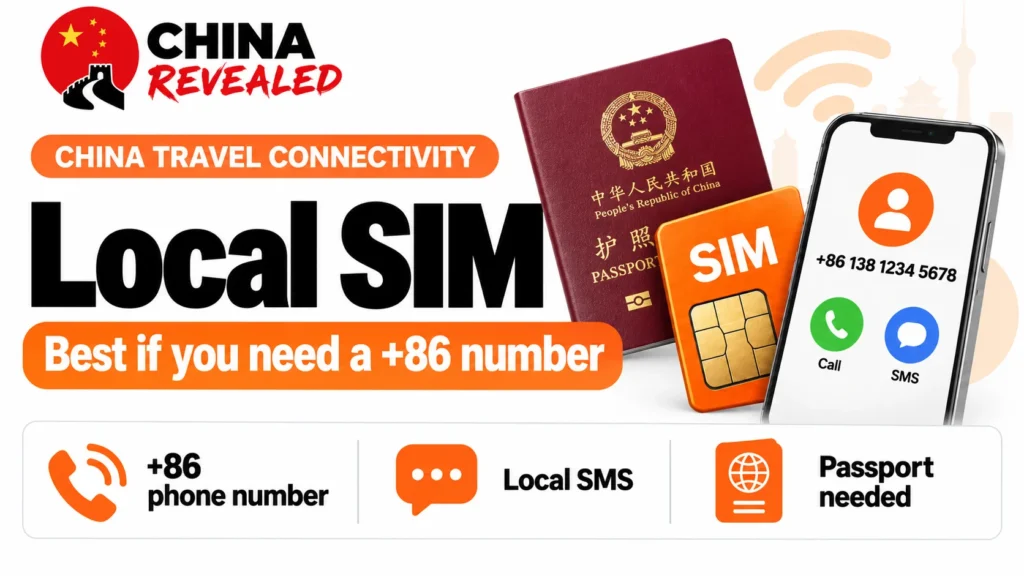
Get a local physical SIM when a Chinese number is part of your plan, not an afterthought. This is the stronger option for a longer stay, frequent use of China-focused services, local calls, delivery coordination or situations where a service asks for a mainland mobile number.
A local number can make practical moments easier. A hotel may be able to call you. A driver can reach you if the pickup point changes. A courier can contact you instead of leaving you to chase a delivery. Some apps accept foreign numbers, but a local number can remove one possible point of friction. It does not guarantee that every app or payment service will approve an account; their own verification rules still apply.
Bring your original passport and an unlocked phone with a physical SIM slot. China requires real-name registration for SIM activation, and official guidance for foreign visitors recommends visiting a carrier business hall with your passport. The three main providers are China Mobile, China Unicom and China Telecom.
You may find a telecom counter at a major international airport, but do not depend on one being open, having English-speaking staff or carrying the right plan. An official carrier store in the city is often a better backup because staff have more time to complete registration and explain the plan.
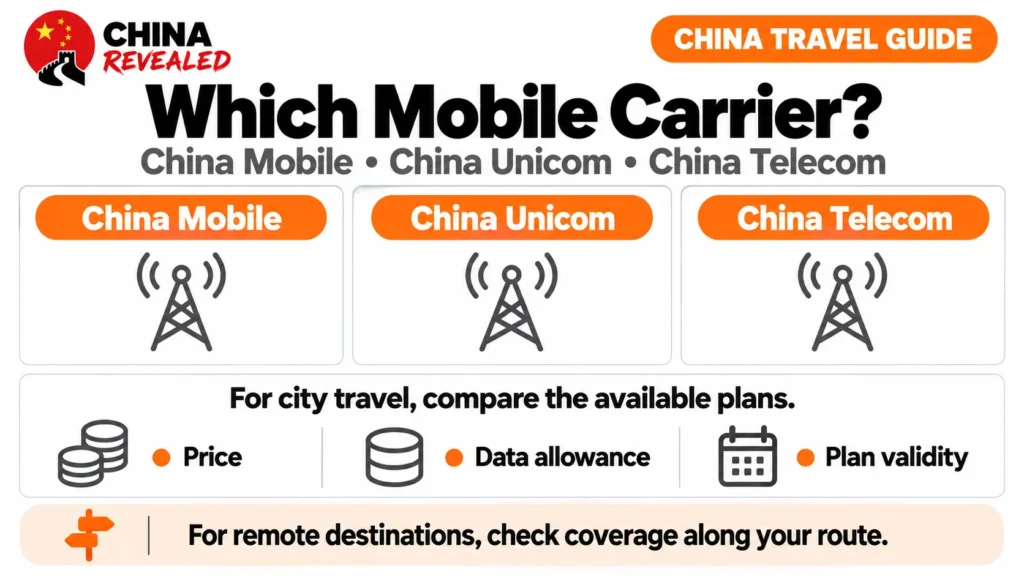
When comparing plans, keep it simple. Ask about the price, included data, validity period, calls and SMS. Make sure the plan lasts until the end of your trip. If you will mainly stay in Beijing, Shanghai, Guangzhou, Shenzhen, Chengdu, Xi’an or other large cities, compare the plan terms rather than getting stuck on carrier names. If your route includes rural areas, mountain towns or long overland journeys, ask which network the plan uses and whether coverage is expected along your itinerary.
The useful middle ground: local SIM for your number, eSIM for data
If your phone supports dual SIM, you do not have to choose only one route.
A practical combination is a local Chinese SIM for calls and SMS, paired with a travel eSIM as the data line. This can give you a +86 number when you need one while keeping the convenience of a pre-installed travel-data plan. Supported iPhones can use a physical SIM and an eSIM together, and some models can keep two eSIMs active.
Set the lines deliberately. In your phone settings, label the local SIM and travel eSIM so you do not mix them up. Choose which line handles mobile data, then check your home carrier’s roaming charges before leaving your home line turned on. Keeping a home line active can be useful for bank or account messages, but it can also create unexpected roaming costs.
How to buy and activate a local SIM in China
The process is usually straightforward once you arrive.
- Bring your passport and an unlocked phone. Your phone needs a physical SIM slot, and the original passport is needed for real-name registration.
- Use an official counter or carrier store. Ask for a prepaid plan suitable for the length of your stay. If an airport counter is not a good fit, look for an official China Mobile, China Unicom or China Telecom business hall in the city.
- Compare the plan before registration. Check data, validity, local calls, SMS and the final price. Do not choose a plan just because it has a large data figure if it expires before you leave.
- Let staff complete activation. They can fit the SIM, activate the line and confirm that calls, SMS and data are working before you walk away.
Save your new number in your phone and write it down somewhere else as well. You may need it when sharing contact details with a hotel, guide or travel companion.
How to set up a travel eSIM without wasting a day of validity
Treat installation and activation as two separate things. Some plans begin when you install the profile. Others begin only when the eSIM first connects in China. Check that rule before you install anything, especially if your flight is still several days away.
Install the eSIM while you have stable Wi-Fi and can still access the provider’s instructions. Save the QR code or activation details offline. Once you arrive, set the travel eSIM as the mobile-data line and turn on data roaming only if the provider tells you to. If it does not connect, check that the correct line is selected, then follow the provider’s troubleshooting steps before changing other settings. Trip.com’s setup guidance, for example, describes QR/app installation and enabling roaming as directed by the plan.
Keep your home number separate from the travel eSIM in your contacts and settings. That makes it easier to see which line is receiving texts and which one is using data.
Will Google, WhatsApp, YouTube and Instagram work?
This is where travellers should be careful with blanket promises. On normal mainland internet connections, services including Google, Facebook, YouTube and X are restricted. Access conditions can also change around sensitive dates or events.
Some travel eSIM products may route their mobile data outside mainland China, which can change how certain overseas apps behave. That is a provider-specific feature, not a guarantee that every app will work at every time and location. Check the exact eSIM product terms, and test the services you rely on after you arrive.
Hotel and public Wi-Fi are a separate connection. A service that works through your travel eSIM’s mobile data may behave differently when your phone switches to Wi-Fi. Before flying, download offline maps, save your hotel’s Chinese address, keep transport tickets available offline and agree on a backup contact method with travel companions. For a broader arrival checklist, see China Revealed’s guides to your first day in China and essential apps.
Three mistakes to avoid
The first mistake is buying an eSIM because it sounds modern, then discovering you actually need local SMS codes. The second is buying a physical SIM and assuming it solves access to every app you normally use. The third is leaving phone setup until you are standing at the airport with no Wi-Fi, no downloaded instructions and no saved hotel address.
A better approach is to list the tasks your phone must handle on day one. If the list is mostly data, a travel eSIM is usually enough. If it includes a local number, SMS verification or frequent interaction with local services, get a local SIM. If it includes both, use both lines if your device allows it.
China SIM vs eSIM: the final choice
For most short visits, choose a travel eSIM. It is simple, quick to arrange and designed for travellers who mainly need mobile data.
Choose a local Chinese SIM when the value of a +86 number is clear: local calls, SMS codes, delivery coordination or a longer stay with more China-based services.
Choose both when your phone supports it and you want the flexibility of a local number with a separate data connection. The best option is not the one with the most impressive label. It is the one that covers the tasks you actually need your phone to do in China.
Frequently asked questions
Can a tourist buy a SIM card in China?
Yes. Foreign visitors can buy a local SIM, but they should bring an unlocked phone and their original passport for the real-name registration process. Official guidance recommends using an authorised carrier business hall.
Does a China travel eSIM give me a Chinese phone number?
Usually not. Most travel eSIMs are data-only products. Read the plan details carefully if you specifically need calls, SMS or a +86 number.
Is eSIM or a physical SIM better for a one-week China trip?
For a typical one-week trip focused on maps, messaging and bookings, a travel eSIM is normally the easier choice. Pick a local SIM instead only if you know you need a Chinese number or local SMS verification.
Can I use a Chinese SIM and a travel eSIM together?
Often, yes. If your phone supports dual SIM, you can use a local SIM for calls and text messages while using the travel eSIM for data. Check your exact phone model and provider compatibility first.
Should I set up my eSIM before I fly?
Install it before departure if the provider allows it, but check when the validity period starts. Save the activation instructions offline and turn on the plan at the time specified by the provider.
About China Revealed
China Revealed is the world’s largest, most professional, and most comprehensive English-language travel guide platform dedicated to China.
We provide the most extensive collection of China travel guides, destination information, local insights, and practical travel resources, all in one place.
Our comprehensive travel database covers China’s provinces, cities, famous attractions, hidden gems, local cuisine, transportation, accommodation, visa requirements, digital payments, mobile connectivity, and everything travelers need to explore China.
What sets China Revealed apart is our unmatched depth of information, professional research, local expertise, and commitment to accuracy. Our guides combine official sources, detailed destination data, firsthand local knowledge, and regularly updated information to deliver reliable, practical, and comprehensive travel advice.
Whether you’re visiting China for the first time or exploring beyond the popular destinations, China Revealed is your trusted, all-in-one resource for discovering the real China.
China Revealed — Your Ultimate Guide to China.
About China Revealed
China Revealed is the world's largest, most professional, and most comprehensive English-language travel guide platform dedicated to China.
We provide the most extensive collection of China travel guides, destination information, local insights, and practical travel resources, all in one place.
Our comprehensive travel database covers China's provinces, cities, famous attractions, hidden gems, local cuisine, transportation, accommodation, visa requirements, digital payments, mobile connectivity, and everything travelers need to explore China.
What sets China Revealed apart is our unmatched depth of information, professional research, local expertise, and commitment to accuracy. Our guides combine official sources, detailed destination data, firsthand local knowledge, and regularly updated information to deliver reliable, practical, and comprehensive travel advice.
Whether you're visiting China for the first time or exploring beyond the popular destinations, China Revealed is your trusted, all-in-one resource for discovering the real China.
China Revealed — Your Ultimate Guide to China.