

Explore the region
Tap any red Chinese text to hear it in Mandarin.
What you are actually walking through
Liyang is the older of the two riverside settlements. A county named Liyang was established here in 208 AD, and local people still say “Tunxi belongs to the Ming and Qing, Liyang to the Tang and Song”. The street you walk today, however, is a modern leisure district rather than a preserved old street. The redevelopment kept the line of the old street and about ten reasonably intact Huizhou houses, repaired them, and wrapped new buildings, a water channel, a food street and a bar strip around them. The commercial district opened on 5 July 2013, was rated a national 4A scenic area in 2016, and was included in the first batch of national-level tourism leisure districts announced in January 2022.
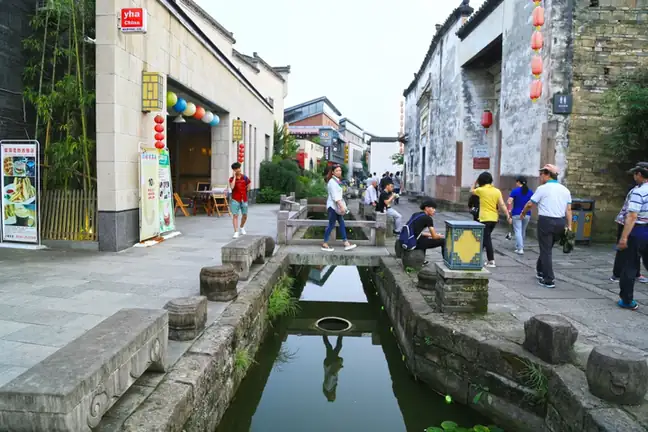
That history matters when you look at the place, because two kinds of fabric are standing side by side. The courtyards, carved door surrounds and grey-tile roofs of the retained houses are genuine building stock; the glass-fronted neighbours, the water channel with its misting nozzles and the montage images projected onto old white walls at night were designed in the 2010s. A local account of the redevelopment notes that the approach was criticised as commercial redevelopment that broke the historic street’s texture, and defended as “preserve, relocate, innovate”. Walk the two together rather than treating the district as untouched antiquity.
The three houses to look for
The surviving old buildings are individually listed municipal protected structures, and their old street numbers are more useful than any walking order, because the numbering does not follow the route a visitor takes: the Shi residence is 黎阳街12号, the Li family medical residence 黎阳街18号, and the Jia residence 黎阳街28、30号.
- Shi family residence (石家大院) — the best-preserved house on the street, roughly three centuries old. Look at the brick, timber and stone carving around the courtyards, the decorated door hood, and the tall halls and deep light wells that give the building its bulk. It has been repaired and turned into Zhanchuan Bookstore (占川书局), described as Anhui’s first Huizhou-culture-themed library and run as a compound of exhibition space, bookshop and library, café-bar and guest rooms; it is a branch of Huangshan Library, published as open 10:00–22:00 at 文峰路黎阳In巷23幢.
- Jia family residence (贾家大院) — white outer walls, grey tiles and an internal skywell. The Tunxi district culture and tourism bureau and the district jointly built the Huizhou Worthies Hall (徽州乡贤馆) inside it, in six sections covering 57 historical Huizhou figures and ten present-day Tunxi residents. Read the section labels rather than only the portraits: the rooms are organised around the themes of patriotism, diligence, honesty and friendliness.
- Li family medical residence (李氏医寓) — a smaller house at 黎阳街18号; like several other retained buildings it has been adapted for shops or lodging, so what you see from the lane is the stone doorframe and façade rather than an interior museum.
How to walk it
The district is made up of three main streets — a historic-culture street on the old alignment, a Huizhou food street, and a riverside bar and leisure street — plus dozens of side alleys, so it rewards wandering rather than following one axis. An archway inscribed with the characters 黎阳 stands at the main entrance.
Work outwards in this order: the old houses first, while the light is flat and the carvings are readable; then the central square and stage; then the water.
- Huanqing Square and the Liyang opera stage (欢庆广场、黎阳古戏台) — the stage is a provincial base for passing on intangible heritage, and the operator counts roughly 200 folk and modern performances a year here, including the Liyang war drums (黎阳仗鼓, a provincial intangible heritage item), fish-lantern parades and bench-dragon processions. Scheduled shows cluster around festivals — the 2026 Mid-Autumn and National Day programme, “黎阳秋鼓千灯会”, ran from 25 September to 7 October 2026 with drum performances, lantern processions and audience participation. Do not build an evening around a guaranteed performance; check the current programme on site or through the district’s own channels.
- Craft and food — the Huizhou lacquerware master Gan Erke has a studio in the district, and a 2,000 m² food hall styled after Tang and Song market architecture gathers Huizhou snacks such as hairy tofu (毛豆腐) and stinky mandarin fish (臭鳜鱼) in one place. Stalls and restaurants here change with the seasons, so judge each counter on what is on display rather than on a name carried over from an old guidebook.
- The waterfront — an 8,000 m² riverside plaza and a landing stage (亲水码头) face the confluence of the Xin’an, Heng and Shuai rivers, with Wenfeng Bridge (文峰桥) lit across the water after dark. The historic logic is visible from here: in the trading era the shops stood on the Tunxi side and the warehouses and family houses stood on the Liyang side.
Getting there and back
There is no metro. Huangshan has no metro system, so the realistic choices are walking from Tunxi Old Street, a city bus, the tourist micro-bus, or a taxi.
On foot from Tunxi Old Street (the usual approach). Walk to the west end of Tunxi Old Street and cross Zhenhai Bridge (镇海桥), known locally as the Old Bridge (老大桥): a 133 m, six-pier, seven-arch stone bridge, a national key cultural relic, closed to motor vehicles and reserved for pedestrians. It collapsed in the flood of 7 July 2020 and reopened after rebuilding in December 2021, with much of the original stonework reused. Crossing it puts you directly in Liyang; Tunxi Old Street, Tunxi River Street and Liyang are treated as one continuous walk.
By bus from Huangshan North Railway Station (黄山北站). Bus 21 is the high-speed-rail connection: from the station forecourt to the 老街二马路 Lǎojiē Èr Mǎlù or 黄山眼科医院 Huángshān Yǎnkē Yīyuàn stops on the Tunxi Old Street side, then a short walk to the bridge. City guidance from 2025 gives first departure 6:50 and last departure 23:00 from the north station, with intervals of 8–40 minutes depending on the time of day. Express line 1 (高铁快线1路) also serves the 黄山眼科医院 stop. At least one English-language account took bus 21 from Huangshan North and got off directly in the Liyang Old Street area.
Tourist micro-bus (“徽小黄”). A dedicated tourist loop started running on 22 September 2026 on a trial basis to 31 December 2026, with four 6 m electric minibuses and about 70 departures a day split between day and night shifts. The daytime routing runs 戴震公园–延安路–华山路–黎阳桥–文峰路–文峰桥, i.e. along the Liyang side of the river; the night routing extends to 南滨江路. It links Tunxi River Street, Tunxi Old Street, Liyang water street, Wenfeng Bridge and the South Bund. Fares during the trial are ¥2 per ride (free from 22 to 30 September 2026), against a normal tourist-line fare of ¥5.
By train or coach. High-speed trains arrive at Huangshan North Railway Station (黄山北站), about 14 km from the old-street area; conventional trains use Huangshan Railway Station (黄山站), roughly 3.3 km from Tunxi Old Street. Long-distance coaches use Huangshan Coach Station (黄山市汽车客运总站); a 2023 city guide lists buses 12 and 21 running from the coach station to the old-street stops (老街一马路), from where you walk across the bridge. Treat that coach-station link as a lead and confirm the current route at the stop, since city bus lines here have been revised several times.
By taxi or ride-hailing. Give the driver 黎阳in巷 or 黎阳老街 Líyáng Lǎojiē, on the 文峰路 Wénfēng Lù side of the river — the archway entrance and the Zhanchuan Bookstore address (文峰路黎阳In巷23幢) are both on that frontage. Do not ask for “the old street” alone: Tunxi Old Street (屯溪老街) is across the river and drivers will take you there instead.
Returning. The bridge walk back to Tunxi Old Street is the simplest option and is lit at night. Taxis are normally easy to find near the old streets, but one visitor account of an evening at Liyang reported difficulty finding a cab late at night and advised arranging a car in advance if you are heading back to Tangkou at the foot of Mount Huangshan.
Practical notes
- No ticket, no gate. Liyang in Lane is free to enter year-round; “opening hours” here apply to shops, halls and bars, not to the lanes themselves. The Zhanchuan Bookstore branch publishes 10:00–22:00.
- Surface and terrain. The lanes are stone-paved and the landscaping is built around a water channel crossed by small bridges, matching the operator’s own description of “small bridges, flowing water, flagstone lanes”. Expect uneven stone and a few steps rather than a step-free promenade; stone is slick after rain.
- Timing. Midday is quiet and hot; the light projections, misting and bar strip belong to the evening, and festival nights draw the largest crowds.
- Pair it with Tunxi Old Street and Tunxi River Street across the bridge, or use Liyang as the last stop of an arrival day before heading to Mount Huangshan.
- A candid caution. An English-language guide to the district treats it as good for a couple of hours of food and photographs rather than a half-day of sightseeing, and finds the night lighting photographs less well than the daytime flower wall. Plan it as an evening meal and a stroll, not as a substitute for Hongcun or Xidi.
Find Liyang Old Street
黎阳老街 · 屯溪区
No reliable map pin yet: search by the Chinese name.
Sources & visit information
Sources checked on 22 October 2026. Hours, tickets, reservations and transport can change; confirm with the operator before you go.
- 黎阳in巷 — 维基百科(自由的百科全书) ↗
- 黎阳老街 — 百度百科 ↗
- 黎阳in巷 — 百度百科 ↗
- 街区带你游安徽|黎阳in巷:千年古镇 时尚新生(中安文旅) ↗
- 黄山市图书馆国庆节期间开馆公告(含徽文化主题分馆·占川书局) ↗
- 从黄山北站出发,畅达黄山市各景点的公交/班车全攻略(澎湃新闻) ↗
- 黄山『徽小黄』文旅专线今起试运行(黄山日报,经中安在线客户端) ↗
- 安徽黄山|『徽小黄』纯电动文旅专线试运营(客车网) ↗
- 安徽黄山:重『见』镇海桥(新华社) ↗
- 镇海桥 — 维基百科(自由的百科全书) ↗
- 一场Citywalk里的烟火新篇——黄山市屯溪区以微更新激活城市空间(凤凰网) ↗
- 黄山屯溪打造特色非遗夜游盛宴(大皖新闻,凤凰网转载) ↗
- Guide to Liyang Old Street: What You Need to Know for a Visit(Huizhou Deep Tour) ↗
- Tunxi Old Street (Tunxi Ancient Street) — China Discovery ↗
- 2023黄山市黎阳in巷免门票攻略(附游玩路线+交通指南)(合肥本地宝) ↗
Image credits & notes (1)
- Liyang Old Street · 黎阳老街Photo: sohu.comResized for the web; the photo itself has not been edited.