

Explore the region
Nanping sits in Biyang Town, Yi County (黟县碧阳镇), a few kilometres south-west of the county town, below the hill that gives it its name. Its old name was Yecun, “Ye Village”. Within a footprint of roughly 16 hectares, about 300 Ming and Qing houses, 36 wells and 72 lanes survive, and eight ancestral halls stand in one run along a 200-metre stretch of the central street (横店街). The run is complete: a hall for the whole Ye clan, halls for branches of it, and small shrines kept by individual households — which is why the village is nicknamed “China’s ancient ancestral-hall museum”.
The village building group (南屏村古建筑群) entered the sixth batch of Major Historical and Cultural Sites Protected at the National Level in 2006, for buildings of the Ming and Qing periods, and the village was named a Chinese Historical and Cultural Village in 2008. It is operated as a 4A scenic area, Nanping Scenic Area (南屏景区).
Nanping is the third village of the Yi County trio for a reason. Hongcun is read through its water system and Xidi through the ranking of its streets; Nanping is read through clan architecture and film sets. It was not included in the World Heritage listing that Hongcun and Xidi received in 2000, and it has kept more of its working texture — a waterwheel still turns near the entrance, and residents still wash clothes at the pool beside the lanes. Expect far fewer people than at Hongcun or Xidi, and expect interiors that open and close with the day’s staffing.
Reading the halls
The halls are not spread evenly through the village. They cluster on the central street, where 宗祠 (clan halls), 支祠 (branch halls) and 家祠 (household halls) stand within sight of one another, so the clan’s structure is legible as you walk.
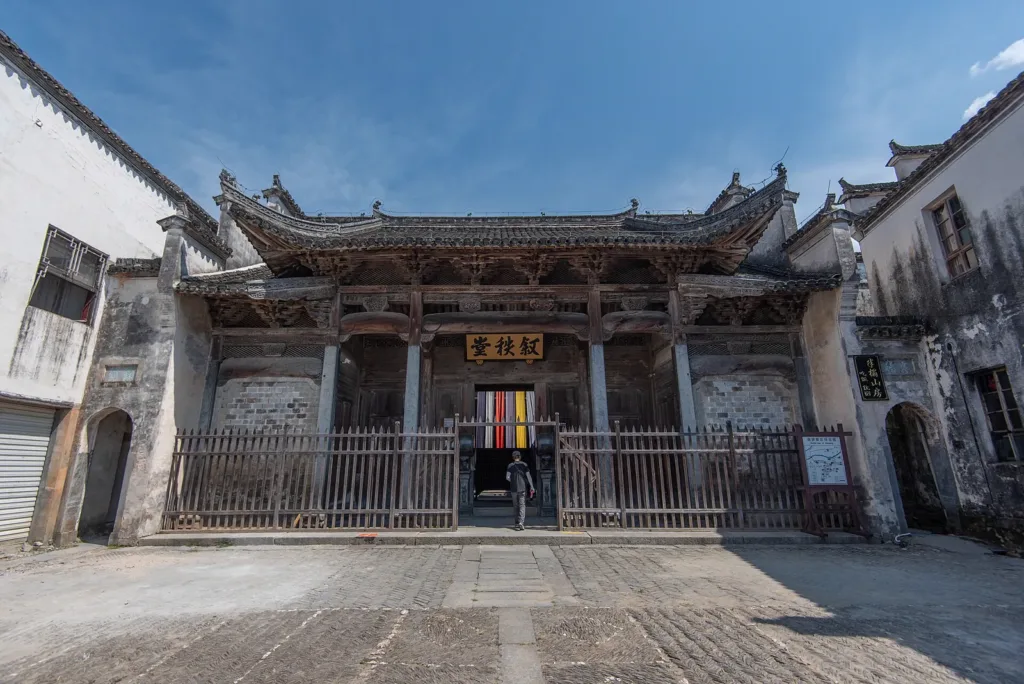
叙秩堂 (Xuzhi Hall) — the Ye clan hall, built in the Chenghua period of the Ming (1465–1487) and rebuilt in 1798. It faces west, three bays wide and three halls deep, with a pair of dark 黟县青 stone drums at the gate and carved beams and brackets above them. Zhang Yimou filmed Ju Dou (1990) here, using the middle hall as the Yang family dye mill; the 老杨家染坊 signboard still hangs by the entrance and coloured cloth is still strung across the interior, which is why many visitors photograph the cloth without noticing the timber frame behind it. The hall has also been used as an exhibition space: in November 2023 a Tsinghua University paper-craft project filled 叙秩堂 and 奎光堂 with installations.
奎光堂 (Kuiguang Hall) — the Ye branch hall, built in the Hongzhi period (1488–1505) and repaired in the Qing, dedicated to the fourth-generation ancestor Ye Wengui. Two carved stone mirrors stand in front of the door as a mark of rank, and three honour plaques hang over the entrance. Ang Lee used the interior for Crouching Tiger, Hidden Dragon (1999) as the Xiongyuan escort-agency set, and film stills hang in the hall.
The same street continues with 程氏宗祠 (宏礼堂), the Cheng clan hall, and with smaller halls and houses such as 敦睦堂, 慎思堂, 倚南别墅, 冰凌阁 (怀德堂) and the late-Qing 孝思楼, whose upper floors borrow semicircular Romanesque arches and windows. A short walk away are 半春园 (梅园), a Guangxu-period garden built for the family’s children to study in, and the remains of 西园, laid out in 1791 and known from a Qing essay by the Tongcheng-school writer Yao Nai — a gate lintel, a bridge and old camphor trees are what is left.
Observation method: don’t try to memorise the names. Compare the halls instead — the width of the doorway, the size of the stone drums or mirrors, the number of bays, how many steps you climb from the front court to the shrine. The order of size, 宗祠 → 支祠 → 家祠, is visible at a glance, and it shows how far the Ye clan had split into branches rich enough to build for themselves. Orientation also differs from hall to hall: published descriptions give 叙秩堂, 奎光堂 and 慎思堂 as facing west and 敦睦堂 as facing south, so the shorthand that “the halls face south” does not hold here.
Lanes, wells and the water mouth
Between the halls, Nanping is 72 lanes and 36 wells. The lanes bend and interlock, so a straight line across the village is rarely possible; a Chinese-speaking guide is normally provided at the site, and published guides warn that it is easy to lose your bearings. A 2012 report in China Youth Daily describes art students sitting in the lanes to sketch doorways and windows, and notes where Nanping’s carving sits: on door frames, lattice windows and window shutters rather than on the big beams, with many gates built as a carved outer leaf over a solid inner door.
三元井 (Sanyuan Well), one of the 36, has three openings cut into the same stone kerb so that three households can draw water at once; the small mouths also keep children out of the shaft. The name puns on the three first places of the imperial examinations.
The village’s water mouth (水口) — the landscaped edge that Huizhou villages used to “lock” a site — lies on the north-east side, where the Wuling Stream (武陵溪) runs out towards the Xiwu River. 万松桥 (Wansong Bridge) marks the boundary between inside and outside; behind it, the 万松 grove and the small shrine and pavilion buildings of the water mouth form a layered entry corridor before you reach the houses.
One more interior worth asking about is 抱一书屋, a free school founded in the Guangxu period by the merchant Li Zongmei for poor pupils of the village; the reading room and its courtyard were still in family hands when a reporter visited in 2012.
Tickets, hours and what to expect inside
Nanping is a gated scenic area: the halls are staffed and unlocked for visitors during the day, and there is a car park outside. It was not among the six Anhui 4A ratings revoked in September 2026.
- Ticket. Trip.com listed an adult ticket at US$6.44 (about CNY 46) on 22 October 2026 before a platform discount, while Baidu Baike’s older entry quotes CNY 30; the operator’s own price notice is published as an image, so no figure could be read from it. Confirm the current price at the gate or on 徽黄游, the county’s official booking mini-program. Parking is charged separately, according to 2025 visitor reviews.
- Opening hours. Listings disagree: Trip.com gives 07:00–18:00, while other listings give 07:00–17:30 or 08:00–17:00. Treat the halls as a daylight visit and confirm the day’s closing time on arrival.
- Concessions. The operator runs periodic offers rather than a standing discount for foreigners: entry was free for under-18s on 28–30 April and 6–8 May 2026, and through 2025 the group ran half-price tickets for overseas visitors (including Hong Kong, Macau and Taiwan) at Nanping and nearby scenic areas. Check the current notice instead of assuming either offer still applies.
- Time. Two to three hours is the usual recommendation; a slow architectural read takes longer, and the village is small enough to walk twice.
- Behaviour. The halls are ceremonial buildings and the houses are lived in. Local advice is to keep photography inside the halls discreet, ask before photographing residents, and stay out of courtyards that are not signed as open.
Getting there and back
There is no metro in Yi County. The nearest railhead is the high-speed station 黟县东站 (Yixian East Railway Station), on the Huangshan–Nanchang and Chizhou–Huangshan lines; the county has also built a fast road link from the station to the county town and to Xidi.
- From 黟县东站 (Yixian East Railway Station). The station’s four official tourist lines are reported to serve Hongcun, Xidi, Bishan and Guanlu; Nanping is not named among them. Two practical options: the county’s 预约公交 (on-demand reserved bus, run by 黟县全域交通公司), which covers Nanping along with Bishan, Hongcun and Xidi and is booked in advance; or a taxi or ride-hailing car, giving the driver 南屏景区(黄山市黟县碧阳镇南屏村). By road the village is about 18 km and roughly 25 minutes from the station — a mapping figure quoted by an operator page, so allow more time in traffic.
- From 黟县汽车站 (Yixian bus station). The county town is only a few kilometres from the village, and older listings describe a minibus from the bus station to Nanping (then CNY 6, but infrequent) with a walk in from the village entrance; the on-demand bus now covers the same trip. Ask at the station for the current departure point and the last return.
- From 黄山北站 (Huangshan North Railway Station). Coaches leave from the Huangshan Tourism Passenger Transport Centre beside the station for Yi County and Hongcun; the alternative is a short high-speed hop to 黟县东站 and a transfer from there.
- From Tunxi (屯溪) and the city centre. A “station bus” (站点巴士) links Tunxi with Yi County and Hongcun, running roughly 06:40–17:10, with promotional single fares from CNY 14.9 when it launched in 2025; tickets are sold through the 皖美出行 mini-program and DiDi. Timetables and fares change, so re-check before travelling.
- Return. Public services thin out in the late afternoon and there is no guaranteed late bus back; the safe pattern is to fix a return time with a driver, or to book the on-demand bus in both directions, before you start walking the lanes.
What to combine it with
Nanping is 8 km by road from 关麓 (Guanlu), which makes a bicycle loop of about 80 minutes between the two; 碧山 (Bishan), 西递 (Xidi) and 宏村 (Hongcun) are all within a short drive, and each answers a different question. If you have one day for villages and want the crowds, go to Hongcun; if you want to understand how a clan organised itself in buildings, spend the day in Nanping.
Find Nanping Old Village
南屏古村 · 黟县
The pin marks the area, not the entrance.
Sources & visit information
Sources checked on 22 October 2026. Hours, tickets, reservations and transport can change; confirm with the operator before you go.
- 国务院关于核定并公布第六批全国重点文物保护单位的通知(2006,文化和旅游部网站) ↗
- 住房和城乡建设部、国家文物局关于公布第四批中国历史文化名镇(村)的通知(2008-10-14,南开大学转载) ↗
- 南屏村古建筑群(来源:安徽省文物局,中国文物网 2014-05-23) ↗
- 《万里走单骑》抛出发展之问:旅游开发是不是传统村落保护的灵丹妙药(中国日报 2021-04-19) ↗
- 安徽省黄山市黟县碧阳镇南屏村(北京大学流域人居系统研究中心,案例 ES-005) ↗
- 门票政策(黟县徽黄西递旅游开发有限公司官网,含2026-04-25及2025-03-29公告) ↗
- 黟县:织密交旅融合路网 激活全域旅游动能(新华网安徽 2026-09-29,来源黟县县委宣传部) ↗
- 黟县:小车厢里的暖心事 预约公交串起徽州好风景(安徽文明网 2026-09-03) ↗
- 屯溪⇌黟县⇌宏村!旅游“站点巴士”即将开通(黄山文旅/长运出行,搜狐转载 2025-07-02) ↗
- Nanping Village – tickets, opening hours, address (Trip.com attraction page) ↗
- 黟县南屏(百度百科) ↗
- 细看南屏老宅(中国青年报 2012-06-08,作者黄若菲) ↗
- 南屏为何又被称为“中国古祠堂建筑博物馆”?(2017-11-06,搜狐) ↗
- Nanping Village – Museum of Chinese Ancient Ancestral Hall (China Discovery, English) ↗
- 在黄山南屏村的祠堂里,开展一场纸文化的艺术复兴(中国网 2023-11-12) ↗
- 安徽主动摘掉六块4A牌子:一次动真格的系统布局(中新网安徽 2026-09-14) ↗
- Nanping Guide: Ancestral Halls, Film History (China Go Trip) ↗
- 南屏景区门票与游客点评(去哪儿网) ↗
Image credits & notes (1)
- The Ye clan hall 叙秩堂, with the Ju Dou dye-mill cloth still strung across the entrance. Photo: SiyuwjPhoto: CC BY-SA 4.0