


Get to know Yi County
- Administrative area
- County · 县
- Part of
- Huangshan
- Chinese name
- 黟县
- Local areas
- County guide
Area & population
- Area
- 857.00 km²
- Population · 2020
- 76,211
- Administrative seat
- Biyang
Source: English Wikipedia, as of the dates shown.
What and where it is
Yi County (黟县) is a mountain county of roughly 850 km² on the southern side of Mount Huangshan, in Huangshan City, Anhui. It is the smallest county in the municipality by area, and the county seat is Biyang Town (碧阳镇). Eight township-level units make it up: the towns of Biyang, Hongcun, Xidi, Yuting and Kecun, and the townships of Meixi, Hongtan and Hongxing.
The county is not a single sight. It is a scatter of lived-in villages, and the reason to come is that two of them — Xidi and Hongcun — are on the UNESCO World Heritage list, inscribed in 2000 for street plans, architecture, decoration and water systems that survive from a type of non-urban settlement that has largely disappeared elsewhere. Xidi opened to tourists as early as 1986, which makes this one of the first rural tourism areas in China. On 2 June 2021 the State Council added Yi County itself to the National Famous Historic and Cultural Cities list. The county counts about 3,600 surviving old houses, the largest number in southern Anhui, along with 46 Chinese traditional villages and 1,684 registered old dwellings. The 2020 census recorded 76,211 residents; a 2026 report describes a local population of a little over 70,000 against more than 19 million visitors a year. People still farm, keep shops and live in these lanes, so the villages work best at walking pace and outside the middle of the day.
How the county divides
The county town and its ring (Biyang 碧阳镇). The old county town covers 1.16 km² and was listed as a provincial historic city in 1989; three of its quarters — 黟县古城街区, 麻田街区 and 郭门后街街区 — became provincial historic districts in 2015, and 48 protected buildings sit inside it. Walk 直街 for houses carrying small "registered immovable cultural relic" plaques that are still family homes, and cross 通济桥, the Qing three-arch bridge at the old north gate. The county bus station is here. Villages within a short ride: Nanping (南屏) to the west, a Ye-clan settlement with more than 300 Ming and Qing buildings and eight ancestral halls, protected as a national key cultural relic site since 2006; Pingshan (屏山) and Guanlu (关麓); and Bishan (碧山), where a village branch of the Nanjing bookstore chain Librairie Avant-Garde (碧山书局) has been running since the early 2010s, and craft workshops now take visitors in the lineage halls. Further out, Shiting (石亭) has a former village primary school converted into a book-lined guesthouse, and Fengwu (丰梧) has a rice-wine farm and a rebuilt lane that now holds a rural memory museum.
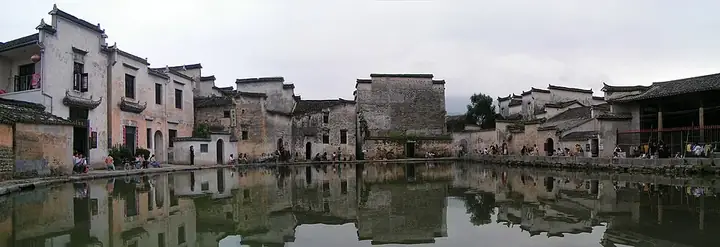
Hongcun and the north-east (宏村镇). Hongcun (宏村) is the Wang-clan village founded in the Song dynasty, laid out in the shape of an ox, with a water channel passing the houses into the half-moon Moon Pond (月沼) and the bow-shaped South Lake (南湖). Chengzhi Hall (承志堂) is the grandest of the merchant houses, its beams and panels carved with scenes of nature, myth and Qing life. On the same lane out of the village are Tachuan (塔川), where Chinese tallow trees turn the hillsides red in late autumn, and the Mukeng bamboo sea (木坑竹海), and a little further on, Lucun (卢村), where 志诚堂 and the wider 卢村 building group are provincial-level protected sites. Up in the hills, Sixi (泗溪) is torreya country.
Xidi and the south-east (西递镇). Xidi (西递) is entered past the Ming 胡文光 memorial archway; three streams run through the village and meet at Huiyuan Bridge to the south, and the Hu-clan halls 敬爱堂 and 履福堂 show how lineage, scholarship and merchant money were displayed in a house. The 石林 flower fields lie about a kilometre from the rail station, and 叶村 and 潭口 sit along the same road.
Getting there
By high-speed rail. Yixian East Railway Station (黟县东站) is the practical arrival point, in Xidi Town. It opened on 27 December 2023 with the Anhui section of the Hangzhou–Nanchang high-speed line, and the Chizhou–Huangshan line has called here since 26 April 2024; the station has two platforms and eight tracks, and about 24 trains a day stopped here as of early 2024, heading for Huangshan North, Hefei South, Hangzhou West, Shanghai Hongqiao, Nanjing South, Nanchang East and Jingdezhen North among others. Fastest times published when the line opened: Yixian East to Hangzhou West 1 h 41 min, to Hefei South 1 h 53 min. The station is about 3 km from Xidi's old village, about 1 km from the Shilin flower fields, about 15 km from Hongcun and about 10 km from Mount Qiyun.
From the station into the county. The integrated coach hub is about 70 m from the exit — turn right — and a tourist express bus runs station → Xidi → Pingshan → Saijinhua's former residence → Hongcun, a 28 km route at ¥8, roughly every 30 minutes, first departure in the morning and last at dusk. Line numbers have been adjusted since the station opened: the December 2023 official notice called this route 8路, while the county's October 2026 account calls it 10路, so read the board at the hub rather than a saved timetable. In the same December 2023 trial schedule, county bus 2路 linked the county bus station (黟县汽车站) with Xidi and the rail station on a 30-minute headway (7:30–16:30 from the bus station, 8:30–17:30 back), and a fixed-departure 10路 served the station → Xidi → Nanping → Shanzhuoyuan → Guanlu run at 10:30 and 14:30 out, 9:00 and 15:30 back; that notice described all of it as trial operation subject to change.
From Huangshan North Railway Station (黄山北站). Walk from the exit to the Huangshan Tourism Passenger Transport Center beside the station for direct coaches to Xidi and Hongcun; Xidi's own visitor guidance gives about an hour to Xidi, and a 2026 English-language station guide lists roughly 1.5 hours and ¥30–35 to Hongcun, with customized shuttles added from 1 January 2026 and booking through the "畅行黄山" / 黄山长运出行 WeChat mini-program. The quicker alternative is a short high-speed hop to Yixian East and then the county bus.
From Tunxi, the airport and the mountain. From the Huangshan city bus station (黄山市汽车客运总站) in Tunxi, coaches run to 黟县汽车站 and 2路 continues to Xidi; from Huangshan Tunxi International Airport the same combination takes about two hours in total. From the Huangshan Scenic Area south gate at Tangkou (汤口镇换乘中心), direct buses reach Xidi in 1–1.5 hours, and buses also run between the Hongcun coach station and Xidi in about 30 minutes.
By road and taxi. The nearest expressway exit to Xidi is 黟县收费站 on the S42 Huangfu expressway, about 9 km away. Didi and Gaode both operate in Huangshan, which saves explaining a route in Chinese. Give the driver a destination, not a county name: 宏村景区西门停车场 or 宏村景区南门, 西递景区游客中心, 南屏景区, 碧山村, 塔川村. There is no metro in Yi County and no scheduled boat service, so everything above is bus, coach, taxi or your own two feet.
Note on the old station. The conventional-railway 黟县站 in Yuting Town, on the Wuhu–Jiangxi line, stopped handling passenger and freight business on 1 September 2009 and now only handles trains passing or crossing plus a staff commuter service — do not plan around it.
Getting around
The county runs 43 buses and coaches over 13 rural and inter-village lines, which is what connects the smaller villages, but service thins out in the valleys; check the last return bus before setting off for a day trip. For a slower look, the 醉美218 tourist byway runs about 85 km from Gantang in Huangshan District south to Yuting, following the old S218 road (now G530) and stringing together Hongcun, Lucun, Nanping, Xidi and the Mukeng bamboo sea. The 41 km BCE221 country cycling path loops the villages around Xidi and Hongcun with bike rental at its start and rest points such as the Bishan camp; a slow ride from the start to Nanping takes about 40 minutes. On foot, Xidi and the Shilin fields are about a kilometre apart, and Tachuan and Mukeng lie on the lane out of Hongcun toward the hills — everything else needs a vehicle.
Eating and buying
Laba tofu (腊八豆腐) is the county's own cured tofu, made in villages such as 石印村 in Xidi Town around the eighth day of the twelfth lunar month, when households dry tofu for the New Year. Local yellow soybeans, spring water, iodised salt and natural spices are pressed and dried, traditionally in mild sun, so the block keeps; it is round with a sunken centre and a brown-yellow crust, firm when cut, salty-savoury-sweet, and locally nicknamed "vegetarian ham". A black-soybean version counts as one of the county's "Five Blacks". You can watch the old method at the 石印村 workshop and display centre, buy ready-to-eat packs there or at the shop the village runs inside the Xidi scenic area, and eat it cooked in farm restaurants.
Two more local things to look for: 食桃, rice-flour cakes pressed into wooden moulds and steamed, and the "Five Blacks" (五黑) the county promotes — black tea, black fruit, black grain, black chicken and black pig, of which 黟山石墨 tea, Yixian torreya and Huangshan black chicken hold national geographical-indication status. Torreya (香榧) is the hill product to bring home: the county has more than 370 wild trees over a century old, groves are concentrated at Sixi and Hongxing, and "泗溪贡榧" holds a municipal intangible-heritage listing and a national agricultural geographical indication. Together with kuding tea and kudzu starch, torreya makes up the "three treasures of Sixi".
Sleeping
Guesthouses are the county's main accommodation: 1,070 of them at the 2026 count, promoted under the "黟宿美居" brand, with one of the country's largest clusters of top-rated (甲级) rural guesthouses. Hongcun and Xidi are the obvious bases, with guesthouses inside the villages themselves; Bishan, Shiting and Fengwu have quieter conversions of halls, farm buildings and an old school — a 2026 report describes 石亭书院, a 14-room guesthouse in a former village primary school with a wall of local books, and 缦玺酒店, a 55-room Huizhou-style resort that has deliberately stayed small. A booking platform, 黟山小住, is reported to connect more than 400 guesthouses countywide. Village cores are pedestrian and stone-paved and vehicles stop at the gate or car park, so expect to carry your bag over the lanes.
When to go
Spring brings rapeseed around Kecun and across the fields, and April is when the Bishan bookstore holds readings and performances; the colour season is late October to November, when Tachuan's tallow trees redden day by day and morning mist sits in the valley — the county's own account treats that as the signature fortnight. Summer suits the bamboo sea and the streams; winter snow on white walls is quieter still. National Day week is the peak, and the smaller villages are where visitors go when they want the county without the crowds.
Practical notes
Villages are ticketed separately and are working settlements rather than enclosed parks: Xidi's own visitor guidance listed an adult full ticket of ¥104 in 2025 with the village open all day, and re-entry rules vary by village — check the individual village guides for current prices, hours and any combined tickets. WeChat Pay and Alipay work widely in Huangshan, credit cards are generally not accepted for buses and taxis, and a little cash is useful for small operators. English signage is limited, so keep destination names in Chinese characters on your phone.
Guide sources
- Ancient Villages in Southern Anhui – Xidi and Hongcun, UNESCO World Heritage Centre
- 推进“旅游+”融合发展 打造全域旅游黟县模式,国家发展改革委
- 国务院批复同意将安徽省黟县列为国家历史文化名城,国家文物局
- 黟县,何以成为国家历史文化名城,光明日报(光明网)
- 黟县亮相《300秒看家乡》:时光藏古黟 千年徽州情,新华网
- 奔赴“县”场|安徽黟县:如何从“到此一游”到“留此成邻”,澎湃新闻
- 池州至黄山高铁4月26日正式开通运营,中国国家铁路集团有限公司
- 合肥高铁直达西递宏村,新华网安徽频道
- 黟县东站,维基百科(中文)
- 黟路铺秋景 乡道蕴人烟,新华网安徽频道(来源:黟县县委宣传部)
- 关于高铁黟县东站旅游快速专线和城乡公交运行班次(试运行),黟县全域交通运输有限公司公告(网易转载)
- 徽州西递古村落深度探访,感受建筑与历史的交融,西递景区网站
- Huangshan North Railway Station, Huangshan Tour Guide
- 黟县,维基百科(中文)
- 南屏村,维基百科(中文)
- 黟县站,维基百科(中文)
- 黟县腊八豆腐点亮乡村振兴之路,中新网安徽
- 安徽黟县“五黑”产业今年有望实现产值6亿元,人民网安徽频道
- 黟县:探索多元化产品促进香榧产业发展,中新网安徽
- Hongcun, Wikivoyage
Explore Yi County
Core places to explore, with English and Chinese names.
Places to explore around Yi County
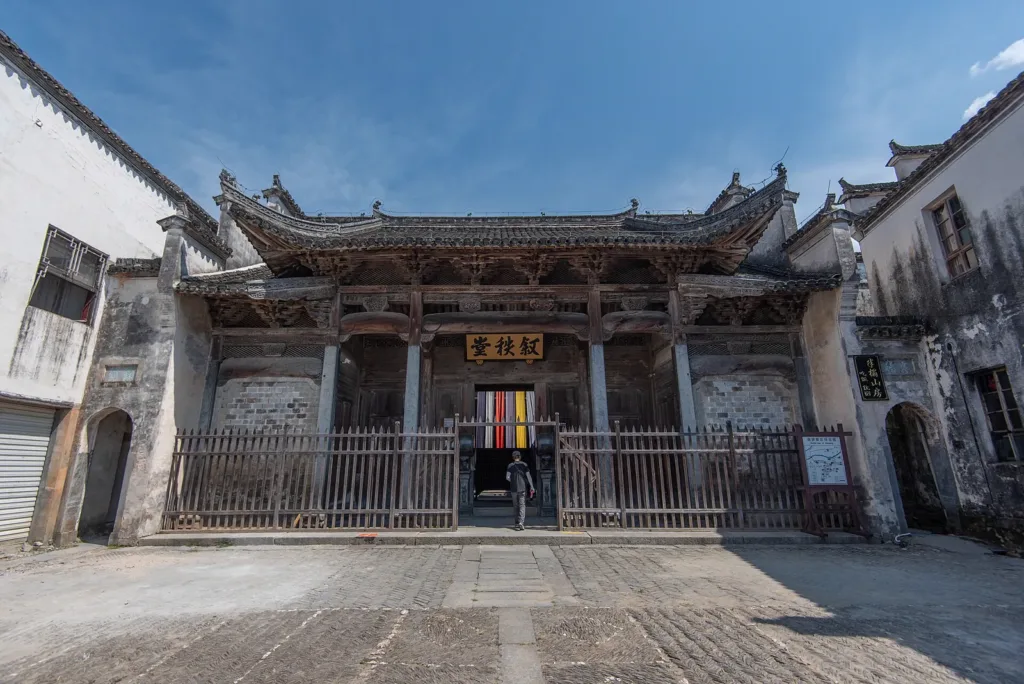 The Ye clan hall 叙秩堂, with the Ju Dou dye-mill cloth still strung across the entrance. Photo: Siyuwj · CC BY-SA 4.0
Nanping Old Village南屏古村
Nanping is a Huizhou village in Yi County, Huangshan, whose central street carries eight Ye, Cheng and Li lineage halls in one unbroken run — clan hall, branch halls and household shrines. Quieter than Hongcun or Xidi, it also has 72 lanes, 36 wells and a stone-arched water mouth where Wansong Bridge marks the village edge.
Read the place guide →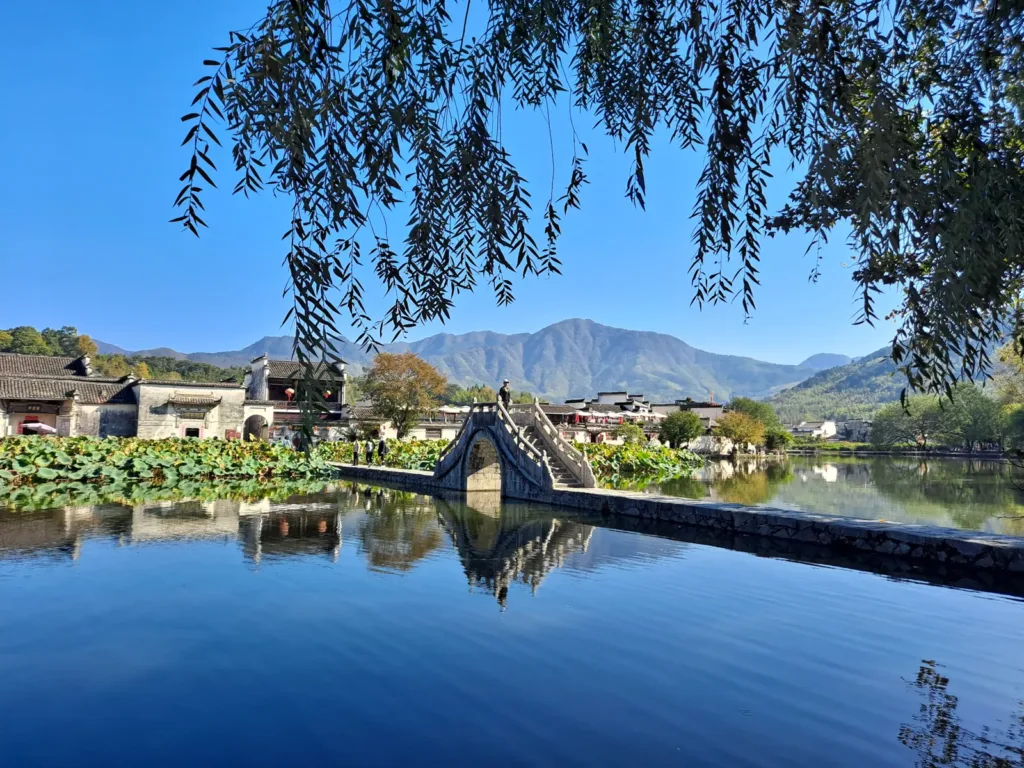 South Lake, with the painted bridge (画桥) crossing the water and Huizhou houses behind Photo: EditQ · CC BY-SA 4.0
Hongcun宏村
A lived-in Huizhou village in Yi County, Huangshan, arranged around a hand-dug water channel that enters at a north-west weir, threads the lanes past the half-moon Moon Pond and drains into the bow-shaped South Lake at its southern edge. Behind the whitewashed lanes, merchant houses such as Chengzhi Hall hold the carved interiors and skywell courtyards that the water system was built to serve.
Read the place guide →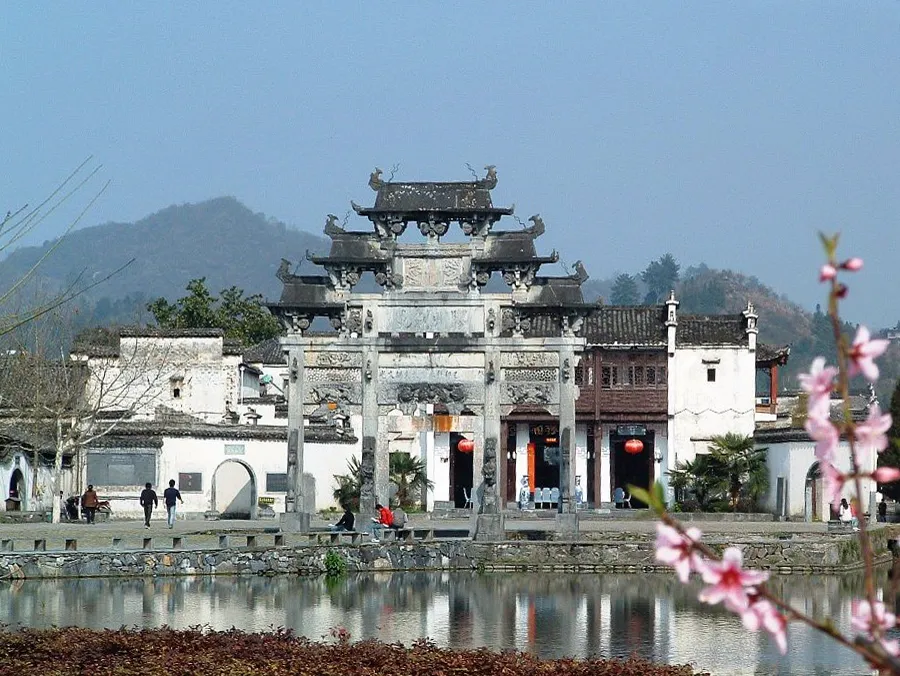 The Hu Wenguang memorial archway (胡文光刺史牌楼) at the entrance to Xidi, with whitewashed houses and wooded hills behind and peach blossom in the foreground. Photo: Ahunter2003 (Wikimedia Commons) · CC BY-SA 3.0
Xidi西递
Xidi (西递) is a UNESCO-listed Huizhou merchant village in Yi County, Huangshan, where three east-west streams run between 124 intact Ming and Qing houses and lanes paved in bluestone. Its landmark is the 1578 Hu Wenguang stone archway; the village is reached by county bus from Yixian East high-speed station (about 15 minutes) or by direct tourist bus from Huangshan North station (about an hour).
Read the place guide →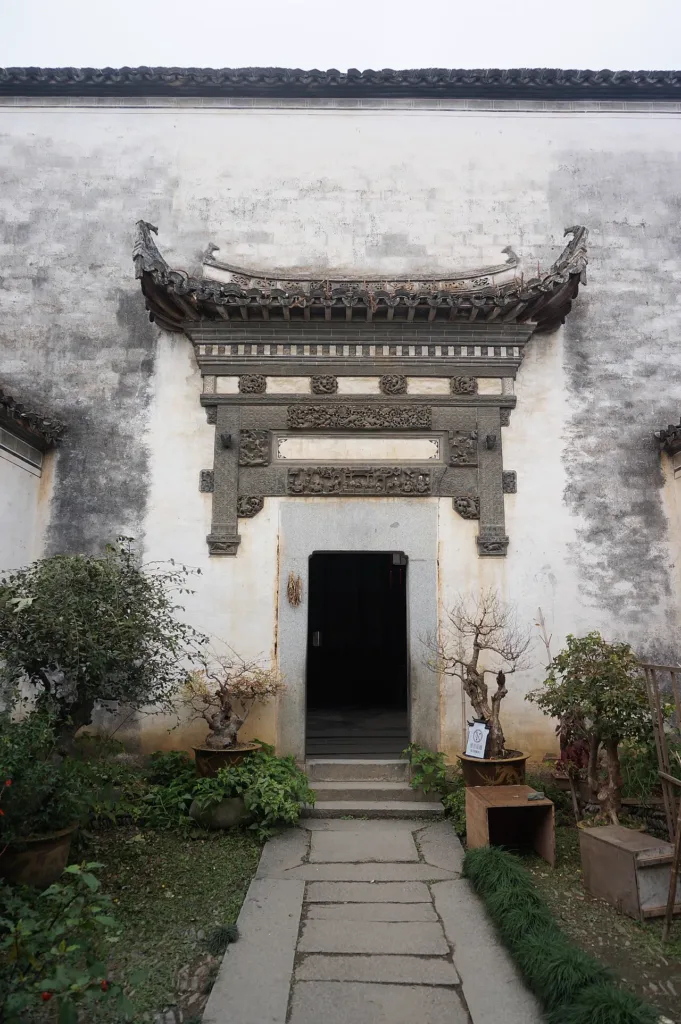 The carved stone-and-brick gateway of Zhicheng Hall, seen from the courtyard Photo: 猫猫的日记本 (Wikimedia Commons) · CC BY-SA 4.0
Lucun Village卢村
Lucun, also called Zhishan, sits about two kilometres from Hongcun in Yi County, and its reason to be on an itinerary is the Daoguang-period 'seven households' complex built by the merchant-official Lu Bangxie: Zhicheng Hall, dense with courtyard door panels carved in four registers, a gatehouse band of auspicious puns, and an intact set of schoolroom panels that villagers sealed with mud to save them.
Read the place guide →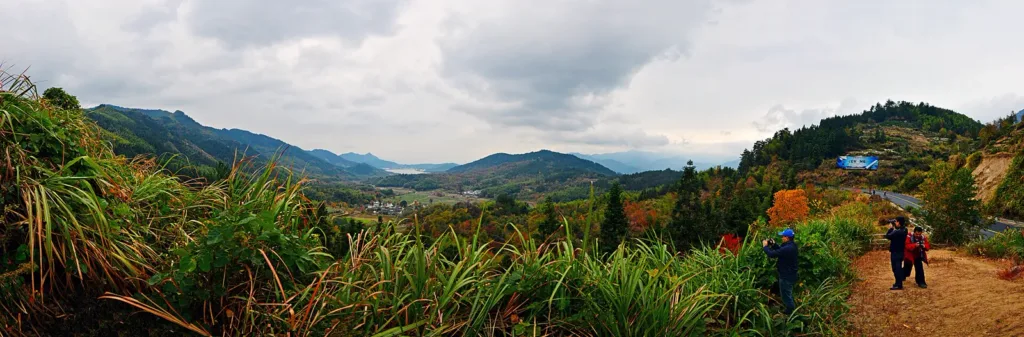 Photo: fish4fish, via Panoramio, uploaded to Wikimedia Commons by Panoramio upload bot · CC BY-SA 3.0
Tachuan Village塔川
A hillside farming village in Yi County, Huangshan, about three kilometres from Hongcun, where Chinese tallow trees, terraced rice fields, a stream and stacked white-walled houses make the autumn scene that the village is known for — much of it visible for free from the signposted viewpoints on the road above.
Read the place guide → AI illustration · AI 示意图(仅供参考,非该地点实拍)
Bishan Village碧山村
An old Wang-clan Huizhou village about 4 km from the Yi County seat in Huangshan, Anhui: a five-storey Qing pagoda standing in the fields, a provincial-listed ancestral hall, more than a hundred Ming- and Qing-era houses, and a bookshop inside a Qing hall. It is a lived-in village, not a ticketed scenic area.
Read the place guide →Plan your visit
Getting there
Yi County is about 45 km (straight-line distance) from central Huangshan. Search for 黟县 in a map app to find stations and your accommodation.
Where to stay →Build your route
Nanping Old Village and Hongcun are about 15 km apart (straight-line distance). The linked place guides have entrance and visit details.
Continue with Huangshan →More in Huangshan
Sources & geographic information
Administrative names and parent areas: Official geographic directory (dmfw.mca.gov.cn) · Reference date 2026-09-06.
Background text adapted from Yi County, Anhui — Wikipedia contributors, under CC BY-SA 4.0. Text has been shortened and reorganized; source revision 1324538374.
Map data © OpenStreetMap contributors. Pins mark approximate centres, not entrances or boundaries.
Image credits & notes (1)
- The pond and traditional houses of Hongcun in Yi County, Anhui. Source date: 18 October 2006 (original upload date).Photo: No machine-readable author provided. Rolphin~commonswiki assumed (based on copyright claims). · CC BY-SA 3.0Resized for the web; the photo itself has not been edited. Thumbnails may show a cropped view.
